
Direct answer
The KonMari method, created by Marie Kondo, asks you to tidy by category rather than by room, gathering every item of one type in one place and keeping only what you value. The usual order is clothes, books, papers, miscellaneous household items (komono) and finally sentimental items. For a whole-house clearance or a move, the same order works well, with three adjustments: set a clear outcome and deadline, decide your exit routes (sell, donate, recycle, dispose) before you start, and treat items that belong to other people or to an estate differently. Done properly, it shrinks the volume you need to pack, move or have collected.
Contents
- What the KonMari method actually is
- What "spark joy" means in practice
- Where KonMari fits a clearance or a move
- Before you start: set the outcome, the deadline and the exits
- Time, energy and help
- Category 1: clothes
- Practical rules for deciding on clothes
- Category 2: books
- Setting a limit that you can live with
- Category 3: papers
- A simple system for the papers you keep
- Category 4: komono, the miscellaneous household items
- Working through the kitchen and bathroom
- Garage, shed and electrical items
- Category 5: sentimental items
- Methods that make keeping and letting go easier
- Items that belong to other people
- Having the conversation early
- Using KonMari for moving day
- A realistic timeline for a move
- Planning what leaves: sell, donate, recycle, dispose
- Selling and donating without letting it drag on
- Common mistakes
- Frequently asked questions
What the KonMari method actually is
A short, accurate summary.
The KonMari method comes from the Japanese organising consultant Marie Kondo, whose book The Life-Changing Magic of Tidying Up became widely known in English in the mid-2010s. Its central idea is that you decide what to keep by choosing what you want in your life, rather than by deciding what to throw away.
Three habits define it. First, you tidy by category, not by room, so that you see the full quantity of each type of item at once. Second, you pick up each item and ask whether it sparks joy for you, keeping what does and letting go of what does not. Third, you thank items that you are discarding, which many people find makes parting with them easier.
It also includes a way of folding and storing clothes upright so that you can see everything in a drawer. That storage part matters when you are staying in a home. When you are clearing or moving, the sorting part is the useful one, and it is the part this guide concentrates on.
What "spark joy" means in practice
It is a prompt, not a rule.
The phrase "spark joy" can sound vague, so it helps to translate it. For most people it means a small, immediate positive reaction when they hold an item: a sense that they want it, that it is useful or that it matters to them. Kondo suggests paying attention to the first response, rather than arguing yourself into or out of a decision.
It does not mean that only decorative or delightful objects survive. A good saucepan, a reliable screwdriver or a warm coat can all spark a quiet kind of satisfaction because they do their job well. The test is whether the item has a place in the life you want.
If you find the phrase unhelpful, you can substitute plainer questions: do I use it, do I love it, would I buy it again today. The point is to make a choice deliberately, rather than keeping something because it is there.
Where KonMari fits a clearance or a move
A good method, with limits.
KonMari is built for someone who owns the home, owns the things in it and is going to keep living there. A house clearance or a move changes the picture in several ways. You may be working to a fixed date, such as a completion or a lease end. You may be sorting belongings that are not yours. You may be clearing an entire property in one push, not tidying slowly over months.
The method still helps, because it gives you a clear rule for decisions, and a clear order for working through a house. Where it needs adapting is in the speed, the criteria and the exits. Joy is a fine test for your own belongings. It is not the right test for a deceased relative's papers or a landlord's furniture.
Think of it as a framework to borrow from. Keep the category order and the habit of gathering everything first. Replace or add to the joy test where it does not fit, and add a plan for what leaves the house.
Before you start: set the outcome, the deadline and the exits
The decisions that stop you stalling.
Marie Kondo suggests imagining the lifestyle you want before you begin. For a clearance or move, make that concrete. How much space will the new home have? Which rooms need to be empty by which date? Is the property being sold, let or handed back? A target such as "everything for the new flat fits in one van" gives the joy test something to work against.
Next, decide the exit routes in advance. Items you will sell, items you will donate, items for recycling and items for the council or a collection all need somewhere to go. If you do not choose in advance, discarded things pile up in the hall and the process stops. A simple way to do this is to set aside four boxes or zones and label them.
- Keep: goes to the new home or stays in the house.
- Sell or give to family: has a named buyer, listing or recipient.
- Donate or recycle: has a charity, bank or centre in mind.
- Dispose: general waste, or items needing special handling.
Then work backwards from the deadline. If you have six weeks, allow a week per category, with a buffer. If you have three days, you need help, and probably a collection booked. Our house clearance checklist and moving day preparation guide give you the surrounding timeline.
Time, energy and help
Plan sessions you can finish.
A whole house cannot be sorted in an afternoon, and trying to do so is a quick route to exhaustion. Break the work into sessions of two to four hours, each focused on one category or sub-category, and finish each session by removing what you decided to discard from the room.
Energy matters as much as time. Decisions get harder as you tire, so do the difficult categories earlier in the day, and leave simple tasks such as boxing up for later. Eat, drink and take breaks.
Where there is heavy lifting, such as taking furniture out of an upper floor, ask for help or arrange it in advance. Our guide to moving heavy furniture safely sets out sensible precautions for lifting and carrying.
Category 1: clothes
Start here because the decisions are easiest.
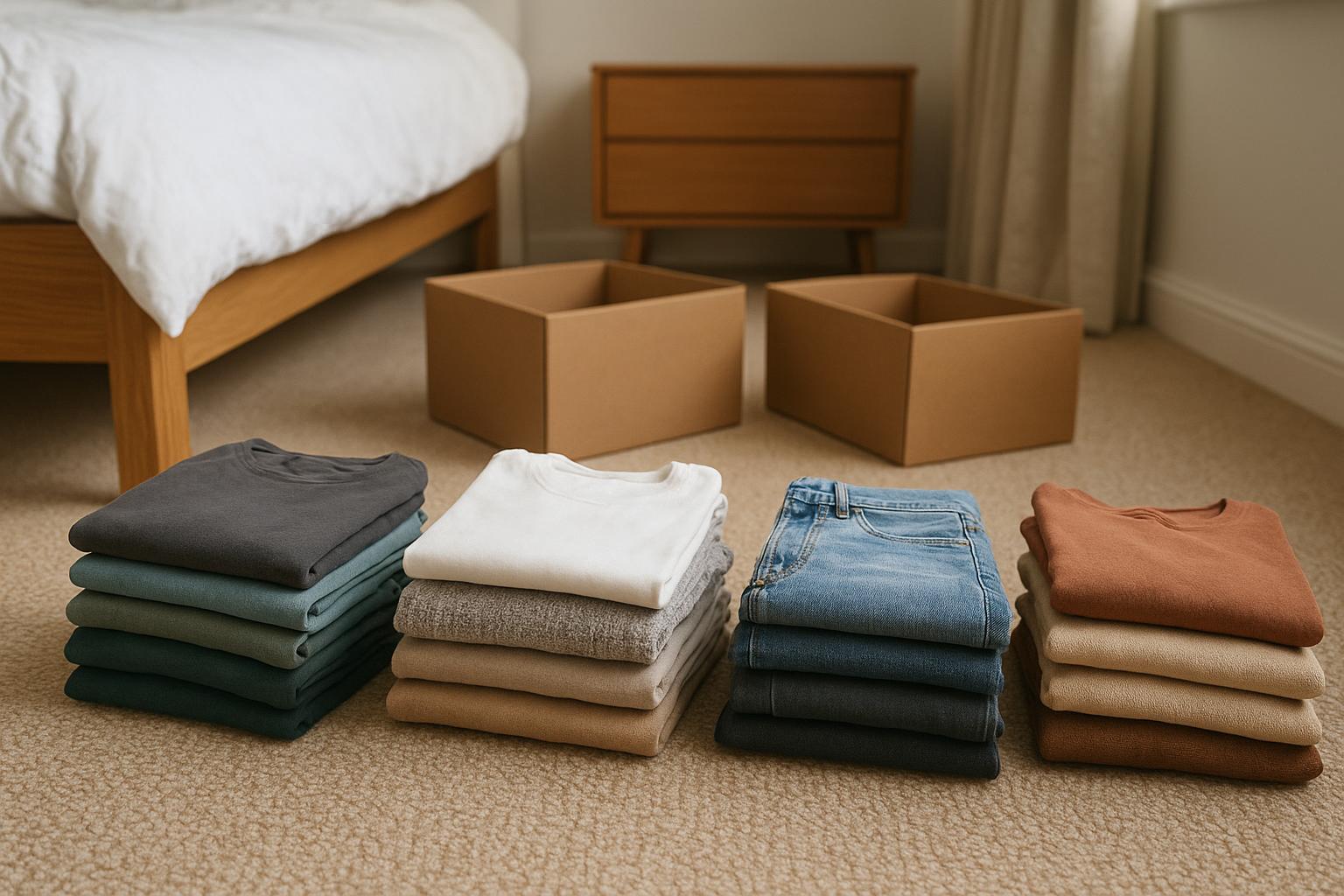
Kondo starts with clothes because most people find clothing decisions less emotional than photographs or letters, which makes it a good place to learn the process. Gather every garment from every wardrobe, drawer, hook, spare room and suitcase into one pile on the bed or floor. The size of the pile is often a surprise, and that surprise is useful.
Pick up each item and decide. For a move, add a practical filter alongside the joy test: does it fit, is it in good condition, and have I worn it in the last year or two? Keep what passes. Anything stained, damaged or worn out can usually go to textile recycling rather than the bin.
Do not forget the quiet corners, such as coats in the hall cupboard, shoes under the stairs and winter clothes in the loft. Our guide to recycling old clothes and linens and the one on clothing banks and textile recycling help you decide where each type of item should go.
Practical rules for deciding on clothes
Faster decisions without regret.
For a move, add a few simple checks to the joy test. Does it fit you now? Is it clean and in good repair? Does it suit your current life, such as work, climate and activities? If the answer to any is no, it is a candidate to go.
Duplicates deserve a second look. Most people do not need six similar black jumpers, and keeping the best two will serve you better. Seasonal items such as heavy coats can stay if you will genuinely use them, but be honest about it.
Items with a story, such as a wedding outfit, can go into the sentimental category and be revisited later. This keeps the clothing stage moving without forcing decisions that you may regret.
Category 2: books
Quantity is the issue, not just attachment.
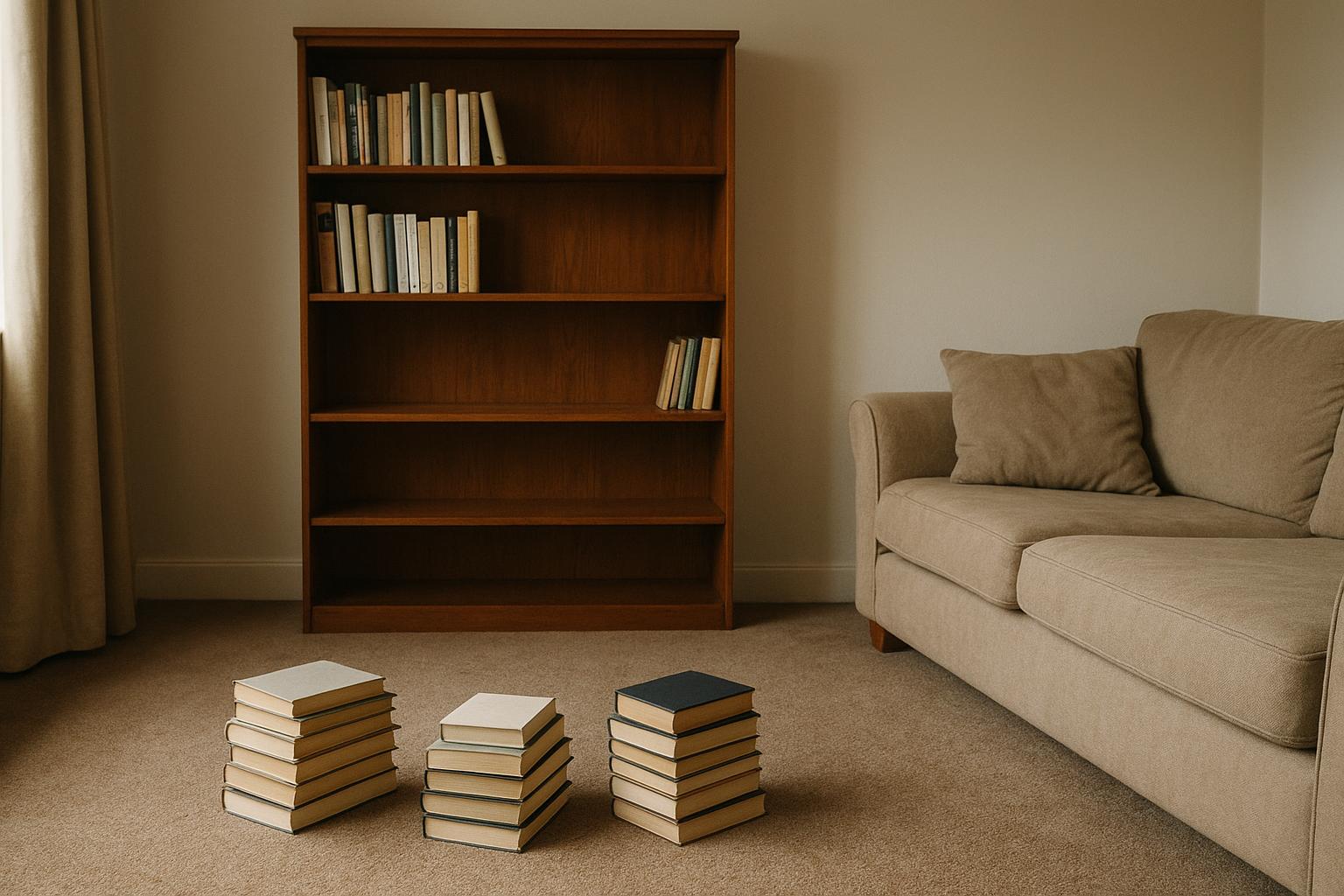
Books are heavy, which makes them one of the most expensive things to move in terms of space and effort. Take every book off the shelves and pile them on the floor. This forces you to handle them, which is the point, because a book left on a shelf is rarely reconsidered.
Keep the books you love or will genuinely use again, and be honest about the ones you intend to read someday. A reasonable rule for a move is to keep only the ones you would be happy to carry up a flight of stairs yourself. Reference books that are out of date, such as old travel guides and textbooks, can usually go.
Charity shops, libraries, schools and book-swap schemes often take books in good condition. Our guide to donating old books and textbooks in Greater London covers what is usually accepted and what is not.
Setting a limit that you can live with
A number helps.
Some people find it useful to set a rough limit for the new home, such as one bookcase or two shelves. This turns an abstract decision into a practical one. If you cannot fit them, something must go.
Do not forget books stored out of sight, such as in the loft, in a spare room or in a car boot. Bring them out so that you can see the full number. If you are moving to a smaller place, you may be surprised by how many you can part with.
For books that have value, such as first editions or signed copies, set them aside and check before you donate or discard. Our guide to valuable antiques in an estate clearance explains how to get a sensible opinion on possible valuables.
Category 3: papers
Sort carefully, because some papers matter.
Papers are the category where a ruthless approach can cause problems. Kondo's general advice is to discard almost everything, but in a real clearance you must keep documents that have legal or financial importance. Create a "keep" folder first for passports, birth and marriage certificates, mortgage and tenancy documents, insurance policies, pension and tax records and anything related to ongoing matters.
Everything else you can sort into three groups: needs action, needs to be kept for a period and can be shredded. As a general rule, check how long you should keep financial and tax records with HMRC guidance on GOV.UK, and keep anything you are unsure about until you have checked.
Documents that include names, addresses or account numbers should be shredded or securely destroyed rather than put in the recycling. If you are clearing a relative's home, read our guide to hidden family valuables and documents before throwing anything away, because important papers are often found in unexpected places.
A simple system for the papers you keep
Three folders are enough.
For the papers you keep, a very simple system works better than a complicated one. Use three folders or boxes: current, which holds anything that needs action or is being used now; important, which holds identity, property, insurance and financial records; and archive, which holds older records that you want to keep for reference.
Label each clearly and keep them together in one place. If you are moving, carry the important folder with you personally, rather than putting it in a removals box.
Scanning documents can reduce paper volume, but check whether a copy is acceptable for the purpose before you discard the original. If you are not sure, keep the original. Our guide to secure document shredding covers destroying confidential papers properly.
Category 4: komono, the miscellaneous household items
The biggest category by volume.
Komono is the Japanese word Kondo uses for miscellaneous items, and it covers most of what is in a house, including kitchen goods, bathroom products, stationery, tools, electronics, cables, hobby equipment, cleaning supplies and décor. It is usually the largest category by volume, and the one that benefits most from being gathered together.
Kondo suggests working through komono in subcategories, such as kitchen, bathroom, garage, electrical and so on, so that you are comparing like with like. In a clearance, this also lets you plan the exits more precisely, because each subcategory has its own disposal route. Electricals, for example, are covered by separate recycling rules, which our guide to WEEE regulations and recycling old electronics explains.
Set aside anything hazardous or awkward early, including paint, chemicals, gas bottles and batteries, so that it does not end up mixed in with ordinary waste. We cover safe disposal in our guide to household chemicals, paint and varnish.
Working through the kitchen and bathroom
Where duplicates hide.
Kitchens often hold the most duplicates: several sets of mugs, multiple chopping boards, gadgets used once. Gather everything onto a table or the floor, and keep what you use. Check food and cosmetics for dates, and discard expired items.
Bathrooms collect half-used products, old medicines and unused gifts. Out-of-date medicines should be returned to a pharmacy rather than thrown in the bin or flushed, and many pharmacies accept them. Check with your local pharmacy.
Cleaning products and chemicals need care. Do not pour them down the drain or mix them. If you are unsure how to dispose of something, check the label and your council's guidance.
Garage, shed and electrical items
Heavier, messier and more regulated.
Garages and sheds can be the largest and least pleasant part of a clearance. Tools, paint, car parts, garden equipment and old appliances often accumulate there. Sort them in the same way, but allow extra time, and wear gloves and sturdy footwear.
Cables, chargers, old phones and small electrical items are easy to overlook. They can usually be taken to a recycling centre or a retailer that accepts small electricals, and should not go in the household bin.
For larger jobs, such as a full garage, our guide to garage clearance preparation can help you plan, and our guide to car batteries, tyres and motor parts explains the awkward items.
Category 5: sentimental items
Last, because it takes the most time.
Sentimental items, such as photographs, letters, children's drawings, gifts and keepsakes, come last in the KonMari order. By this stage you have practised making decisions, which helps. Do not rush this category, and do not do it on the last day if you can avoid it.
Photographs are a good example. Gather them all, and choose the ones that you really want to keep. Consider scanning the rest, and storing the prints in a single box. Keepsakes work best when you keep a representative few, rather than keeping everything or nothing.
If you are clearing the home of someone who has died, you may feel pressure to decide quickly. It is fine to set a box aside to revisit in a few months. Our guide to coping with the emotional side of clearing a parent's home offers support for this stage.
Methods that make keeping and letting go easier
Keep the meaning, not the clutter.
If an item reminds you of a person or an event, consider whether a photograph of it would do the same job. Many people find that photographing a child's drawing, a souvenir or a piece of old furniture lets them keep the memory without the object.
A memory box is a useful boundary. Give each person, or each family member, a box of a fixed size. Whatever fits stays, and the rest is reconsidered. The limit makes decisions easier, and it keeps what you have valued.
Some items are better passed on than discarded. If a relative would value an heirloom, offer it before it leaves the house. If nobody wants it, and it is in good condition, a charity shop or specialist may be a good home.
Items that belong to other people
The joy test is not enough.
KonMari assumes that each person decides about their own things. In a shared house, that means each person gathers and sorts their own belongings, and shared spaces such as the kitchen and living room are decided together. Do not discard someone else's items on their behalf, even if you think they will not miss them.
For children, many families find it works to involve them in a small, age-appropriate way, and to keep their decisions respected. For a partner or housemate, agree in advance what counts as shared and what does not.
For inherited or estate items, the position is different. The executor or the beneficiaries decide, not the person doing the sorting. Our guides on dividing family belongings without disputes and executor responsibilities for property and chattels explain how to handle this fairly.
Having the conversation early
Avoid disputes later.
Disagreements over belongings are one of the main sources of friction in a clearance. Talking early, and setting a simple process, helps. Agree who decides what, how disputes will be settled and what deadline applies.
A walk through the house with everyone concerned can be useful. Mark items that someone wants, and record who has claimed what, in writing if the situation is delicate. If there is any dispute about ownership, pause and take advice before anything is removed.
If someone is reluctant to part with their things, do not push. The method works best when each person is making their own decisions. For help supporting someone who finds discarding difficult, our guide on anxiety over discarding items may be useful.
Using KonMari for moving day
Sort first, pack second.
The best use of KonMari for a move is to complete the sorting before you pack. Every item you pack costs time and space, and every item you move costs money. Sorting first means you pack only what you have chosen to keep.
Once you have sorted, pack by category and label boxes clearly, for example "Kitchen, heavy" or "Books, small box". Heavy items go in small boxes, and fragile items go in well-padded ones. Keep an "essentials" box with things you will need on the first night, such as kettle, bedding, chargers and toiletries.
Our guides on packing tips for moving and the London moving checklist cover boxes, labelling and timing in more detail.
A realistic timeline for a move
Working back from the date.
As a general guide, begin sorting six to eight weeks before a move if you can. Spend the first weeks on clothes, books and papers, then komono, and leave sentimental items until you have time to consider them properly.
In the last two weeks, concentrate on packing, labelling and arranging collections. Book removals or a van, confirm dates for any donations and arrange to have the old property cleaned if needed.
On the day itself, keep documents, keys, medicines and valuables with you, and check each room, cupboard and the loft before you leave. A final walk-through avoids leaving things behind.
Planning what leaves: sell, donate, recycle, dispose
The exits are half the work.
Sorting is only half the job. Items that have been sorted but not removed remain in the house, and the clutter does not improve. Plan the exits and set dates for them.
For items worth selling, decide quickly whether it is worth the effort, and set a deadline. A good approach is to list the best items online and give yourself a week or two, and to donate or dispose of anything that has not sold by then. For donations, check what each charity accepts, and arrange collection if you have large pieces.
For items you want collected in bulk, you can request quotes from independent carriers through houseclearance.co and compare them. Check what is included, what is excluded and how waste will be handled before you accept. Our guide to arranging rubbish clearance in London explains the steps.

Selling and donating without letting it drag on
Time-box the effort.
Selling can take longer than expected, so set rules. Decide a minimum value worth the effort, photograph items in good light, write honest descriptions and set a date by which unsold items will be donated or collected.
For donations, check that the charity wants the items. Many cannot take some furniture or electrical goods, and shops can be strict about condition. Our guide to why charity shops refuse donations explains typical exclusions.
Local online groups and giveaway sites can be quick for items in good condition, and our guide to giving items away free covers the main options.
Common mistakes
What tends to go wrong.
The most common mistake is starting with sentimental items. They are the hardest and slowest to deal with, and doing them first can stall the whole project. Starting with clothes builds confidence.
Another is sorting by room instead of by category, which hides how much of one type of item you own. A third is finishing the sort but leaving the exits undecided, so that bags and boxes stay in the house for weeks. A fourth is discarding papers too quickly, and so losing something important.
Some people also expect KonMari to be a one-weekend job. For a whole house, it takes longer, and it is better to plan realistic sessions of a few hours at a time than to try to do everything in one go.
Frequently asked questions
Common questions about using KonMari for clearances and moves.
What is the KonMari method?
It is a tidying method created by Marie Kondo. You gather everything in a category, keep what you value, and let go of the rest, working through categories in a set order.
What order should I follow?
The usual order is clothes, books, papers, komono (miscellaneous household items) and then sentimental items. Starting with the easiest category helps you build confidence.
Does KonMari work if I only have a few weeks?
Yes, but you need to set a schedule, get help and book your exits, such as donation drop-offs or a collection, early. A shortened version, sorting category by category, still beats sorting room by room.
How do I use it for someone else's belongings?
The joy test is for your own things. For another person's belongings or an estate, the owner, executor or beneficiaries decide what to keep, and you follow their instructions.
What should I do with papers?
Keep legal and financial documents until you have checked how long you need them, and shred anything with personal details. If you are unsure, keep it until you can check.
Is it better to sort before or after I book a clearance?
Do the sorting first so that you only pay to have removed what you have chosen to remove, but it can help to request quotes early so that you know what lead time to expect.
Can I do KonMari with children in the house?
Many families do, with each person sorting their own items. Keep children's involvement age-appropriate and respect their decisions about their own belongings.
What if I cannot decide about an item?
Put it in a "maybe" box with a date on it. If you have not opened it by that date, you will usually find it easier to let go.
