Direct answer
Anxiety over discarding items is a real fear response, not stubbornness, and it responds better to patience than to pressure. The most helpful approach is to stay calm, ask permission, listen before suggesting anything, and let the person make every decision about their own things. Break sorting into short, small steps, never remove anything without agreement, and encourage a GP appointment if the distress is persistent: the NHS describes talking therapy, particularly cognitive behavioural therapy (CBT), as a treatment for hoarding disorder. If there is a fire, health or safety risk, act on that risk first. A clearance should come last, at the pace the person has agreed to.
Contents
- Why throwing things away can feel frightening
- Recognising anxiety about discarding
- Before you say anything: check your own approach
- What to say: language that helps
- What to avoid saying and doing
- Pacing: start small and keep control with the person
- Helping with the feelings that come up
- Professional help available in England
- When safety comes first
- Capacity, consent and who decides
- Where a clearance fits, and how houseclearance.co works
- Frequently asked questions
Why throwing things away can feel frightening
Understanding the fear is the first step to helping with it.
To most people, a stained chair or a stack of old post is rubbish. To someone who is anxious about discarding, the same item can trigger a surge of fear, guilt or dread, and that reaction is real even when it looks out of proportion from the outside. Telling the person that it is "only stuff" usually misses the point, because for them it is not only stuff.
Clinicians have long described several threads that tend to sit behind this anxiety. Items may carry memories, so that letting go of an object feels like losing the person or event attached to it. They may represent possibility ("I might need it", "I could fix it", "someone might want it"), so that discarding feels like closing a door. They may feel like part of the person's identity, or a source of comfort and safety. And many people fear making the wrong decision and regretting it later, which makes every choice feel high stakes. Research on compulsive hoarding, including the cognitive-behavioural model developed by Randy Frost and Tamara Hartl in the 1990s, points to this combination of emotional attachment, difficulty with decision-making and beliefs about possessions.
Not everyone who struggles to discard has hoarding disorder. Plenty of people feel uneasy letting go of things after a bereavement, a divorce or a move into smaller accommodation, and that unease is normal. What this guide covers is the wider situation: a person becomes visibly distressed when asked to get rid of things, and you want to help without making it worse. If the clutter is extensive, our hoarding disorder house clearance step-by-step guide and our collecting versus compulsive hoarding explain where hoarding disorder is defined and how it differs from a large collection.
It is also worth saying plainly that you are not diagnosing anyone. Only a qualified professional can say whether someone has hoarding disorder, obsessive-compulsive disorder, depression, an anxiety disorder, a neurodevelopmental difference or the effects of dementia, and several of these can look similar at the front door. Your role is to be a steady, kind person who makes it safer for them to take the next step.

Recognising anxiety about discarding
What it can look like in everyday life.
The anxiety does not always look like panic. Common signs that someone is struggling with discarding include:
- Visible distress when the subject comes up. Tears, anger, a sharp change of subject, going quiet, or leaving the room.
- Long delays over small decisions. Picking up the same item repeatedly without deciding, or reorganising piles rather than reducing them.
- Strong justifications. A firm, detailed reason why each item must stay, often with a tone suggesting they have explained it many times before.
- Distress at others touching things. Even helpful rearranging can feel like an invasion.
- Avoidance. Not inviting visitors, refusing repairs, or turning away tradespeople because of what they would see.
- Physical signs of anxiety. Racing heart, sleeplessness, irritability or a sense of being overwhelmed.
- Shame. Apologising, minimising ("it's not that bad") or concealing the state of the home.
The strength of the reaction is also a clue about timing. A person who is acutely distressed after a recent loss may simply need time and support rather than a sorting plan, and our coping with the emotional weight of clearing a parent's home looks at that situation in more detail.
Before you say anything: check your own approach
Your calm is the most useful thing you bring.
Before raising the subject, it helps to be clear with yourself about what you are trying to achieve. Helpers often arrive with an unspoken goal of a clear home, and the person can sense it. A more useful goal is to keep the relationship intact and to make it a little easier for the person to take control of their own situation.
A few questions are worth asking yourself first:
- Am I worried about safety or about appearances? Blocked exits, a cooker covered in items, no working smoke alarm, leaks, mould or signs of pests are safety concerns. Untidiness on its own is not.
- Am I calm enough to listen? If you are angry, frightened or embarrassed, postpone the conversation. Frustration leaks out in tone of voice.
- Have I got the time? Rushed conversations on the doorstep tend to end badly. Choose a quiet moment with no deadline.
- Do I understand who decides? In England, an adult with mental capacity has the right to make decisions about their own home and belongings, even decisions others consider unwise. The principles of the Mental Capacity Act 2005 start from the presumption of capacity.
What to say: language that helps
Small changes in wording make a large difference.
The research on motivational interviewing, a counselling style often used in work around hoarding, suggests that people change when they feel understood and in control rather than lectured. You do not need training to borrow its basics: ask open questions, reflect back what you hear, and avoid arguing for change yourself.
Helpful phrases include:
- "I'm worried about you, and I'd like to help in whatever way suits you. Would it be all right to talk about it?"
- "Tell me about this one. What does it mean to you?"
- "What would make this feel safer for you?"
- "There is no pressure to decide today. We can just look."
- "You are in charge. I will only touch what you say I can."
- "What's the worst part of letting this go?"
Listening is an action in its own right. When the person explains why an item matters, resist the urge to counter it. Something like "It sounds like that was an important time for you" shows you have heard them, and being heard tends to reduce defensiveness. Counter-arguments, by contrast, usually produce the opposite: the more you argue for throwing something away, the more the person argues for keeping it.
Ask permission repeatedly and mean it. "Can I move this?" or "Would you like to put it here or there?" keeps decisions with them. Offer choices instead of instructions, and keep the choices small and concrete.
What to avoid saying and doing
Some well-meant habits cause lasting damage.
The following approaches commonly backfire and can damage trust that took years to build:
- Labels and judgement. Words such as "rubbish", "junk", "filth", "disgusting" or "you're a hoarder" are experienced as an attack. Use the person's own language for their things.
- Ultimatums. "Either this goes or I do" can occasionally be necessary for safety, but as a routine tactic it increases fear and secrecy.
- Surprise clear-outs. Clearing a home while the person is out is among the most distressing things that can happen to someone with this anxiety. Specialist guidance consistently warns against it, and it often leads to rapid re-accumulation and a broken relationship. Outside genuine emergencies, do not do it.
- Taking things without asking. Even a single bag of "obvious rubbish" can be a betrayal in the person's eyes.
- Forcing speed. A deadline set by you, rather than by the person or by a genuine safety need, tends to produce panic and refusal.
- Making the person confront everything at once. The scale of the task is itself frightening.
Pacing: start small and keep control with the person
A manageable first step builds confidence for the second.
Practical help works best when it is slow, small and led by the person. Specialists often describe a "harm reduction" mindset: rather than aiming for a perfectly tidy home, aim first at reducing risk and improving daily life, such as a clear route to the front door, a usable bed or a safe cooker. Progress is measured in function and comfort, not in bags removed.
Choose a very small starting point
Pick something low-stakes and agreed in advance: one chair, one corner of a work surface, a stretch of hallway floor, or a pile of obviously unopened junk mail. A short session of 20 to 30 minutes with a clear end time is usually kinder than a long day. Stop when the person says stop, or earlier if you see distress rising.
Sort into categories that the person controls
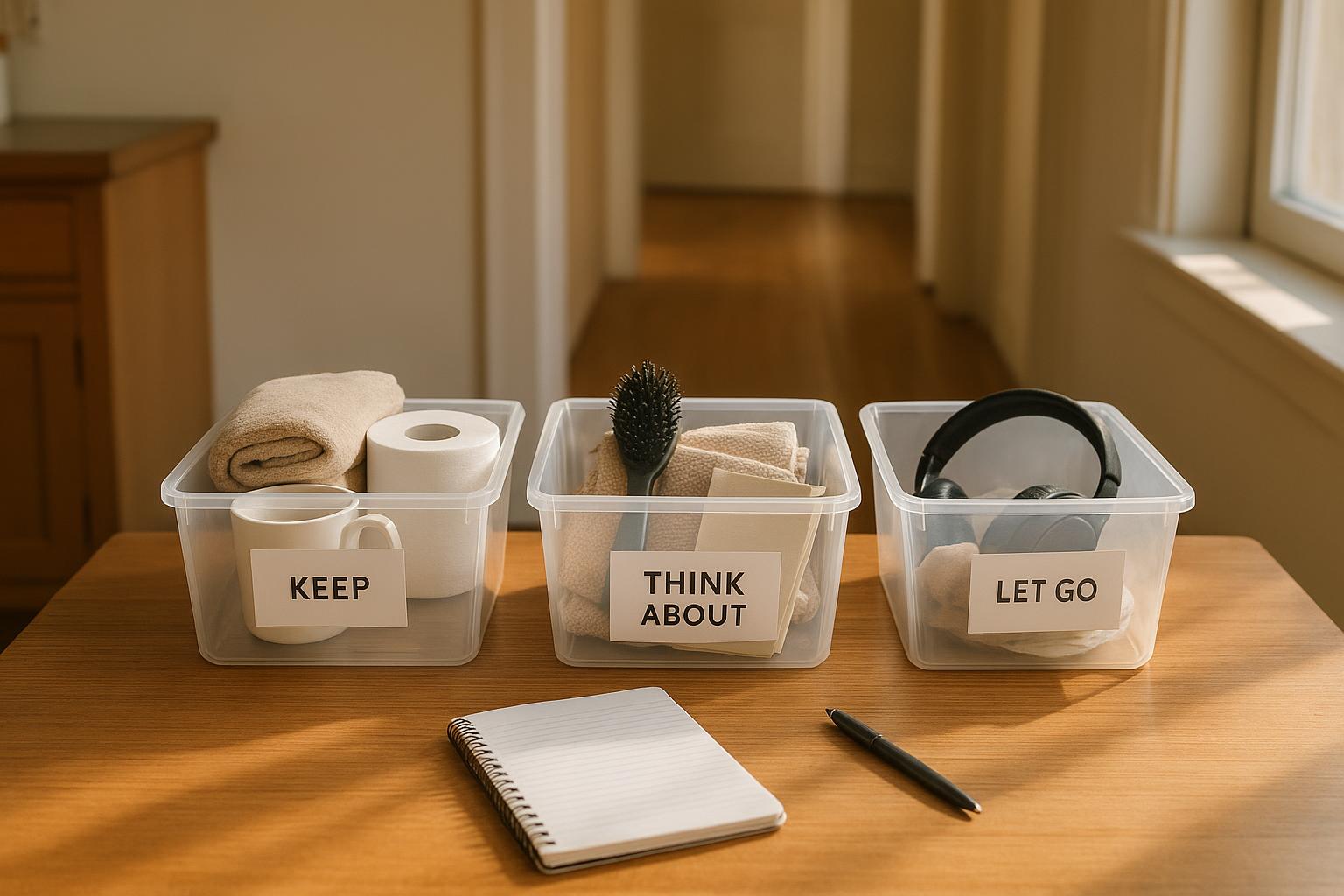
A common structure is three or four containers or areas, such as "keep", "decide later", "recycle or donate" and "bin". The "decide later" box is important because it removes the pressure of an immediate final decision. Agree in advance how long items can stay there, for example until a date the person chooses. Photographing an item before it leaves can help some people, though it does not suit everyone.
Handle one item at a time
Pick up an item, ask a simple question such as "Do you use this?" or "Would you like to keep it?", and accept the answer. Avoid asking more than two or three questions about the same object. If the person cannot decide, move it to "decide later" and carry on.
Use a scale to talk about progress
The Clutter Image Rating scale, developed by Frost, Steketee and Tolin, is a series of pictures of rooms from empty to heavily cluttered that is widely used in research and by support services. It can help the person describe how a room looks to them and where they would like it to be, without relying on judgemental words. Hoarding UK and some local services use similar tools, so ask the service if you want to use one.
If the plan includes finding a new home for items, our guides on dividing family belongings and hidden valuables and documents may help with the question of what to do with things of sentimental or practical value. For people who need space but cannot yet part with items, storage unit clearance can sometimes act as a temporary stage, though it should be a considered choice rather than a way of relocating the problem.
Helping with the feelings that come up
Anxiety rises and falls, and it can be handled in the moment.
Expect distress to appear during sorting. That does not mean the plan has failed. A few approaches can help in the moment:
- Pause and breathe. Slow breathing, a glass of water or a short break at a window can bring a spike of anxiety down. Do not rush back to the task.
- Name the feeling. "This looks really hard" is more helpful than "Don't be upset".
- Allow the anxiety to pass. A core principle in CBT-based work is that anxiety usually peaks and then falls if the person stays with it for a while rather than avoiding the situation. This is easier with a supportive person alongside, and harder when someone feels pushed.
- Return to the person's own goals. If the person has said they want to cook again, have a friend visit or sleep in their own bed, remind them gently of that goal rather than of your own.
- End on a positive note. Finish the session with something small that went well and a clear time for the next one, if they want one.
Be alert to signs of low mood or hopelessness. Anxiety around possessions often coexists with depression, social isolation and bereavement. If the person says anything that suggests they might harm themselves, take it seriously, stay with them if you can, and contact their GP or emergency services if there is immediate danger. The Samaritans offer a free listening service on 116 123 at any time, and you can use it yourself if you are finding the situation hard to carry.
Professional help available in England
Encouraging a first step towards support.
For persistent or severe anxiety about discarding, professional help can make a real difference. The NHS information on hoarding disorder recommends speaking to a GP, who may refer the person for talking therapy; it describes CBT as the main treatment, delivered by a therapist who helps the person work on thoughts and behaviours around possessions. Medication may be considered where there are coexisting conditions such as depression or anxiety.
Realistic routes include:
- A GP appointment. You can offer to help book it, write down the main concerns beforehand or go along if the person wants you there. A GP can discuss options, check for physical health issues and refer on.
- NHS Talking Therapies. In England, many people can refer themselves to a local NHS Talking Therapies service without seeing a GP first, though availability and the range of problems each service treats vary by area, so check locally.
- Charities. Hoarding UK is a charity focused on hoarding that provides information and support for people affected and their families. Mind publishes information on mental health problems and can point to local services. Check each organisation's current services directly, as offers change.
- Local council and adult social care. Where a person has care and support needs, the council may carry out an assessment under the Care Act 2014, and some boroughs run or commission hoarding support. Policies differ between councils.
If the anxiety follows a death, our directory of bereavement support organisations in London lists organisations that offer bereavement support, which may be a better first step than any sorting.

When safety comes first
Sometimes the risk cannot wait for the person to feel ready.
Everything above assumes there is time. Sometimes there is not. If the home presents an immediate danger, safety has to take priority over comfort, while still involving the person wherever possible.
Warning signs include blocked exits or hallways, items stacked near a cooker, heater or electrics, no working smoke alarm, evidence of rodents or insects, structural damage, a collapsed floor or stairs that cannot be used safely, and rubbish or food waste that is attracting pests. Falls are a particular risk for older people living with cluttered floors.
- Fire. Call 999 if there is a fire. The London Fire Brigade offers free home fire safety visits to Londoners, and it is a good idea to ask for one for anyone with a heavily cluttered home. Fire services work with the person rather than against them, which can be less threatening than a family member raising the issue.
- Medical concern. If someone is ill, injured or cannot leave the home, call 999 in an emergency or contact their GP or NHS 111 for urgent advice.
- Ongoing concern for an adult. If you believe an adult with care and support needs is at risk and unable to protect themselves, you can contact the council's adult social care team. Under section 42 of the Care Act 2014, councils must make enquiries where they have reasonable cause to suspect abuse or neglect, and statutory guidance treats self-neglect, which can include hoarding behaviour, as within scope.
- Environmental health. Pests and unsanitary conditions can be reported to the local council, which has powers under public health and housing law. Our collecting versus compulsive hoarding explains these routes in more detail.
Capacity, consent and who decides
Respecting autonomy is part of helping.
The law in England leans strongly towards personal choice. The Mental Capacity Act 2005 sets out that an adult must be assumed to have capacity unless shown otherwise, that a person must be supported to make their own decisions where practicable, and that making an unwise decision does not by itself show lack of capacity. That is why consent matters even when family members are certain they know best.
Capacity is specific to each decision and each moment. A person may be able to make decisions about their possessions on a good day and struggle on another, and conditions such as dementia can change the picture over time. If you are seriously concerned that someone cannot understand or weigh up decisions about their home, speak to their GP or the council's adult social care team rather than acting on your own. Where someone has appointed a lasting power of attorney, the attorney's powers are limited by the terms of the document and by the person's best interests, and legal advice is wise before relying on them to discard belongings.
Where a clearance fits, and how houseclearance.co works
A clearance can help, but only at the right moment and at the right pace.
For some people, practical help from outside the family eventually becomes part of the plan. This may be because the volume of items is too large to sort alone, because a landlord, council or insurer requires action, or because the person has decided they want a fresh start. A clearance should follow the person's decisions, not replace them.
houseclearance.co is a marketplace for quotes, not a clearance company. You describe the job, and independent, licensed local carriers may contact you with quotes. We do not price jobs on this page and cannot promise any particular outcome. If you decide to go ahead, a few points are especially relevant where anxiety is involved:
- Say so honestly when you post the job. Mention that the person is anxious about discarding and, if they are comfortable with it, that sorting will be gradual. This lets carriers tell you whether they have worked in sensitive situations and whether they can offer a phased or attended visit.
- Ask about the way they work. Will the person be present? Can items be set aside on request? Will the crew keep to an agreed list? Our hoarding clearance in London page and our hoarding clearance cost guide describe how carriers typically handle heavily cluttered properties.
- Compare more than the number. Our how to compare house clearance quotes article explains what to look for, including what each quote includes and how the carrier plans to dispose of waste.
- Check the licence. Anyone who carries waste in England must be a registered waste carrier. You can check a waste carrier licence on the public register, and our insurance and safety page explains cover and protections.
- Do not rush. A quote is a starting point, not a commitment. Take it away and give the person time to think.
If you simply want help getting started, decluttering services in London may be a gentler first step than a full clearance. Our guide for families dealing with hoarding and downsizing and clearance planning article also set out the practical planning.
Frequently asked questions
The questions that come up most often about supporting someone who is anxious about discarding.
Is anxiety over discarding items the same as hoarding disorder?
Not necessarily. Many people feel anxious about letting go of belongings, especially after a bereavement or a move. Hoarding disorder is a specific diagnosis, in the DSM-5 and ICD-11, involving persistent difficulty discarding possessions, distress at parting with them and clutter that stops living spaces being used as intended. Only a qualified professional can say whether it applies.
What is the best thing to say to someone who panics when I suggest throwing things away?
Start with understanding rather than solutions. Something like "I'm worried about you and would like to help in a way that suits you" works better than a request to declutter. Ask open questions, listen without arguing, ask permission before touching anything and make clear that every decision stays with them.
Should I clear the home while the person is out?
Outside genuine emergencies, no. Clearing someone's belongings without their agreement is widely advised against by specialists, because it is experienced as a violation and often leads to a broken relationship and fast re-accumulation. If there is a serious safety risk, involve the GP, the fire service or adult social care rather than acting alone.
Can I force a relative to get rid of their things?
Generally no. An adult with mental capacity is entitled to make their own decisions about their home and possessions under the Mental Capacity Act 2005, even decisions others see as unwise. Councils have powers where the property is a statutory nuisance, a serious hazard or where an adult with care needs is self-neglecting, but these are separate legal routes and not family powers.
What treatment is available in England?
The NHS says hoarding disorder can be treated and that a GP is the usual first step. CBT with a trained therapist is described as the main treatment, and medication may be considered where there are other conditions such as depression. Many people in England can also self-refer to NHS Talking Therapies, though what each local service treats varies.
How can I help if the person refuses any help?
Keep the door open. Stay in regular, non-judgemental contact, focus on safety issues that matter to them, suggest a GP visit when the moment is right and look after yourself. Change often needs several conversations over a long time. If there is serious risk, you can contact adult social care or the fire service.
How do I pace sorting so it is not overwhelming?
Choose one small, low-stakes area, work in short sessions of 20 to 30 minutes, use categories such as keep, decide later, recycle or donate and bin, and let the person decide each item. Stop when they say stop. Measure progress by how usable the space is, such as a clear path or a cleared chair, not by how much has been removed.
When should I contact adult social care or the fire service?
Contact the fire service if there are blocked exits, clutter near a cooker or heater, or no working smoke alarm, and call 999 in an emergency. Contact the council's adult social care if an adult with care and support needs appears at risk and unable to protect themselves. The London Fire Brigade offers free home fire safety visits to people in London.
Can a clearance company help someone who is anxious about discarding?
It can, if it is done at the person's pace. Tell carriers about the situation when you post a job and ask how they handle sensitive work, for example attended or phased visits and keeping items set aside at the person's request. A clearance should follow the person's own decisions rather than replace them.
How does houseclearance.co fit into this?
houseclearance.co is a marketplace, not a clearance company. You describe the job and independent, licensed local carriers may contact you with quotes. We do not give prices on this page or promise outcomes, and you should check each carrier's waste carrier registration before agreeing to anything.