
What houseclearance.co does
A quote-matching platform, not a single clearance firm.
houseclearance.co is an online platform and marketplace for house clearance in London. Rather than quoting you a fixed, company-wide price, the platform asks you to describe the clearance job - property type, rough volume, access and any items that need special handling - and then shares those details with suitable, independent licensed waste carriers covering your postcode. Interested carriers get in touch with their own quote, and you choose which one (if any) to accept. houseclearance.co itself does not send a van or a crew to your door; the clearance work is carried out by the carrier you select, not by houseclearance.co staff.
That distinction matters because it changes how pricing and accountability work. A single clearance company can only offer the price its own crew needs to make the job worthwhile. A marketplace of carriers means your postcode, floor level and specific items can all be reflected in the quotes you actually receive, rather than averaged into one one-size-fits-all rate card. It also means you're not limited to whichever single company happens to answer the phone first - you can compare more than one real quote before deciding anything.

The platform is designed to cover all 33 London boroughs, from inner boroughs like Camden and Southwark to outer boroughs like Bromley and Hillingdon. Coverage doesn't depend on houseclearance.co having its own depot or office in a borough - it depends on licensed carriers being available to take jobs there, which is normally the case across Greater London. See the coverage map for the full borough-by-borough picture.
How it works
Three steps from "what a mess" to "sorted".
Tell us what needs clearing
Describe the job, including a photo if that helps - then post the job for licensed carriers to quote.
Post the job
Add your postcode, date and a few details. Takes about a minute.
Review quotes from carriers
We share your request with suitable licensed local carriers. Interested carriers can provide quotes; you review them and pick the price and time that works for you.
There's no cost to post a job and no obligation to accept any of the quotes you receive. The more detail you give - rooms involved, stairs or lift access, whether a car can park outside, and any regulated items like mattresses or fridges - the less likely a carrier's price is to change once they see the property in person. If you're not sure what to include, how it works walks through the full process in more depth, and our checklist guide covers what to note down before you post.
Clearance solutions for your property
Clearing a property can involve a few unwanted items or the contents of several rooms.
Explore clearance services for furniture clearance, shed clearance and garden clearance, or describe a mixed load of household waste when requesting a quote. Explain what needs removal, what should stay and any access restrictions so the clearance service can assess the work. Beyond the core house clearance service, the platform also covers more specific situations: flat clearance for leasehold properties with lift or stair access to consider, loft clearance for hatch-access spaces that need careful handling, basement and cellar clearance for below-ground storage, and hoarding clearance for properties where the volume or condition of contents needs a more considered approach.
Landlords and letting agents arranging a clearance between tenancies can see end-of-tenancy clearance, while anyone dealing with a relative's estate may find probate clearance more relevant. Businesses clearing an office, shop or warehouse have their own section too - see office clearance and commercial & retail clearance for details that don't apply to a typical household job.
House clearance, waste clearance and rubbish collection
Different terms, different scopes of work.
House clearance usually concerns the contents of a property, while waste clearance, waste removal and rubbish removal may describe a smaller or mixed collection. For a rubbish collection enquiry, list the items, include photographs where possible and explain whether furniture, bagged rubbish or other waste needs collecting. Our rubbish removal & waste collection page covers smaller and mixed-load collections; for a whole property see house clearance instead.
The two aren't always easy to tell apart in advance. A single sofa and a few bin bags is a rubbish collection job; a two-bedroom flat with furniture in every room, a loft full of boxes and a shed to empty is a house clearance job. If you're somewhere in between - say, a partial clear-out after downsizing - describe the actual rooms and items involved when you post the job rather than trying to pick the "correct" category yourself. Carriers quote on what you describe, not on which page you started from.
What's normally included - and what needs separate handling
Most household contents can be cleared in one visit.
Most general household contents can be removed as part of a standard house clearance: furniture, boxed and loose belongings, white goods, carpets and rugs, and general household waste. Some categories need to be flagged in your job post rather than assumed, because they carry their own regulatory handling requirements and affect how a carrier prices and plans the job:
- Mattresses and upholstered furniture fall under Persistent Organic Pollutants (POPs) regulations and can't be mixed with general waste - see the surcharge detail on our prices page.
- Fridges, freezers and other cooling appliances are covered by WEEE (Waste Electrical and Electronic Equipment) rules because of the refrigerant gases involved.
- Electronics more broadly - TVs, monitors, small appliances - are also WEEE-regulated and need dedicated recycling routes rather than general disposal.
- Builders' and renovation waste such as rubble, plasterboard or soil is priced and handled differently to household contents - see builders & renovation waste clearance.
- Confidential documents need secure destruction rather than standard disposal - see confidential waste & document clearance.
Flagging these items up front, rather than mentioning them for the first time on the day, means the carrier's quote is more likely to match what you actually pay. Heavy or bulky pieces such as large wardrobes, piano-sized furniture or appliances are worth naming in the job post too, as they can affect crew size and access.
Common reasons people arrange a house clearance
The reason behind a clearance often shapes what matters most.
People arrange a house clearance in London for a wide range of reasons, and the underlying reason often changes what's most important about the job. Someone preparing a property for sale usually cares most about timing and presentation. Someone downsizing into a smaller home needs to separate what's coming with them from what isn't. A landlord between tenancies is usually working to a fixed handover date. Whatever the reason, describing it briefly in your job post helps a carrier understand the priorities, not just the volume of items.
Probate, bereavement and end-of-tenancy clearances
Two situations that often need a more careful approach.
A probate house clearance usually takes place after someone has died, when an executor or family member needs to clear a property as part of settling the estate. These jobs often involve sorting through personal belongings, identifying items that need separate valuation, and working to the timescale set by the wider probate process rather than by the clearance itself. See probate clearance and our guide to probate house clearance for executors for more detail on how this usually works in practice.
An end-of-tenancy clearance is a different situation with a different pressure point: a fixed handover date set by a tenancy agreement, often with a landlord or letting agent needing the property returned to a lettable condition. See end-of-tenancy clearance and our letting agent guide to clearance between tenancies if you're managing this from the landlord's side rather than the tenant's.
What affects your quotation
There's no fixed company-wide price - here's what actually moves the number.
Because houseclearance.co is a marketplace, not a single business with one rate card, there's no single published price that applies to every job. What a carrier quotes for your specific clearance depends on a combination of real, practical factors:
- Volume of contents - a studio flat and a five-bedroom house sit at opposite ends of the same service, and carriers price accordingly.
- Access - stairs without a lift, a long walk to the vehicle, or a narrow entrance all add time and labour compared with ground-floor access next to a loading bay.
- Parking and loading restrictions - a controlled parking zone or a red route near the property can mean a carrier needs a permit or a parking suspension, which they'll usually factor into the price.
- Type of waste - general household items are priced differently from regulated categories like mattresses, fridges or electronics, which carry their own disposal surcharges.
- Labour and number of loads - a job that needs two people and one van load costs less in practice than one needing three people and multiple trips.
- Urgency - a same-day or next-day request can narrow the pool of carriers able to take the job, which can affect the quotes you receive.
The most reliable way to see where your own job is likely to sit is to check our indicative price ranges by property size and van load, then post your actual job details so a licensed carrier can give you a real number rather than an estimate built from averages.
Compare clearance companies, costs and quotes
Check what's included before you compare prices.
When comparing clearance companies, check what each clearance company includes in its quote. The total cost can depend on the load, labour, access and disposal requirements. Compare prices for the same scope of work, ask which charges are additional and request an invoice showing the agreed services. For unusual items or access arrangements, ask for a custom quote and check the collection van requirements.

Preparing for clearance day
A little preparation makes the job faster and more accurate.
Before your chosen carrier arrives, it helps to walk through the property and confirm what's staying and what's going - especially in shared or family situations where more than one person has a say. Clear a path to the front door and, if possible, to the vehicle's parking spot, so loading doesn't lose time to obstacles that could have been moved in advance. If any items need dismantling - flat-pack wardrobes, bed frames, shelving units - mention this when you post the job, since dismantling adds time that a carrier will usually want to know about before they arrive, not on the day.
If you're clearing a flat in a managed building, check whether the freeholder or managing agent has any rules about lift use, permitted access hours, or where a van can wait outside - this is worth confirming before the carrier's visit rather than discovering it on the day.
Reuse, charity donations and responsible disposal
What happens to items after collection.
Before arranging disposal, separate furniture and other belongings that may be suitable for reuse. A charity may accept selected items, subject to condition and collection availability. Ask the provider what can be recycled and how the remaining waste will be handled. If a service is described as "eco friendly", ask what that means in practice rather than assuming everything will be diverted from disposal.
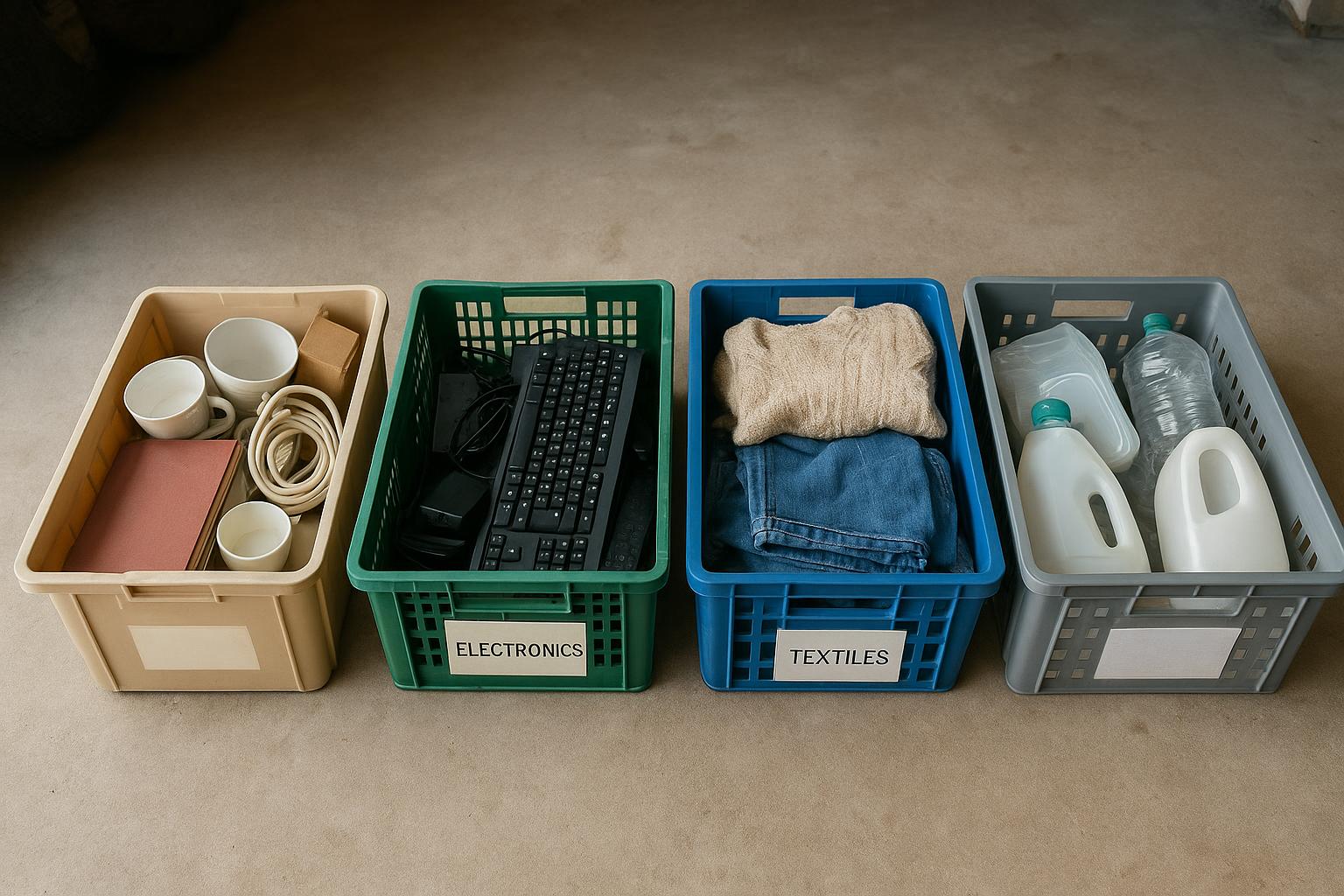
What can I recycle?
Ask the carrier which materials they can recycle as part of the job - this varies by item and by the carrier handling the collection. See responsible disposal for how recycling and reuse fit into the clearance process, and understanding waste transfer documentation for when paperwork applies.
Furniture and item donation
If furniture or household items are in good, usable condition, donation may be worth considering before they're added to a clearance job - not every item can be donated, and acceptance depends on the charity's own condition and collection criteria. See furniture donation in London for a more detailed look at how that process generally works.
Coverage across London's 33 boroughs
Searching for "house clearance near me"?
Start with the property's London postcode and check availability for the address. Explore our West London information and other area guides, then include your location and preferred date in your enquiry. See the coverage map for the full list of London boroughs covered.
Rather than listing all 33 boroughs on this page, it's more useful to browse by part of London: Central London, North London, North-West London, East London, South London and South-West London each group together the boroughs and local areas within them, with their own local considerations around property types, parking and access - useful if you're not sure which specific area page matches your postcode.
Waste carrier licensing and duty of care
Why the licence check matters for anyone disposing of household waste.
English law makes you responsible for what happens to your rubbish after it leaves the house. Handing it to someone without Environment Agency registration is a risk you carry, so carriers here must hold a waste carrier licence, and a status check against the public register happens before any carrier can respond to a job. What the licence covers and how the check is run are explained on their own pages.
The stakes are practical. Rubbish dumped by an unregistered operator can be traced back to the household that hired them, and a fine may follow. Our fly-tipping liability guide sets out where that responsibility sits.
Who writes the guidance on this site
A small editorial team, not an anonymous content mill.
The pricing pages, borough and area guides, and practical advice across houseclearance.co are written by a small named team rather than published anonymously. David Sterling has written about house clearance and property services for over a decade, focusing on planning a clearance and comparing the scope of different services. Sarah Jenkins covers reuse, donation and household recycling - helping readers work out what might still be usable before it's added to a clearance job. Marcus Vance writes about the practical logistics that affect a clearance, including access, stairs, lifts and loading time, while Tom Reynolds focuses on clearance pricing and why two quotes for what looks like a similar job can genuinely differ. Elena Rostova writes customer-facing guidance on requesting quotes and preparing for a clearance, including when arranging one on behalf of a relative. See about us for the full team and our editorial policy for how guides are researched and kept up to date.
Your house clearance checklist
Plan what stays, what goes and what's wanted elsewhere.
Use a checklist to separate items to keep, donate, sell or remove. Identify belongings that are still wanted before collection day and make sure everyone involved understands what should remain. If selected items may have resale value, consider whether auctions or individual sales fit your timescale before the clearance is booked. See our house clearance checklist for the full list.
What should an "everything must go" advert include?
If you organise a sale before clearance, an "everything must go" advert should state which items are available, their condition and the collection arrangements. Whether you use a flyer or a sign, clear details and actual photographs are more useful to buyers than decorative clipart or a logo.

A finished clearance should leave the property swept and clear, ready for its next use - whether that's a sale, a new tenant, or simply an empty room. If anything was agreed verbally with the carrier beforehand (an extra item, a specific finish time), it's worth having it confirmed in writing as part of the booking, not relied on from memory alone.
FAQs
A few things worth knowing before you post a job.
What is houseclearance.co?
It is a request board for London property clearances. You describe the job once, and independent licensed carriers who cover your postcode can respond with their own offers. We don't own vans and we don't set the final fee.
Why can't you give me one fixed price up front?
Every property differs: stairs versus ground floor, parking outside versus a long carry, a half-empty flat versus a packed loft. Each carrier prices those details for themselves, so the number you accept is the carrier's, not ours.
Does it cost anything to post a request?
No. Posting is free and carries no obligation. Money changes hands only if you accept a carrier's offer and book them.
How do you check the carriers?
A carrier must show a current Environment Agency waste carrier registration before it can see and respond to jobs. We look the number up on the public register, and you can repeat that lookup yourself before booking.
Does houseclearance.co send a crew to my home?
No. The team that turns up belongs to the carrier you picked. Our part ends once your details reach carriers and their replies reach you.
Which parts of London do you serve?
All 33 boroughs, from Barking and Dagenham to Westminster, provided a licensed carrier is free to take the job on your date. Our coverage map links to every borough page.
How soon could a clearance happen?
It hinges on who is free near your postcode on the day you want. Short-notice requests attract fewer replies, so say plainly in the post if the date is fixed, for example a key handover or a completion.
What can't be included in a standard clearance?
Asbestos, chemicals, gas bottles and other hazardous waste need specialist handling. Fridges, mattresses, electricals, rubble and confidential papers usually need separate disposal routes, so list them when you post.
Should I sort anything before the carriers come?
Set aside valuables, paperwork and sentimental items first. Then pull out good-condition furniture or electricals that a charity shop might accept, since charities turn away worn or unsafe goods.
Is a free clearance realistic?
Occasionally, when the contents are mostly saleable furniture or working electricals that a reuse charity wants. If rubbish, broken items or bulky waste are mixed in, expect to be quoted a fee.
Will anyone pay me for the contents?
A clearance firm charges for removal and disposal; it doesn't normally buy stock. Genuine antiques, jewellery or collectables are better taken to a valuer or auction house before the clearance date.
Roughly what does a London clearance cost?
Indicative figures run from about £150 for a studio or one-bed up to £1,400 or more for a three-bedroom house. The real figure depends on volume, access and the carrier's own rates.
Can I rely on a London price for a property elsewhere?
No. London estimates reflect London disposal fees and access conditions. For a property outside the capital, ask for a quotation based on that property's own postcode.
What should an "everything must go" advert say?
List what is for sale, state each item's condition, give the collection window and add real photographs. Buyers respond to honest detail far more than to logos or clipart.
Who writes the guides on this site?
A small named editorial team. Their backgrounds are on the about us page, and the editorial policy explains how pieces are researched, sourced and refreshed.