Direct answer
The emotional difficulty of clearing a parent's home isn't a sign you're handling it badly - it's an ordinary, well-recognised reaction to a task that forces hundreds of small, personal decisions about objects that carry real emotional weight. There's no fixed timetable, no "correct" pace, and no requirement to feel a particular way about any given item. What tends to help is working in shorter sessions rather than one long push, expecting grief to resurface unevenly rather than fade in a straight line, separating the memory of an object from the need to keep it physically, and bringing in help - family, a friend, or a licensed carrier for the physical side - when the task starts to outweigh what you can manage alone. This guide focuses specifically on the emotional and psychological side; our house clearance after a bereavement guide covers the practical sequence of steps if you haven't started yet, and if the property is going through probate, our guide to when a probate house clearance can legally begin covers the legal timing question separately from the emotional one.
Contents
- Why this is a different kind of hard
- Grief doesn't move in a straight line through this process
- Decision fatigue: why it gets harder as the day goes on
- Why ordinary objects can hit harder than meaningful ones
- Separating the memory from the object
- When family members grieve at different speeds
- Signs it's time to stop for the day
- Choosing a pace that actually fits your situation
- Asking for help isn't avoidance
- Practical self-care during the process
- When it's worth more than self-management
- Frequently asked questions
Why this is a different kind of hard
Most tasks after a death are one-off. This one is repetitive, open-ended, and deeply personal at the same time.
Registering a death, arranging a funeral, notifying a bank - these are difficult but bounded tasks. You do them once, they're unpleasant, and then they're finished. Clearing a parent's home doesn't work that way. It's made up of an enormous number of small decisions - keep, donate, recycle, throw away - repeated across every drawer, cupboard, shelf and box in the property, and each decision is attached to something that belonged to a specific person you loved.
That combination - repetition plus emotional weight - is what makes this particular task feel disproportionately exhausting compared to its practical scale. Clearing a storage unit of unfamiliar boxes is tiring. Clearing a parent's wardrobe, where every item is instantly recognisable and carries its own small memory, is a different kind of tiring, and it's reasonable to expect it to take more out of you than the physical effort alone would suggest.
Grief doesn't move in a straight line through this process
Calm for an hour, then suddenly overwhelmed by something small - that's typical, not a setback.
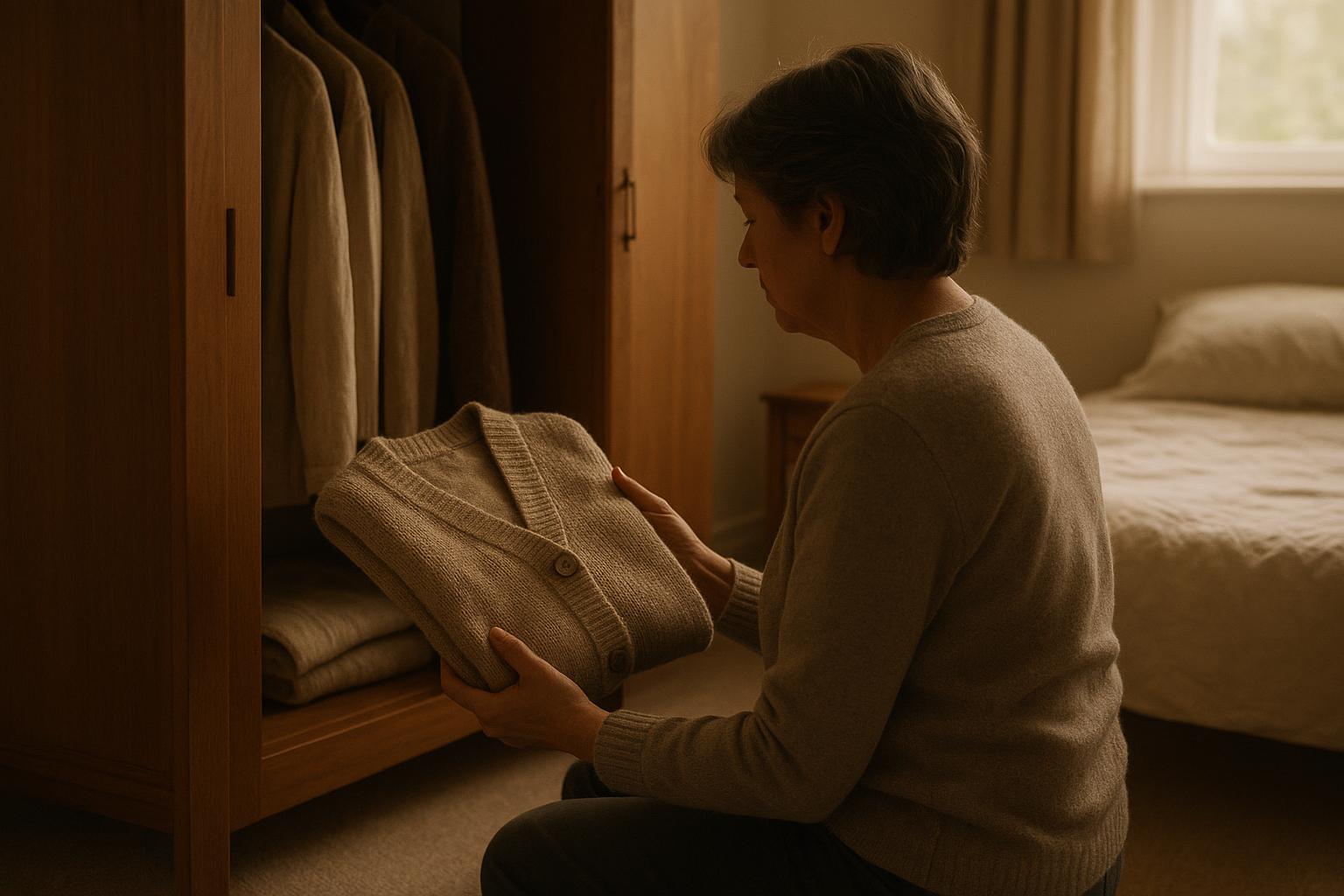
One of the most disorienting parts of clearing a parent's home is how unevenly grief shows up. You might sort an entire wardrobe of clothes calmly and methodically, then be unexpectedly undone by a shopping list in their handwriting, a half-used bottle of hand cream, or a specific chipped mug that was always "theirs". There's no way to predict in advance which object will do this, and it doesn't mean the calm hour before it was fake, or that you weren't taking the task seriously.
It can help simply to expect this pattern rather than be surprised by it each time: a stretch of manageable, even mechanical sorting, interrupted at unpredictable points by something that stops you completely. Neither state is more "real" than the other - they're both normal parts of the same process, and the unevenness tends to settle over repeated sessions, even if it doesn't disappear entirely in any one sitting.
Decision fatigue: why it gets harder as the day goes on
The quality of your decisions changes over the course of a session, even if the items don't.
Decision fatigue is a well-documented pattern: the more decisions you make in a stretch of time, the worse your judgement tends to get on each subsequent one, regardless of how important it is. A full house clearance can easily involve several hundred keep-or-let-go decisions in a single day. By the afternoon, it's common to notice two opposite reactions - either an urge to keep almost everything "just in case", or the opposite, a sudden wish to get rid of everything quickly just to be finished with the decision-making itself.
Neither of those late-session impulses is usually your considered judgement - they're a predictable effect of decision fatigue, not a sign of what you actually think the object is worth keeping. Two things help here: noticing when decisions start to feel automatic or arbitrary rather than considered, and treating that as a signal to stop for the day rather than push through to "finish the room". A short break, or stopping entirely until another day, usually restores better judgement far more effectively than forcing through a few more boxes.
Why ordinary objects can hit harder than meaningful ones
The things that are hardest to sort are rarely the most expensive or the most obviously significant.
It's a common and slightly counterintuitive experience: an heirloom piece of jewellery or a framed photograph - the things you expected to be difficult - can sometimes be sorted with relative ease, while an ordinary biro, a half-finished crossword, or a specific brand of tea in the cupboard brings on a wave of grief that catches you off guard. This happens because grief attaches to whatever carries the strongest sensory or habitual memory, not to whatever has the most obvious sentimental status.
There's no need to treat this as unusual or to feel you should have anticipated it. If a specific ordinary object turns out to be unexpectedly difficult, it's reasonable to set it aside without deciding anything about it in that moment, and come back to it later, once the immediate wave has passed. Our guide to finding and safeguarding hidden valuables, documents and photos covers a practical labelled-box system that works well for this - not just for valuables, but for anything you're not ready to decide on yet.
Separating the memory from the object
You can keep what an item means without keeping the item itself - and that distinction can unblock a stalled clearance.
A large part of what makes sentimental sorting difficult is an unspoken assumption that letting go of an object means letting go of the memory or relationship it represents. In practice, the two can be separated, and doing so deliberately often makes the decision much easier:
- Photograph it before deciding. A clear photo on your phone preserves what the object looked like and the memory attached to it, even if the physical item doesn't come with you.
- Keep one representative piece from a larger collection. If a parent had dozens of ornaments, scarves, or tools, keeping one or two that feel most representative - rather than all or none - is a reasonable middle option many families land on.
- Write down the story, not just the object. A sentence or two about why something mattered, kept alongside a photo, often outlasts the physical item in terms of what you actually revisit later.
- Give yourself permission for the decision to be about now, not forever. A reluctant "let it go" decision made under time or space pressure doesn't have to feel final or comfortable to still be the right practical choice.
None of this is about minimising what an object meant. It's simply a way of making keep-or-let-go decisions without the false premise that the object itself is the only way to hold on to the memory.

When family members grieve at different speeds
One sibling wanting to move quickly and another needing to slow down doesn't mean either of them is wrong.
It's common for siblings or close family members to approach the same clearance in noticeably different ways. One person might want to work through the house quickly and practically, finding it easier to cope by staying busy and making progress. Another might need to go slowly, revisit certain rooms more than once, or avoid particular areas of the house for a while. Both are ordinary responses to grief, not evidence that one person cares more than the other, or that someone is being deliberately difficult.
Naming this difference out loud - "I think we're coping with this differently, and that's probably fine" - tends to prevent it from turning into a lasting source of tension. Where it helps practically, splitting the work by comfort level rather than by room can work well: one person handling more neutral spaces like the kitchen or garage, while a slower pass through a parent's bedroom or personal items happens later, with whoever feels able to do it at the time.
Disagreements about what to keep are a related but separate issue - our house clearance after a bereavement guide covers a simple way to set disputed items aside without it holding up the rest of the clearance.
Signs it's time to stop for the day
Worth recognising in the moment, rather than only in hindsight.
There's no formal checklist for this, but a few signals tend to show up consistently when it's time to close the door on a room and come back another day rather than push through:
- Decisions start feeling arbitrary. Keeping or discarding things almost at random, rather than actually considering each one.
- Irritability over small things. Snapping at a family member about where a box should go, when the real source of tension has nothing to do with the box.
- Rushing to "get it over with". Moving through a room quickly in a way that feels more like avoidance than genuine progress.
- A flat, numb feeling replacing earlier care. Going through the motions without really registering what's being decided.
- Physical signs - a tension headache, tight chest, or simply feeling drained in a way that rest would normally fix but isn't fixing today.
Any one of these is a reasonable reason to stop, not a reason to feel you've failed to get through enough.
Choosing a pace that actually fits your situation
There's no more "correct" approach between a slow, spread-out clearance and a short, intensive one.
Some families prefer to spread a clearance over many short sessions across weeks or months, dealing with one room or one category at a time and letting grief surface in smaller, more manageable amounts. Others find a prolonged, open-ended task more draining than a short, difficult one, and prefer to get the bulk of it done over a few intensive days, even if those days are hard, simply to avoid living with an unfinished task hanging over them indefinitely.
Neither approach is more resilient or more "together" than the other - they suit different people and different circumstances, including how far family members live from the property, work and caring commitments, and simply personal temperament. If there's no external deadline forcing the pace - no tenancy ending, no sale about to complete - it's worth choosing deliberately rather than defaulting to whichever pace feels like it's expected of you.
Asking for help isn't avoidance
Involving other people doesn't mean you're not coping - it often means the opposite.
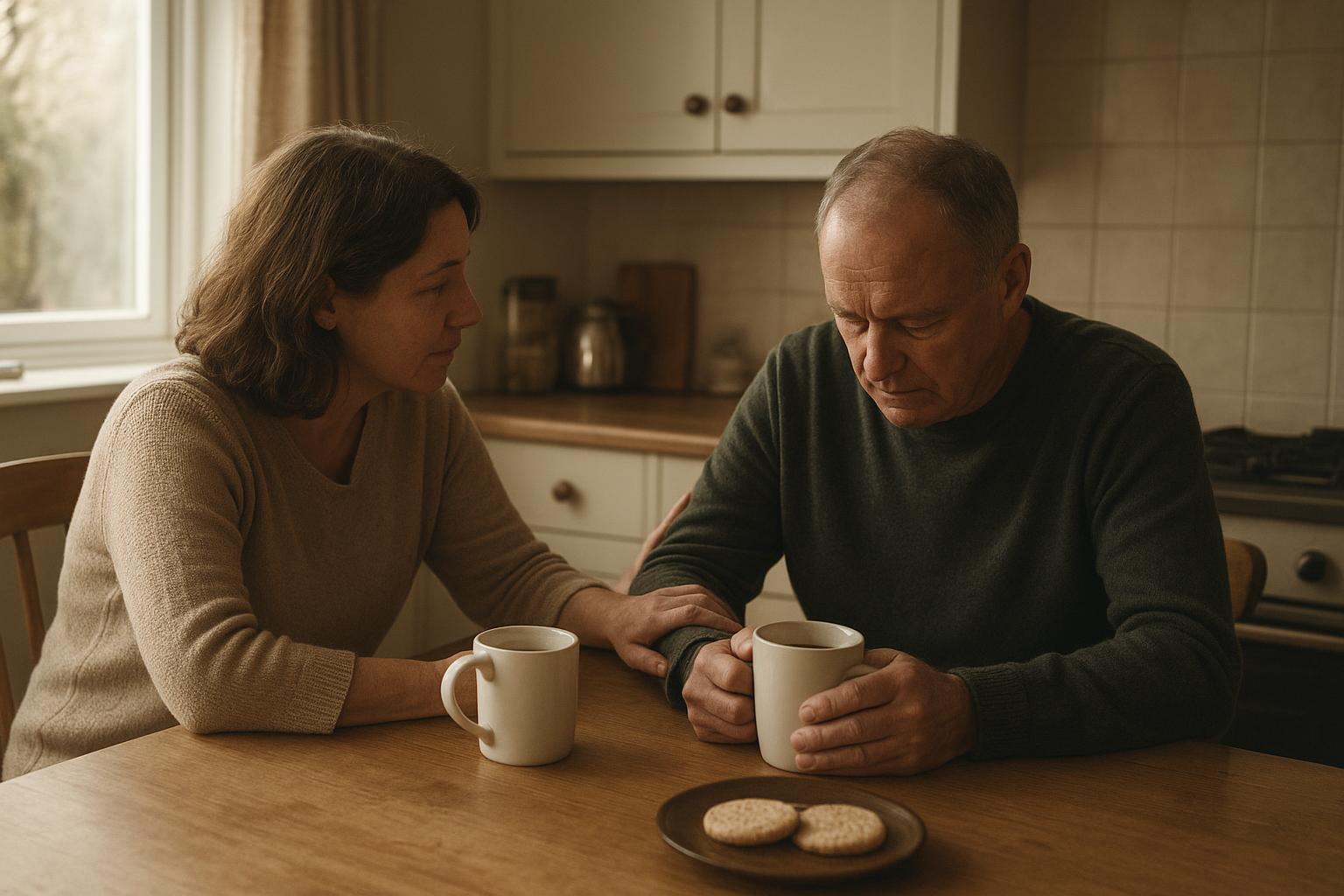
There's sometimes an unspoken feeling that handling a parent's clearance alone, without support, is more respectful or more "real" grieving. In practice, the opposite is usually true: trying to carry the entire emotional and physical weight of the task alone tends to make the process harder and longer, not more meaningful.
A friend or relative who was less close to the person who died can often make steadier, calmer decisions on more neutral items, simply because the object doesn't carry the same emotional charge for them - and their presence alone, without them doing anything dramatic, can be enough to slow the pace to something healthier and prompt natural breaks. Separately, booking a licensed carrier for the physical side - lifting, loading and removing furniture and bulky items - means the heaviest physical labour isn't competing with your energy for the emotional decisions, which is often where people need that energy most. Our guide to choosing a licensed house clearance company covers what to look for, and it's worth telling the carrier directly if a sympathetic, unhurried visit matters to you - many will adjust their approach accordingly if they know in advance.
Practical self-care during the process
Small, unglamorous habits that make a genuine difference over a multi-week or multi-month process.
None of the following is a cure for grief, and it isn't meant to be. These are small, practical habits that tend to make the process more sustainable, especially if it's going to be spread over several weeks or months:
- Eat and drink properly on clearance days. It's easy to work through a full day on very little, which worsens both mood and decision-making.
- Set a rough time limit before you start a session. Deciding in advance "we'll do two hours today" makes it easier to stop on schedule rather than push past the point where decisions are still good ones.
- Leave the hardest room for a day when you feel more able to handle it. There's no requirement to clear rooms in any particular order - starting with more neutral spaces is a reasonable, common choice.
- Plan something afterwards, even something small. Having a reason to leave the property at a set time - seeing a friend, a short walk, simply going home - gives the day a clear end point.
- Accept that some sessions will be unproductive in terms of volume cleared. A day where very little physically changes, but where something emotionally difficult was faced, is not a wasted day.
When it's worth more than self-management
There's no precise threshold, but some signs are worth taking seriously rather than waiting out alone.
Grief that comes in waves during a clearance, as described earlier in this guide, is ordinary. It's worth speaking to a GP or a bereavement-specific service if grief feels like it isn't easing at all over an extended period, if it's consistently preventing you from functioning day to day, or if sleep, appetite or the ability to concentrate stay badly disrupted well beyond the clearance itself. None of this means anything has gone wrong with how you've approached the task - some grief needs more support than a guide like this one can offer, and recognising that early tends to help more than waiting.
Cruse Bereavement Support (cruse.org.uk, national helpline 0808 808 1677) specialises specifically in grief and bereavement support across the UK. Samaritans (samaritans.org, 116 123) are available 24 hours a day, every day, if things feel overwhelming at any point during this process, for any reason - not only in a crisis. GOV.UK's "What to do after someone dies" guidance also covers the wider administrative checklist, if the practical side of things feels like it's adding to the pressure alongside the emotional side covered here.
Ready to see your price?
Post the job whenever you're ready - there's no obligation to book, and no pressure to do it today.
Frequently asked questions
The questions that come up most often about the emotional side of this process.
Why does clearing a parent's home feel harder than other grief tasks?
Because it combines two things at once: an emotional loss and hundreds or thousands of small practical decisions, each one touching an object that belonged to someone you loved. Registering a death or arranging a funeral is a defined, one-off task. Clearing a home is repetitive and open-ended, which is why it tends to surface grief in waves rather than once, and why it can feel more draining than its practical scale would suggest.
Is it normal to feel almost nothing while sorting some items, and then be overwhelmed by something small?
Yes. It's extremely common to clear a full wardrobe calmly and then be unexpectedly undone by a shopping list in a parent's handwriting, a half-used bottle of perfume, or a specific mug. Grief doesn't attach evenly to categories of object - it attaches to whatever happens to carry a strong memory, and there's no way to predict in advance which items that will be.
What is decision fatigue, and why does it matter during a clearance?
Decision fatigue is the well-documented pattern where the quality of your decisions gets worse the more decisions you've already made in a stretch of time, regardless of how important each one is. A house clearance can involve hundreds of keep-or-let-go decisions in a single day. Recognising this means treating a sudden urge to "just get rid of everything" - or the opposite, keeping everything - as a sign to stop for the day, not as your genuine, considered judgement.
How do we stop sentimental attachment from stalling the whole clearance?
Separate the emotional decision from the physical one. You can decide to keep the feeling or memory associated with an item - by photographing it, writing down the story behind it, or keeping one representative piece from a larger collection - without keeping every physical object. Giving yourself permission to let go of the object while keeping the memory is often what actually unblocks a stalled sorting session.
What if siblings or family members grieve very differently during the clearance?
This is extremely common and rarely means anyone is doing it wrong. Some people process grief by moving quickly and practically; others need to slow down, revisit items, or avoid the task for a while. Naming this difference openly - rather than assuming the other person doesn't care, or is being difficult - tends to prevent the friction from turning into a lasting rift.
How do we know when to just stop for the day?
Useful signals include: decisions starting to feel arbitrary rather than considered, irritability with family members over small things, physically rushing through a room to "get it over with", or a feeling of numbness replacing the earlier effort to be careful. Any of these is a reasonable point to close the door on that room and come back another day - there's no deadline that requires finishing in one sitting.
Should we clear the whole house in one go, or spread it over weeks or months?
Either can work, and the right pace depends on the family's capacity, not on some ideal timeline. Clearing in short sessions over weeks or months lets grief surface in smaller, more manageable amounts. Clearing intensively over a few days can suit people who find a prolonged, open-ended task more draining than a short, difficult one. Neither approach is more correct than the other.
Is it okay to ask a friend or professional to help with the emotional side, not just the physical labour?
Yes, and it's a common, practical choice rather than a sign of not coping. A friend or relative who wasn't as close to the person who died can often make steadier keep-or-let-go decisions on neutral items, simply because the object doesn't carry the same emotional weight for them. Their presence can also slow the pace in a useful way, since someone who isn't grieving the same loss tends to notice when it's time for a break.
What should we do with the things we can't bear to sort yet?
Set them aside, clearly, rather than forcing a decision. A single labelled box or a small stack of items left in a cupboard isn't a failure to finish the clearance - it's a reasonable way to let the rest of the property be dealt with without being held up by one particularly difficult category, like letters, photographs, or a parent's clothing. There's no rule that everything has to be decided in one pass.
Does accepting help with the physical clearance mean we're avoiding the grief?
No. Booking a licensed carrier to remove furniture and general contents doesn't remove anyone's right or need to grieve - it simply means the physical labour of lifting, loading and disposing of bulky items isn't competing with the emotional work of deciding what mattered. Many families find it easier to be present with their feelings once the logistics aren't also demanding their energy.
When does grief during this process cross into something that needs more support?
There's no single clear line, but persistent feelings of being unable to function, ongoing sleep disruption, or a sense that grief isn't easing at all over an extended period are reasonable reasons to speak to a GP or a bereavement-specific service rather than waiting it out alone. Cruse Bereavement Support (0808 808 1677) specialises in this, and Samaritans (116 123) are available 24/7 for anyone who feels overwhelmed, at any point, for any reason.
Is there a right amount of time this grief and clearance process should take?
No. There's no fixed timetable for grief, and no fixed timetable for clearing a property either, beyond any external deadline such as a tenancy ending or a sale completing. Comparing your own pace to how quickly someone else dealt with a parent's home - or to how long you think it "should" take - tends to add pressure without any real benefit.