Direct answer
The three-box method means sorting every item into one of three labelled containers: keep, donate (or sell) and trash (or recycle). You touch each item once, make a quick decision using simple rules, and move on, which reduces decision fatigue and stops the sorting from stalling. Work one small area at a time, set a time limit, add a fourth "maybe" box with a deadline for difficult items, and deal with each box the same day: put keepers away, take donations out of the house, and bag rubbish. For a large or emotional job, a clearance carrier can take the donation and rubbish boxes away.
Contents
- What the three-box method is
- Decision fatigue: why sorting wears you out
- Setting up: boxes, labels and a work area
- The rules for fast decisions
- The trash box: what really belongs there
- The donate box: what charities and others will take
- The keep box: be honest about what stays
- The maybe box: a safety valve with a deadline
- Sentimental items and difficult rooms
- What happens after the boxes are full
- Common mistakes with the three-box method
- A simple three-box plan you can follow
- Frequently asked questions
What the three-box method is
A simple sorting system that anyone can use.
The three-box method is one of the simplest decluttering systems there is. You set out three containers, label them keep, donate and trash, and sort every item in the room into one of them. A box can be a cardboard carton, a laundry basket, a crate or even a heap on a dust sheet, as long as each one is clearly marked so that you do not have to think about where something goes.
The method works because it replaces open-ended thinking with a quick sort. Instead of asking "what should I do with this?", you ask "which of three boxes does this belong in?", which is a much smaller question. Because every item ends in a box, the room visibly changes as you work, which keeps you motivated.
It is useful for ordinary decluttering, for preparing a house for sale, for downsizing, for clearing a relative's home and for getting ready for a clearance carrier, because it reduces the amount that needs to be moved and makes it clear what has to go. It is not a legal or financial process, and it does not replace taking care with documents, valuables and anything that has formal paperwork attached.
Decision fatigue: why sorting wears you out
Each choice uses a small amount of mental energy.
Decision fatigue is the idea that the quality of decisions tends to fall as you make more of them in a row. Whether or not the research on it is perfect, most people recognise the experience. After an hour of picking up objects and wondering whether to keep them, you start to say yes to everything or no to everything, or you stop and make tea. In a full house, the number of objects can run into thousands, so the sorting job can easily stall.
Sentimental items make this worse. A mug, a coat or a pile of letters can trigger memories and feelings, and each one takes time. Add the practical questions of cost, usefulness and guilt, and a single shelf can take an hour. The result is often a half-sorted room, which is more stressful than the one you started with.
The three-box method deals with this by making the decision framework fixed. You decide the rules once, at the start, and then apply them. You also reduce the number of options for each item to three, and you limit the time you spend on each one. That keeps your energy for the items that really need thought.
Setting up: boxes, labels and a work area
Ten minutes of preparation saves hours.
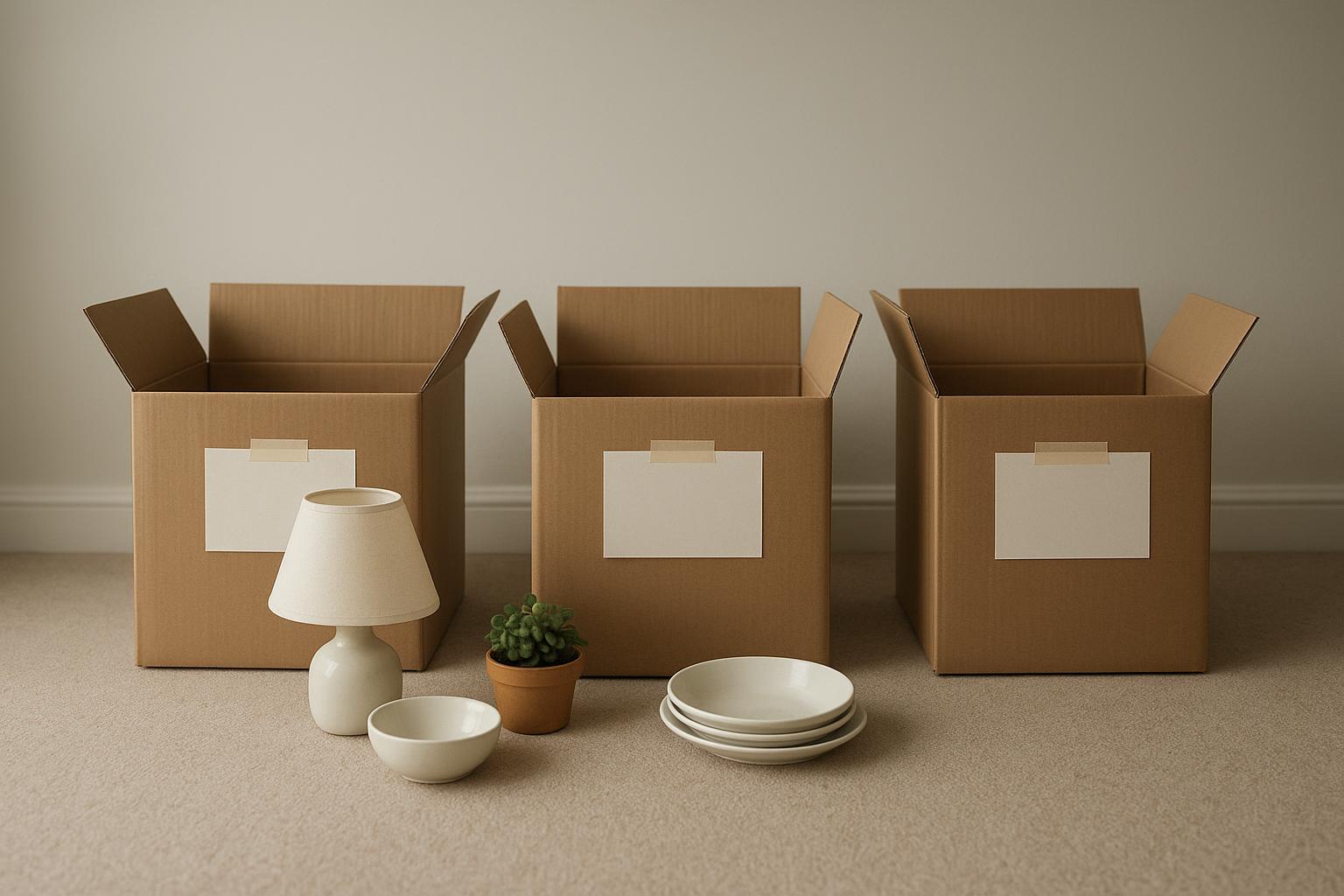
You will need three sturdy containers, a marker pen, tape or labels, rubbish bags, a dust sheet if you are working on a floor, and somewhere to put the boxes when they are full. Write the label on at least two sides of each container so you can see it from any angle. Add a fourth container for items that belong to other rooms, so you do not walk off every five minutes to put things away.
Choose a work area and clear a small space to start. A single drawer, a shelf or the top of a wardrobe is better than trying to do a whole room at once. Put on music or a podcast if that helps, but avoid anything that will distract you from deciding. Keep water nearby, wear comfortable clothes and gloves for dusty items, and take a short break every hour.
Plan where the finished boxes will go. Keepers will go back into a storage place, donation boxes should go by the front door or into the car, and rubbish should go straight into bags and outside. If you leave full boxes in the room they will quickly become new clutter. The house clearance checklist and room-by-room clearance plan help you decide the order of rooms.
The rules for fast decisions
Pick a few simple questions and stick with them.
Speed comes from having a short set of rules and applying them in the same order each time. These questions work for most households:
- Have I used it in the last year? Seasonal items such as a Christmas tree or a winter coat are exceptions, so think in terms of a full cycle of use.
- Do I love it or does it have a real purpose? Useful or loved items stay. Items that are neither usually go.
- Is it in good enough condition to be useful to someone else? Clean, working and complete items can be donated. Broken, stained or incomplete items usually cannot.
- Do I have more than I need? Four spatulas or ten identical mugs are common examples. Keep the best and let the rest go.
- Would I buy it again today? If the answer is no, it is probably a candidate for the donate or trash box.
- Does it belong to someone else? Items that are borrowed or that belong to family members go into a separate return box, not into your keep box.
Give yourself about ten seconds per item for easy decisions. If you cannot decide in that time, it goes into the maybe box described below, not into a long debate. Be consistent: if you decided that you did not need one set of old cables, apply the same logic to the next.
The trash box: what really belongs there
Rubbish is not the same as recyclable or hazardous.
The trash box is for items that are broken, worn out, unsafe or of no use to anyone. In practice, this includes damaged goods, stained items, expired products, dried-up pens and old packaging. It is the easiest of the boxes to fill and the one that grows fastest, so keep a bin bag close by and empty it often.
Before something goes in, quickly check whether it belongs elsewhere. Paper and cardboard can be recycled, glass and metal go in their own streams, and electricals, batteries, paint and chemicals should not go into ordinary rubbish at all. Many are covered by special rules, as explained in the guides to electrical waste and household chemicals.
Documents with personal details such as bank statements, medical letters and old passports should be shredded or kept, not dropped into a rubbish bag whole. If you are clearing someone else's belongings, keep anything that looks like paperwork in a separate box and check it before throwing anything away, as the guide on hidden family valuables and documents explains.
The donate box: what charities and others will take
Good intentions work best when the item is truly usable.
The donate box is for items that are clean, in good condition and likely to be useful to someone else. Clothes, books, kitchenware, small furniture, toys and tools are the usual candidates. Charity shops and other organisations have their own rules about what they will accept, and many cannot take certain items, such as upholstered furniture without the correct fire safety labels, electrical goods that cannot be tested, or damaged items.
Check before you drop off, and consider selling items of value, whether online or at a car boot sale, as explained in the guide on organising a garage sale or car boot sale. If you have large furniture, the guide to London charities that collect large furniture lists what to ask. Do not donate items just to avoid throwing them away, because charities have to pay to dispose of unusable donations.
Keep the donate box dry and tidy, and take it out of the house quickly. A donation box that stays in the hallway for a month becomes part of the clutter, and the items inside deteriorate. Set a date for the drop-off, put it in your diary, and treat it as part of the job.
The keep box: be honest about what stays
Keeping everything defeats the purpose.
The keep box is for items that you use, love or genuinely need. It is also where problems can start, because a keep box that grows too large simply moves the clutter from the floor into a box. A useful safeguard is to set a limit before you begin, such as one box or one shelf per category, and to ask whether each item is worth a place within that limit.
Keepers should have a home. If you cannot say where an item will live afterwards, it is a sign you may not need it. Put items back where you will actually use them, and group similar things together so you can see what you have. Avoid putting keepers into storage boxes that will never be opened, since this is how hidden clutter builds up again.
If you are clearing a relative's home, the keep box may include items for other family members. Agree in advance who gets what and how disputes will be settled, as covered in the guide to dividing family belongings without disputes. Take photographs of items that you are not able to keep but want to remember, which allows you to let go of the physical object.
The maybe box: a safety valve with a deadline
Use it sparingly and give it an expiry date.
Many people add a fourth box for items they cannot decide on. This can be very effective, because it lets you keep moving rather than getting stuck on one item. The danger is that the maybe box becomes a dumping ground that is never reviewed.
To avoid that, limit it to a single box, write the date on the outside, and set a review date, for example four to six weeks ahead. When the date arrives, open the box and look at each item. If you have not needed or missed anything in it during that time, it can go to donate or trash without further thought. Some people tape the box shut, write the date and leave it unopened, and donate it if they have not needed anything.
Be strict about what goes in. Maybe is for items with some uncertainty, not for items that you feel guilty about. If something is obviously unnecessary, put it straight in the right box. If you are using the maybe box for more than around one item in ten, you may need to take a break or ask someone to help with decisions.
Sentimental items and difficult rooms
Some objects need more time, and that is fine.
Not every item can be sorted in ten seconds. Photographs, letters, children's artwork, a loved one's clothes and anything that belonged to someone who has died take longer, and rushing them can cause distress and regret. It is reasonable to set these aside in a dedicated box and come back to them when you are calm and have time, rather than forcing a decision.
If you are dealing with a bereavement, it can help to start with less emotional rooms such as the kitchen cupboards, garage or bathroom, and leave the bedroom and personal papers until later. The guides on coping with clearing a deceased parent's home and supporting someone with anxiety about discarding offer more help with the emotional side.
If you are helping someone else, let them make the decisions and avoid pressuring them. The three-box method can work for people who find sorting difficult, but if they are distressed, a long-term pattern of keeping everything may need more than a sorting system. Support from a GP or a specialist organisation is more appropriate than a decluttering technique in those cases.
What happens after the boxes are full
Finishing the job is where most people stall.
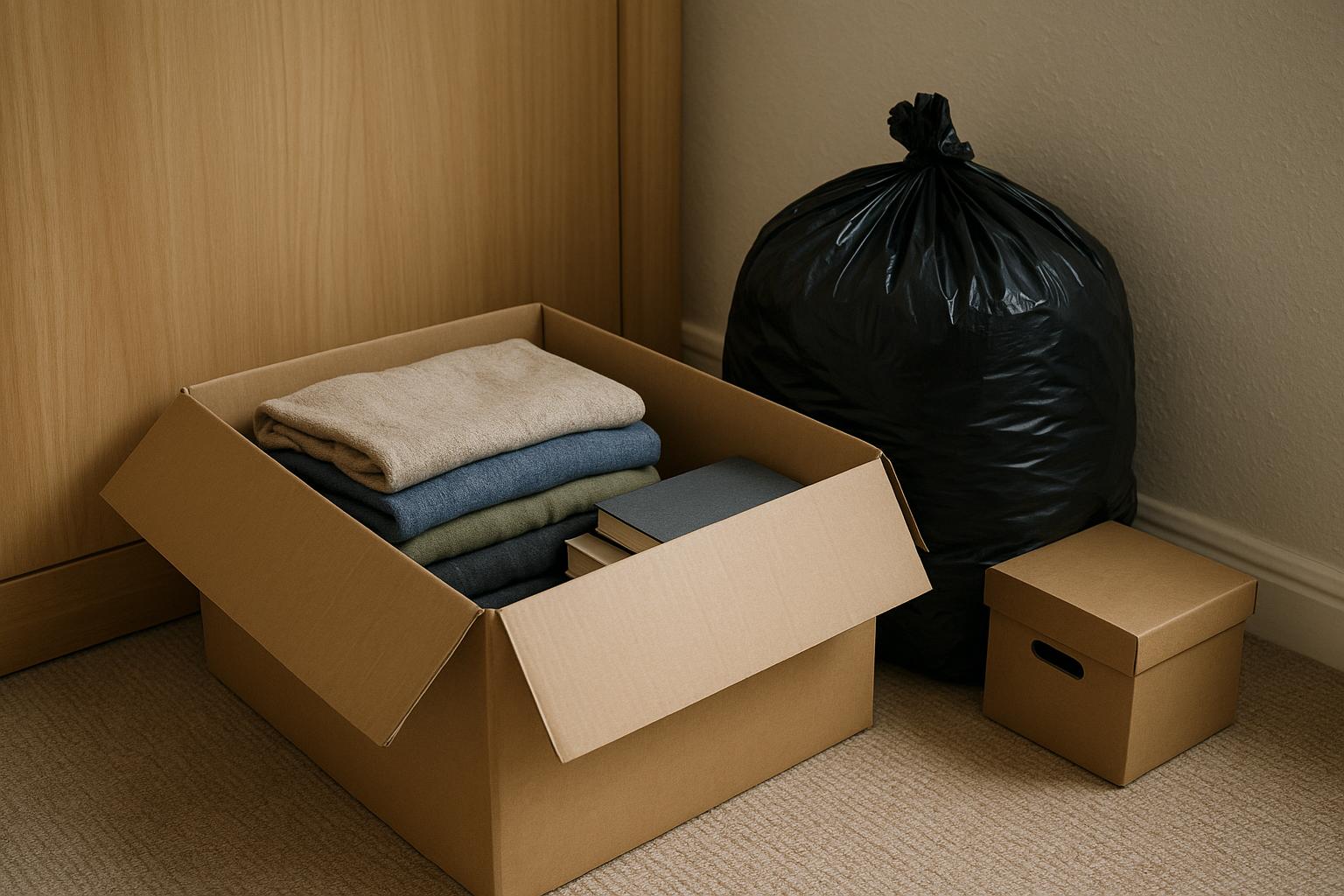
Sorting is only half the task. The boxes need to go somewhere. Keepers should be put away straight after you finish each area. Donations should leave the house within days. Rubbish should go into bags or a collection as soon as possible, and recycling should be taken to the right place.
For small amounts, this is easy to do yourself with a trip to a charity shop and a household waste and recycling centre. For large volumes or bulky items, a carrier may be more practical, and you can request quotes through houseclearance.co, which connects you with independent carriers. Tell the carrier clearly what is rubbish and what is not, and keep keepers and donations physically separate so that nothing is taken by mistake.
Take photos of each room when you finish. Seeing the before and after is satisfying and helps you decide what to tackle next. Keep a note of where things went, especially for valuable items, in case you need to find them later for insurance, probate or family reasons.
Common mistakes with the three-box method
Easy to avoid once you know them.
The most common problems are predictable. Trying to sort an entire room in a single go leads to exhaustion, so work in small zones. Using boxes that are too small or too large causes either constant emptying or boxes too heavy to lift. Not labelling boxes means items get mixed up. Leaving the boxes in the room means the clutter just changes shape.
Other mistakes are about judgement. Treating donations as a dumping ground for broken items wastes charity resources. Allowing the maybe box to grow forever defeats the purpose. Throwing items away without checking for documents, cash, jewellery or keepsakes can cause serious regret. And skipping breaks makes the later decisions much worse than the early ones.
If something goes wrong, do not abandon the whole project. Return to the rules, reduce the size of your task and carry on. A short, repeated routine, such as thirty minutes a day, often works better than a long weekend that leaves you worn out.
A simple three-box plan you can follow
From start to finish in a few steps.
Here is a straightforward plan you can use for any room:
- Pick one small area, such as a single shelf, drawer or wardrobe.
- Set out the keep, donate and trash containers, plus a maybe box and a bag for items that belong elsewhere.
- Set a timer for thirty to forty-five minutes, and take everything out of the area.
- Make quick decisions using your rules and put each item straight into a box.
- When the timer ends, put keepers away, tie the rubbish bag and close the donate box.
- Take donations and rubbish out of the house the same day, or book a date to do so.
- Write a review date on the maybe box and put it away.
- Move to the next area, and repeat.
This takes patience, but the routine is easy to follow and works for a single drawer or an entire house. For very large jobs, a clearance carrier can take away what is left once you have sorted.
Frequently asked questions
Common questions about the three-box method.
What is the three-box method?
It is a decluttering approach where you sort every item into one of three labelled boxes: keep, donate or sell, and trash or recycle. It makes decisions faster because each item has only three possible destinations.
Should I use a fourth box for items I cannot decide about?
Many people do. A maybe box helps you keep going, as long as you limit it to one box, put a date on it and review it after a few weeks. Items you have not needed by then can usually go.
How long should I spend on each item?
Aim for a few seconds for easy decisions and not much more than ten seconds in general. If an item needs more thought, put it in the maybe box or a separate sentimental box and move on.
What can I put in the donate box?
Clean, working and complete items such as clothes, books, kitchenware and small furniture. Charities have rules about what they accept, so check first. Items that are damaged or unsafe belong in the trash or recycling box.
How do I handle sentimental items?
Set them aside in a separate box and deal with them when you have time and feel calm. Taking a photograph can help you let go of the object while keeping the memory. Do not force decisions about items that belonged to someone who has died.
Can the three-box method help with a house clearance after a bereavement?
It can help with some rooms and items, but there may also be legal paperwork, valuables and emotionally difficult belongings. Go slowly, check documents before disposing of anything and consider getting support from family or a professional.
What should I do with the full boxes?
Put keepers away immediately, take donations out of the house within a few days and dispose of rubbish and recycling properly. Boxes left in the room become new clutter.
Is the three-box method suitable for hoarding?
It can be a starting point for some people, but hoarding is a recognised mental health condition and a sorting method alone may not be enough. A GP or specialist support service is the right first step. See the hoarding guides on this site for more information.
Will houseclearance.co sort my belongings for me?
houseclearance.co is a quote-matching service that connects you with independent carriers. What a carrier will do, including whether they sort items, depends on the carrier and the quote, so ask when you request quotes.