
Direct answer
A room-by-room clearance plan for an extremely cluttered property works best in a fixed order: assess safety and access first, create one clear route to the front door, set up sorting zones and waste streams outside the work area, then clear one room at a time from the top of the house down, finishing with a check for papers, valuables and hazardous items. Pick a starting room that is least emotionally loaded and easiest to finish, such as a bathroom, hallway or spare room, so that progress is visible early. Stop and get specialist help if you find sharps, bodily waste, pests, damp-related mould, damaged electrics or anything that looks like asbestos. Where the clutter is linked to hoarding disorder, the person's consent and pace matter as much as the logistics. Carriers you find through houseclearance.co can quote for the physical removal once you can describe the volume and access honestly.
Contents
- What counts as extreme clutter, and what this plan is for
- Five principles that apply before you touch anything
- Step 1: Walk the property and make a written assessment
- Step 2: Make the property safe to work in
- Step 3: Create one clear route first
- Step 4: Set up sorting zones and waste streams
- Step 5: Choose the order of rooms
- Step 6: The method inside each room
- Step 7: Pace, volume and how long it can take
- Step 8: Handling waste legally in England
- Step 9: Plan removals in batches, not at the end
- Step 10: Briefing carriers so quotes are realistic
- Where houseclearance.co fits in this plan
- After the clearance: checks and next steps
- Frequently asked questions
What counts as extreme clutter, and what this plan is for
This plan covers the logistics, not the diagnosis.
"Extreme clutter" is not a legal term. In practice it describes a property where belongings have built up to the point that rooms cannot be used for their purpose, floor space is lost, doors only open part way, and moving through the home means climbing over or squeezing past things. It may be a deceased estate left untouched for decades, a home where someone has found it impossible to discard things, a tenancy abandoned with a full contents behind, or simply a family house where several generations of stuff have accumulated.
This guide gives you a repeatable room-by-room method for that kind of volume. It is deliberately about sequence, safety and logistics. If you are supporting someone who is still living in the property, read our step-by-step guide to a house clearance for someone with hoarding disorder first, because it covers the conversation and consent side that a logistics plan cannot replace. If you are unsure whether the situation is collecting or something more serious, our guide on collecting versus compulsive hoarding explains how clinicians and councils see the difference.
The plan assumes the property is cluttered but not contaminated. If you see signs of biological hazards, stop and use our guide to biohazard clearance and extreme squalor instead. General information only: this is not health and safety, legal or medical advice, and a competent contractor's own site assessment always takes priority over a general guide.
Five principles that apply before you touch anything
Rules that keep a big job safe and finishable.
1. Safety before speed. Extreme clutter hides trip hazards, unstable stacks, blocked exits, sharp objects and sometimes damaged wiring. Do not work alone, and keep a phone charged.
2. One room, one finish. The most common reason big clearances stall is that several rooms are half emptied at once. Complete a room to the stage you defined (cleared, swept, checked) before opening the next, so you always have somewhere to put things and a visible result.
3. Decide the rules once. Agree categories, thresholds and who has the final say before sorting starts.
4. Separate sorting from removal. Sorting is slow and emotional, removal is physical and fast. Keep them apart in time and space: sort into defined zones, and only then move out whole categories in bulk.
5. Protect what matters first. Documents, medication, cash, jewellery, keys and sentimental items are the things people regret losing. Build a way to find them early, using the checks described below, rather than hoping to spot them at the end.
Step 1: Walk the property and make a written assessment
Half an hour of looking saves days of improvising.
Before any bag is filled, walk every room and the outside areas with a notebook or phone. Do not move anything yet. Record the following for each room: how deep the clutter is (ankle, knee, waist, head height or floor to ceiling), whether you can open the door fully, whether there is a clear path to the window, whether furniture is buried, and what the main categories appear to be (paper, clothing, kitchenware, electricals, furniture, boxes, garden items, food packaging).
Photograph each room from the doorway. The photographs let you compare before and after, help carriers understand volume, and give executors a record in a deceased estate.
Note the access picture too. Is the property a house or a flat, which floor, is there a lift, how far is parking from the door, and are there restrictions on the street such as permit zones, red routes or narrow access? Our guide to flat clearance covers upper-floor flats, and our house clearance checklist is a useful template for the information carriers will ask for.
Finally, list the immediate red flags: strong smells, signs of pests, damp or mould, exposed or damaged electrics, a gas smell, blocked stairs, broken glass, sharps, medicines in loose piles, and anything that looks like old asbestos-containing material such as damaged ceiling coatings or old insulation boards. Any of these changes the plan. A gas smell means leaving and calling the National Gas Emergency Service on 0800 111 999. Suspected asbestos should be left undisturbed and checked by someone competent before it is disturbed; the Health and Safety Executive publishes guidance on asbestos in homes.
Step 2: Make the property safe to work in
Equipment, routes and basic precautions.
You do not need specialist kit for an ordinary heavily cluttered home, but you do need sensible basics. Sturdy gloves, closed shoes with a good sole, long sleeves and a dust mask suited to the dust you will meet are a minimum. A head torch helps where lighting has failed.
Check that there is a working smoke alarm, or fit a battery one, before you spend hours inside. Heavily cluttered homes can pose a serious fire risk because fuel is everywhere and exits may be blocked, and the fire and rescue service in London and elsewhere in England offers home fire safety advice to households that are concerned.
Think about the lifting. Boxes of books, paper and tools are far heavier than they look, and extreme clutter often means working in awkward, cramped positions. Lift with your legs, do not twist while carrying, and leave the heavy furniture for carriers or a team of people. The HSE manual handling guidance gives general principles. Take breaks and stop when tired.
If the electrics look damaged, if sockets are scorched, or if extension leads are daisy-chained under piles, do not plug in power tools or heaters. Have a registered electrician look at it before anything more is attempted.
Step 3: Create one clear route first
The most useful thing you can do on day one.
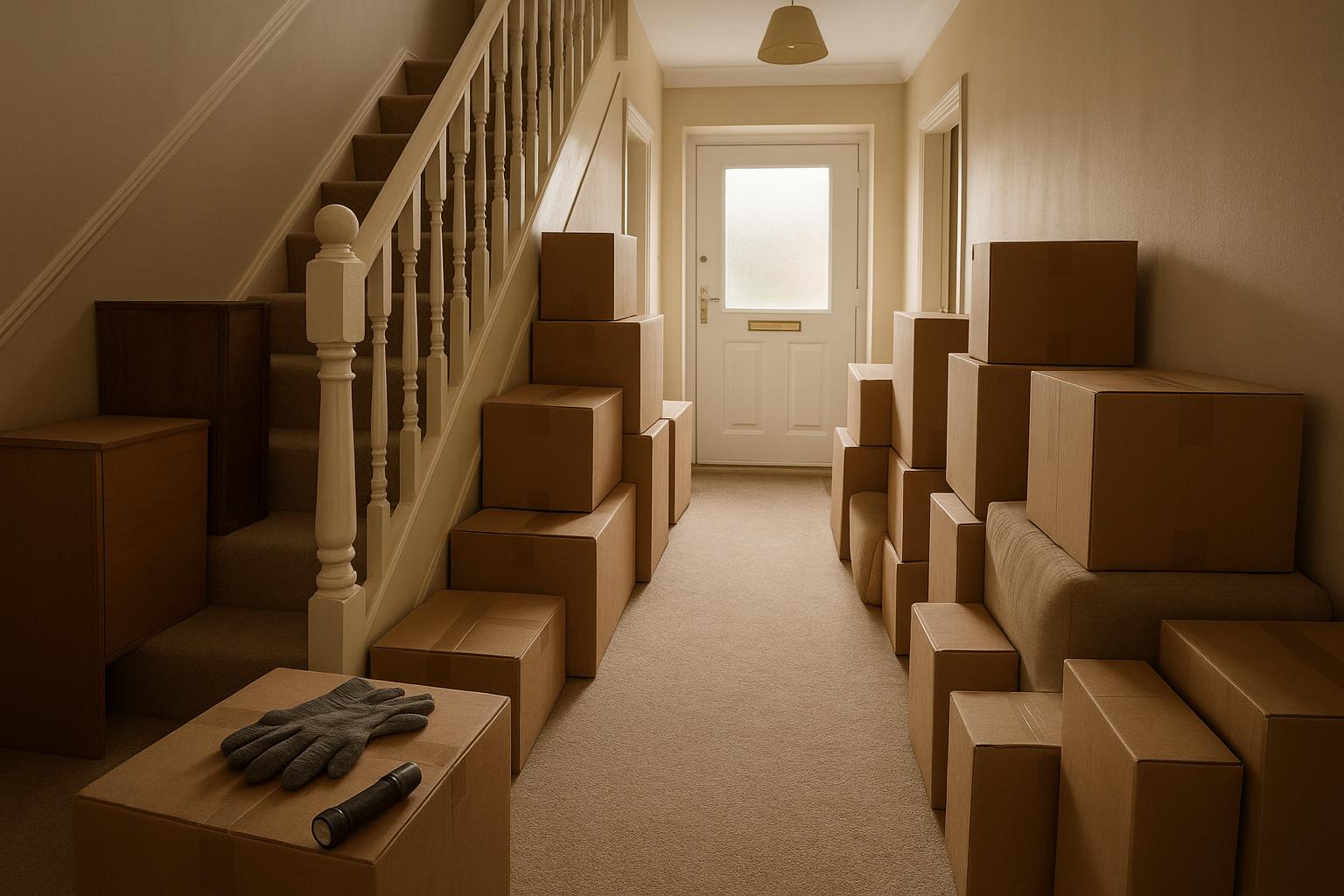
Before you tackle any room, carve one safe, wide enough route from the front door to the first room you will clear, and from that room to the stairs if there are any. Aim for a path that two people can pass along, and that a person carrying a bag or box can use without turning sideways.
The route has three jobs. It gives you a way out if something goes wrong, it lets you move items out without dragging them over other piles, and it gives the home an immediate sense of order that helps everyone's morale. Items cleared to make the route go straight into the sorting zones you will set up in step 4. Do not simply push them into the next room, because that only moves the problem and may block the next stage.
Never block the route with bags awaiting collection.
Step 4: Set up sorting zones and waste streams
The system that makes every later decision faster.
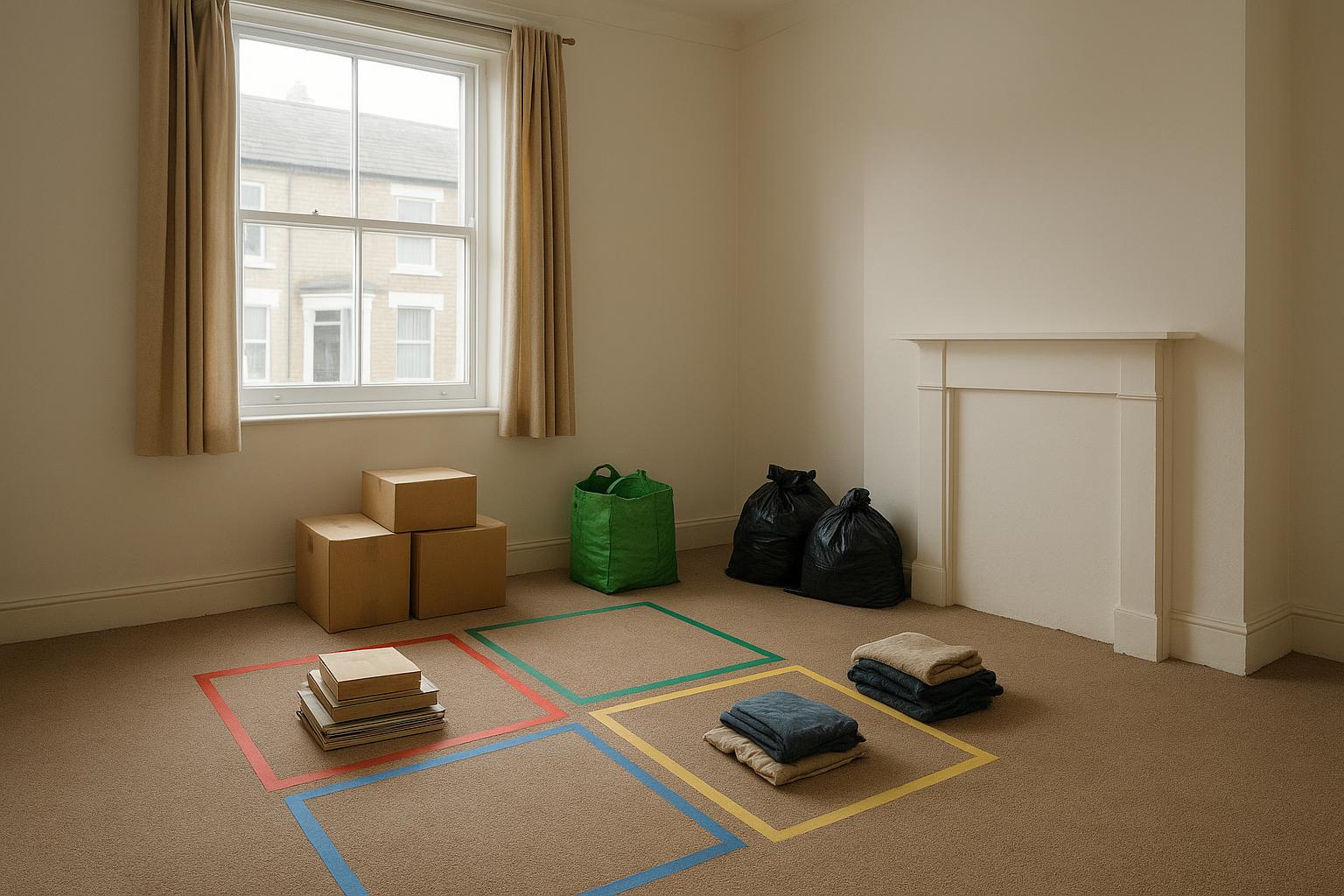
Choose a spot outside the work area for sorting. Ideally this is a cleared room, a garage, a driveway or a garden, and it should be dry and secure. Inside the work area there should only be what you are actively handling. Mark four to six zones with tape or large labelled boxes. A workable set is:
- Keep: items the owner or family wants. Decide in advance where these will physically go, such as a storage unit, a relative's home or a cleared bedroom.
- Documents and valuables: a single locked or closed container for paperwork, cash, jewellery, keys, passports and anything that might be valuable. Everything uncertain goes here rather than in the bin.
- Donate or sell: clean, working items another household could use. Our guide to furniture donation in London explains what charities typically accept.
- Recycle: paper, cardboard, metal, glass, clean textiles, and electricals that can go through proper recycling routes.
- General waste: items with no reuse or recycling value.
- Special handling: chemicals, paint, batteries, gas bottles, fluorescent tubes, medicines, sharps and anything unidentified. These are never mixed into general waste.
The special handling zone matters legally as well as practically. Household waste has rules attached to it in England, and some items are classed as hazardous or need separate collection. Medicines are normally returned to a pharmacy, and electrical items fall under separate waste electrical rules. If you are unsure, keep the item aside and ask the council or a licensed carrier rather than guessing.
Step 5: Choose the order of rooms
Top down, easiest first, and never trap yourself.
There is no single correct order, but a few rules hold in most properties. Work from the top of the house down where there are several floors, so that items are carried down once and nothing falls onto work already done. Where stairs are blocked, clearing the stairs becomes part of step 3.
Start with a room that is easy to finish. A bathroom, a spare bedroom or a hallway usually carries less sentimental weight than a main bedroom or a kitchen where decades of cooking and family life have accumulated. A completed room gives you a staging area for later rooms.
Do the kitchen and bathroom early if there is a safety reason. Spoiled food, out-of-date cleaning products and failed appliances are best removed promptly, but only where there is no sign of biohazard.
Leave the highest-emotion rooms until you have a rhythm. In a deceased estate that may be the person's bedroom or study. For a living person it may be whichever room they use most. Do not leave it until the end by default, though. Where the owner is involved, work with them to decide, using the principles in our guide on supporting someone who is anxious about discarding items.
Step 6: The method inside each room
A repeatable pass, from the door to the far wall.
Use the same pass in every room, so the work becomes routine.
Pass 1, the obvious waste. Take out clearly rubbish items first: empty packaging, old newspapers and flyers, broken items, dead plants, empty bottles and boxes. Bag it, and move the bags straight to the waste zone. Do not leave bags inside the room, as they get opened and mixed back in.
Pass 2, large furniture and bulky items. Once surface clutter has gone, large items become accessible. Anything broken, infested with woodworm or damp, or surplus can go to the donate, recycle or waste zone. Items that are heavy, or that need two people, should be flagged for carriers. If you are not sure whether to use a skip, a man and van or a clearance carrier, our comparison of house clearance versus skip hire sets out the differences.
Pass 3, the layer-by-layer sort. Work from the top of a pile to the bottom, and from one wall around the room, so you do not lose your place. Handle each item once, put it into a zone and keep moving. Spend more time on categories where value or importance is likely: paperwork, photographs, jewellery, collections, tools and electronics.
Pass 4, check inside and under. Pockets of coats, books, handbags, boxes of "rubbish" and drawers can contain cash, letters, keys, cards, medication or small valuables. In a house that has been cluttered for years, it is common for important items to be inside ordinary-looking containers. Quickly leaf through books and shake out bags before they leave the room. A document check is especially important in probate cases, and our guide to finding hidden family valuables and documents explains where these tend to turn up.
Pass 5, floor, walls and finish. Once the room is clear, sweep, check skirting and corners for pests or damage, note any repairs needed, and photograph the finished room. Close the door or mark the room as complete so it does not become the new storage space.
Step 7: Pace, volume and how long it can take
Why honest expectations matter.
It is difficult to estimate how long an extremely cluttered property will take, because the answer depends on the depth of clutter, the number of people, the carry distance and how many decisions each item needs. A single heavily filled room can take several days of focused sorting by a small team, while a full house can take weeks if a family is doing the work in evenings and weekends. Professional carriers usually work faster but still need clear instructions on what to keep.
Set a daily limit. Four to six hours of sorting is a sensible maximum for most people, with proper breaks. Decide at the start of each session which room or part of a room you will finish, and stop when it is done.
Where the person who owns the contents is present, pace is not just a scheduling matter. Pressing someone to clear faster than they can manage often leads to refusal, distress and a worse outcome than going slowly. Our article on the hoarding clearance guide for families covers practical ways for relatives to help without taking over.
Step 8: Handling waste legally in England
Where it goes, and who is allowed to move it.
Clearing a property produces a lot of waste, and in England the person who produces it has a legal duty of care to make sure it is handled properly. In practice, that means you should not hand household or commercial waste to a person who is not registered to carry it, and you should keep a record of who took what. Fly-tipping is a criminal offence, and an unlicensed collector who dumps your waste can leave you answerable if the waste can be traced back to you.
If you use a carrier, ask for their waste carrier registration, which you can check on the Environment Agency's public register through GOV.UK at GOV.UK waste carrier registration, and keep the paperwork they give you afterwards. Our guides on how to choose a licensed house clearance company and on waste transfer notes explain what to ask for and why it matters.
If you take items to a household recycling centre yourself, check the local rules first. Many London boroughs and county councils limit van or trailer use, require proof of address, or restrict the amount of material per visit. Our guide to tip runs in London covers the practical points, though you should always check the council's own page. For a large clearance, repeated tip runs are often impractical, which is one reason people turn to a carrier or a skip.
Some items cannot go with ordinary waste. Asbestos-containing material, certain chemicals, gas cylinders, some paints and solvents, and fluorescent tubes need special routes. Keep them separate and ask the local council or a licensed hazardous-waste carrier how to dispose of them.
Step 9: Plan removals in batches, not at the end
How to avoid the pile that never leaves.
It is tempting to sort an entire house and arrange one big collection. In an extreme clutter property that rarely works. Bagged waste accumulates quickly and blocks the very routes you created.
A better approach is batch removal. Finish a room or a floor, then arrange collection of everything that has gone into the waste and donation zones. Whether that means weekly visits or one large collection depends on storage space, safety and access.
Keep the collection day simple. Tell the carrier clearly what is going and what is staying, mark the keep items so nobody removes them by mistake, make sure the route is clear, and have one person responsible on the day. Put valuables and documents away somewhere secure beforehand. Ask for the waste paperwork.
If the clearance sits within a probate, a landlord's recovery of a property or an end-of-tenancy situation, keep a note of dates, photographs and who authorised the removal. Our loft clearance and basement and cellar clearance pages are useful where the clutter extends into hard-to-reach areas.
Step 10: Briefing carriers so quotes are realistic
What to say when you request quotes.
Carriers can only price what they understand. Underdescribing a heavily cluttered property is the quickest way to get unrealistic quotes, extra visits and disputes on the day. Before you request quotes, prepare a short description covering:
- Which rooms are affected and how full they are (use your photographs and the depth scale from step 1).
- Whether the contents are mostly paper and soft items, or include heavy furniture, appliances, tools or building materials.
- The floor level, stairs, lift access and the distance from the door to where a vehicle can park.
- Whether anyone lives there, and whether they will be present.
- Any hazards you know about, such as sharps, pests, damp, mould or suspected asbestos.
- Whether sorting has already happened and what must be kept.
- Any parking, permit or access restrictions on the street.
Be willing to have a carrier visit or look at photographs and a video before quoting. Many carriers will reserve a final price until they have seen the property, and that is reasonable for extreme volumes. For more on how the cost drivers work, see our hoarding clearance cost guide, which explains the factors carriers consider without quoting prices.
Where houseclearance.co fits in this plan
A quote-matching marketplace, not a clearance company.
houseclearance.co is a marketplace. You describe the job, and independent, licensed local waste carriers may contact you with quotes. We do not carry out clearances ourselves, we do not promise that any carrier will take a particular job, and this page does not quote prices. The plan above is yours to run, whether by family, by a carrier or in combination. The marketplace helps you at steps 9 and 10, when you need physical removal and want comparable quotes.
Honest descriptions help the match. If the property involves extreme clutter, say so, and say whether you need help with sorting, with removal only or with both. Our hoarding clearance London service page explains the type of job carriers in this category handle, and the same principles apply when clutter is extreme for other reasons, such as a long-untouched estate.

After the clearance: checks and next steps
The job is not finished when the last bag leaves.
Walk the property again once everything has gone. Check that nothing you intended to keep has been taken, that the special handling zone has been dealt with and that documents and valuables are in safe hands. Look for repairs, such as damaged floors, damp patches, failed electrics or pest evidence, because those often appear once the contents are gone. Arrange a deep clean or any necessary repairs before the property is reoccupied, sold or relet.
Where a person lives in the property, the first weeks afterwards matter more than the clearance itself. Without support, clutter can return, and some people need ongoing help. In England, a GP, adult social care at the local council and charities such as Hoarding UK can offer further support. Where the situation has reached the point that the council is considering action, see our guide to council intervention in hoarded properties.
If the clearance was part of a probate or estate matter, keep the photographs, the waste paperwork and any invoices with the estate papers, so that the executor can explain what was done.
Ready to see your price?
When you are ready to move forward, describe the job and we will pass it to vetted, licensed local carriers, who may contact you with quotes.
Frequently asked questions
The questions that come up most often when planning an extreme clutter clearance.
How do I start clearing a house that is full to the ceiling?
Start with a written and photographic assessment, make the property safe, and create one clear route from the front door. Then set up sorting zones outside the work area and clear one easy room completely before moving on. Do not try to open every room at once.
Which room should I clear first?
Choose a room that is easy to finish and carries little emotional weight, such as a hallway, bathroom or spare bedroom. A completed room gives you a working space and visible progress. Save the most personal rooms until you have a rhythm, but do not avoid them indefinitely.
Can I clear an extremely cluttered property by myself?
Sometimes, but it is safer and faster with at least one other person. Heavy items, unstable piles, hidden hazards and the sheer volume make solo work risky. If there are sharps, bodily waste, pests, mould or suspected asbestos, stop and get specialist advice before continuing.
How long does an extreme clutter clearance take?
It varies widely with depth of clutter, number of people, access and how many decisions are needed. One heavily filled room can take several days for a small team, and a whole house weeks.
What should I do with documents, cash and valuables I find?
Put them straight into one secure container rather than any waste or donation zone. Check pockets, books, bags and boxes before they leave the room. In an estate, keep what you find together for the executor and note where each item was found.
How should household waste from a clearance be disposed of in England?
Use a registered waste carrier or take it to an authorised site such as a household recycling centre, following local rules. You have a duty of care to make sure waste is handled properly, so ask for the carrier's registration number and keep any paperwork.
What if the person who owns the belongings does not want things removed?
Do not clear against their wishes without legal authority. Take it slowly, agree small steps and involve their GP, adult social care or a support charity if needed.
Should I book removals at the end or in batches?
Batches are usually better. Collecting waste after each room or floor keeps your routes clear, reduces fire and trip risk and stops bags building up. Discuss the rhythm with carriers when you request quotes.
What should I tell carriers when I request quotes?
Describe which rooms are affected, how full they are, what types of item dominate, the floor level, stairs or lift, parking distance, any known hazards and whether anyone is living there. Photographs and a short video help carriers give realistic quotes.
Does houseclearance.co carry out the clearance?
No. houseclearance.co is a marketplace. You describe the job, and independent, licensed local carriers may contact you with quotes. We do not clear properties ourselves and we do not promise that a particular carrier will take any job.
