
Direct answer
The circular economy aims to keep products and materials in use for as long as possible instead of following the take, make, dispose model. In house clearance this means sorting items so that those with life left are reused, repaired or resold, materials are recycled, and only the unusable remainder is recovered or disposed of. Clearance firms can contribute by sorting at source, working with charities and reuse outlets, and keeping records. Householders can help by deciding early what to keep, sell or donate. The model has limits, such as hygiene rules, safety regulations and low demand for some items, so a claim of being fully circular should be treated with caution.
Contents
- What the circular economy means
- The three principles in plain terms
- How house clearance fits into the circle
- An example of a circular clearance
- Reuse, repair and resale
- Barriers to reuse
- Materials recovery: the outer loop
- Why quality of sorting matters
- What a clearance firm can realistically do
- The cost of doing it properly
- What you can do as a householder
- Records that prove the circle closed
- The limits of the circular model
- Where the industry may be heading
- How to judge a circular economy claim
- Five questions that test a circular claim
- Frequently asked questions
What the circular economy means
A different way to think about stuff.
A linear economy takes raw materials, makes products, uses them and throws them away. A circular economy tries to close the loop. It does this by designing products to last, repairing and reusing them, remanufacturing parts and recycling materials into new products. The aim is to cut the demand for new raw materials, reduce waste and lower the environmental impact of everyday goods.
The idea is closely linked to the waste hierarchy, which puts prevention and reuse ahead of recycling, recovery and disposal. Our guide to zero waste to landfill and recycling rates shows how the hierarchy works in a clearance.
In practical terms, a circular approach asks one question about every item in a property: can this continue to be useful, and if not, what is the best way to recover its materials?
The three principles in plain terms
Design out waste, keep things in use, restore nature.
The best-known framework for the circular economy rests on three ideas. First, design out waste and pollution, so that products are made to last, to be repaired and to be taken apart. Second, keep products and materials in use, through reuse, repair, remanufacture and recycling. Third, regenerate natural systems, for example by returning organic material to the soil.
A house clearance touches mainly the second principle. The items in a home were designed and made by others, so a clearance firm cannot change how they were built. What it can do is influence how long they stay useful once the owner has finished with them.
This is also why the circular economy is not only about recycling. Recycling is the last resort among the loops, because it breaks the product down into raw materials. Reuse and repair keep the product intact, and for most furniture and household goods that is by far the better outcome.
How house clearance fits into the circle
A clearance is a stock check of a whole household.
A house contains furniture, appliances, books, clothes, tools, ornaments, kitchenware and much more. At the end of a tenancy, a bereavement, a move or a downsizing, all of this is suddenly surplus. How that surplus is handled determines whether it re-enters use or becomes waste.
A conventional clearance puts most of it in a van and sends it to a transfer station. A circular clearance sorts at the start. Items in good condition are offered for reuse or resale, working appliances are tested or passed to a repair partner, metals and timber are separated for recycling and only the leftover goes for recovery.
This takes more time and planning, and it is not always possible. Some properties are in poor condition or the deadline is too short. But even a partial approach makes a difference, because the items with the most value are often the easiest to divert.
An example of a circular clearance
A hypothetical two-bedroom flat.
To make the idea concrete, consider a two-bedroom flat after the owner has moved to a care home. This is an illustration, not a measured case study, and the details are invented to show how the logic works.
- Week one: the family chooses keepsakes, photographs items for sale and arranges donations of clean clothes and books.
- Week two: an auction house takes a small group of antique items, a local reuse centre collects two good chairs and a table, and a repairer looks at a working washing machine.
- Clearance day: the crew separates metal frames and appliances, electricals for WEEE, cardboard, timber and the mattress, and loads residual waste last.
- Afterwards: the family receives a waste transfer note, a short summary of where items went and a list of the donations.
The family still spends money and time, but the share of the contents that re-enters use is far greater than in a single sweep. Not every property allows this level of planning, but even a few steps can change the outcome.
Reuse, repair and resale
The inner loops of the circle.
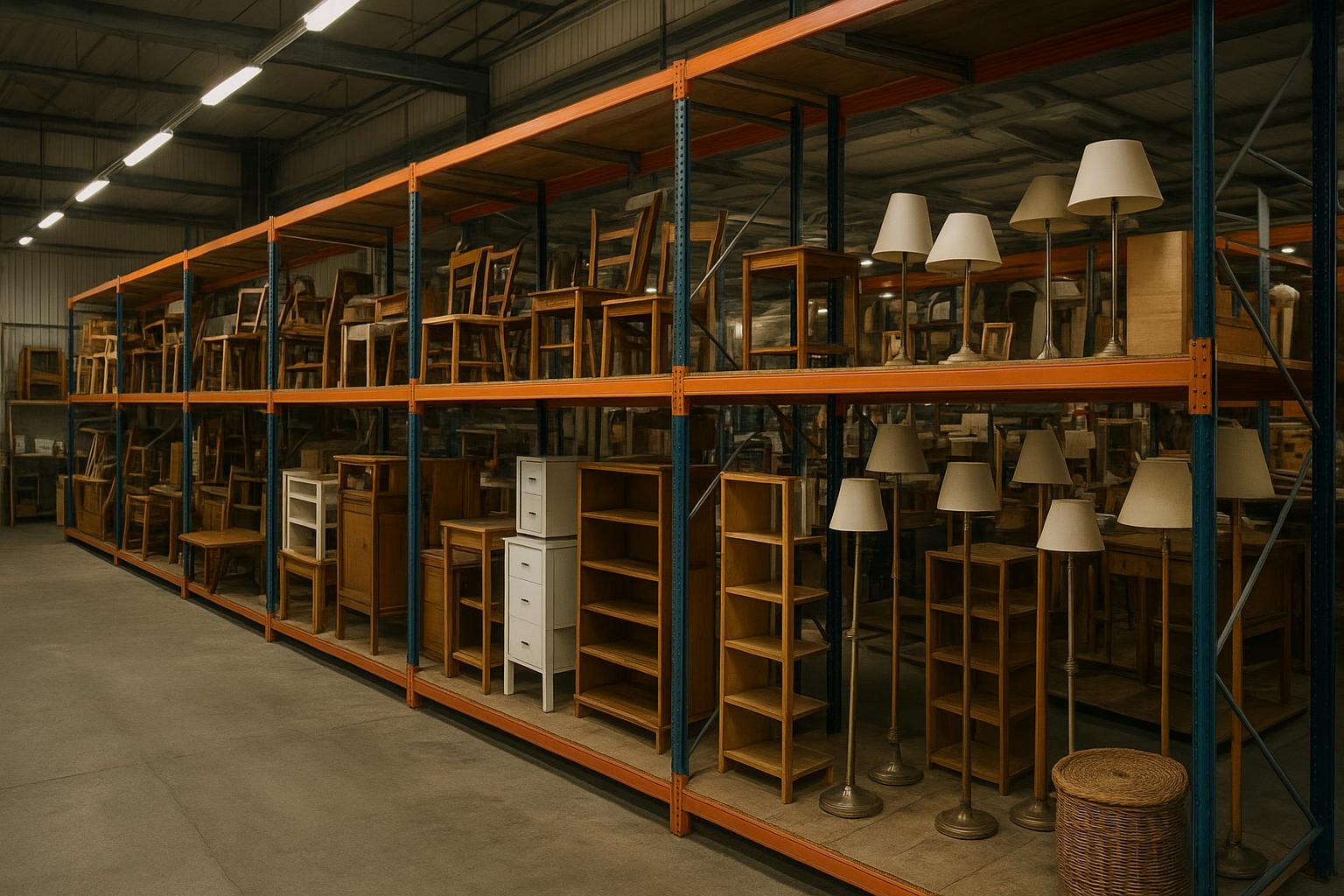
Reuse keeps an item in service in its current form. Repair extends its life. Resale puts it in the hands of someone who wants it. These are the inner loops of the circular economy because they require the least energy and material.
In a clearance, reuse routes include charities, community reuse centres, auctions, online marketplaces, antique dealers and local groups. Our guide to furniture donation in London and the article on upcycling old furniture cover two of these routes in detail.
Repair is more difficult at scale because it needs skills and time, but it can be worthwhile for solid wood furniture, good-quality appliances and tools. Partnerships with local repairers or workshops can turn a pile of tired items into stock that people want.

Barriers to reuse
Why good items still end up as waste.
Reuse sounds simple, but several barriers get in the way. Time is the first. A deadline for vacating a property may leave no room to list, photograph and collect items. Storage is the second, because charities and reuse centres cannot hold unlimited stock. Transport is the third, since large items need vehicles and helpers.
Value is another barrier. Many second-hand furniture items sell for little, which makes the cost of collecting and storing them hard to justify. Condition is a barrier too, because a piece with a small repair need is often rejected even though it could be fixed.
Some barriers can be reduced by planning, and others by partnerships. A clearance firm that has regular arrangements with reuse outlets can often move items faster than a householder acting alone. This is one reason why asking a firm about its partners is a useful question when you compare quotes.
Materials recovery: the outer loop
When an item cannot be reused.
When reuse is not possible, the next best option is to recover the materials. Steel and aluminium are routinely recycled. Timber can be reused as reclaimed wood, chipped for panel board or used for biomass fuel. Glass, paper and card can be recycled when they are clean. Textiles can be reused, recycled into other products or used as industrial wipes.
Electricals have their own route through the WEEE system, as explained in our WEEE guide. Mattresses are covered in our mattress recycling guide. For each material, the more careful the sorting at the start, the higher the quality of the recovered product.
Residual waste that cannot go anywhere else is typically sent for energy recovery, which keeps it out of landfill but does not close the material loop. This is explained in our guide to energy from waste.
Why quality of sorting matters
Clean streams fetch better outcomes.
The value of recovered material depends heavily on how clean it is. Metal that is free of plastic and foam can be sold at a better price. Timber that has not been painted with unknown coatings can be reused or chipped for higher-grade products. Cardboard that has stayed dry can be baled and sold, while wet cardboard may be rejected.
Mixed loads, on the other hand, usually go to a sorting plant where machines and workers separate what they can. Some of this is effective, but contamination lowers the quality and quantity of what is recovered. A crew that keeps materials apart from the start therefore has a direct effect on the outcome.
This is why the practical advice for customers is the same in every guide in this series: separate what you can, keep things dry and tell the carrier what you have. Good habits at the property are the cheapest way to improve recovery.
What a clearance firm can realistically do
Practical steps, not slogans.
A clearance company can make a real difference by changing how it works. The most important steps are listed below.
- Walk the property first: identify items with resale or donation value before the crew starts loading.
- Sort at source: separate metal, timber, electricals, textiles, cardboard and residual waste in the property or on the vehicle.
- Build partnerships: work with charities, reuse centres, repairers and recyclers who can take what the firm collects.
- Keep records: weigh loads, keep transfer notes and report outcomes honestly.
- Avoid unnecessary mixing: do not throw everything into one container if materials can be separated cheaply.
- Be honest about limits: explain what cannot be reused and why.
These steps take time, so price pressure is a real constraint. Customers who understand this are more likely to accept a slightly higher quote in exchange for better outcomes.

The cost of doing it properly
Circular clearance takes time.
Sorting at source requires more labour and more time on site. Separate containers or bays on the vehicle, extra trips to reuse outlets and transfer stations, and the administration needed to keep records all add cost. Firms that offer these services have to recover that cost somewhere, either from higher prices or from the value of reclaimed materials.
Scrap metal, good furniture and some electricals can offset part of the cost, but the market varies and cannot be relied upon. That is why some firms offer a reduced price when a customer provides well-sorted items, or when a property has a high share of valuable material.
For the customer, the sensible approach is to ask what is included and to accept that a very low quote probably means little sorting. See our guide to house clearance pricing by volume for how quotes are built.
What you can do as a householder
Decisions before the crew arrives.
The biggest influence on the outcome is how early and clearly the householder decides what to do. Sort valuables and sentimental items first. Photograph and list furniture and appliances in good condition. Offer them to friends, family, local groups and charities. Keep paperwork and personal data separate.
Set aside time to check for hidden items, such as documents and jewellery, which our guide to hidden family valuables and documents explains. Tell the carrier about items you have earmarked, and ask how they plan to sort the rest.
If you are acting as executor or on behalf of a relative, keep a record of decisions in writing. It helps with probate and avoids disputes. Our guide to dividing family belongings without disputes is a good place to start.
Records that prove the circle closed
Evidence matters for executors and landlords.
If you are acting for an estate or a client, you may be asked to show what happened to the contents. A simple record is enough. List the main items, note where each went, and keep receipts from charities, auction houses and the carrier. Photographs taken before and after the clearance support the record.
Waste transfer notes are the legal record for items that went as waste, and charity receipts or auction statements show items that were reused or sold. Together they form a complete picture, which can be useful for probate accounts, insurance claims or an end-of-tenancy dispute.
Keep the paperwork for at least two years. Our guide to the householder duty of care explains why that period matters.
The limits of the circular model
Honest caveats.
Not everything can be reused. Hygiene rules mean that used mattresses, pillows and some soft furnishings are rarely accepted. Safety rules mean charities may refuse electrical items without testing or upholstered furniture without a fire safety label. Older foam-filled upholstery may need special disposal, as explained in our guide to POPs in old sofas.
Demand is another limit. Brown furniture, large wardrobes and heavy sideboards are hard to sell because many people prefer lighter, flat-pack styles. Charities may have limited storage and cannot take everything. Some materials, such as mixed plastics and composite boards, have weak recycling markets.
Finally, the economics matter. Sorting takes time, and time costs money. If a clearance is priced very low, there is little scope for careful sorting. That is why we advise customers to ask how a firm handles reuse and recycling before accepting the cheapest quote.
Where the industry may be heading
Change is slow but real.
Several trends are pushing the clearance industry towards more circular practice. Landfill costs are high and rising, which makes sorting and recycling more attractive. Customers are asking more questions about what happens to their belongings. Councils and charities are expanding reuse networks, and online marketplaces have made it easier to sell unwanted items quickly.
Regulation is also moving, with wider producer responsibility for products such as packaging and electricals, and new rules on waste tracking in development. These changes will affect how firms record and report what they do with the waste they collect.
The result is likely to be a gradual shift rather than a sudden change. Firms that already sort carefully, keep records and work with local reuse partners will be well placed. Customers who ask the right questions encourage that shift and help to reward the firms that do it properly.
How to judge a circular economy claim
Look for evidence.
Many firms now use phrases such as circular, sustainable or eco-friendly. Some are justified, but others are marketing. Look for specifics. A firm that names its reuse partners, explains its sorting process and can show recycling records is more credible than one that offers a slogan.
Check that the firm is a registered waste carrier using our carrier licence check. Ask for a waste transfer note, as described in our guide to waste transfer notes. If the firm cannot explain what happens to your items, that is a sign that the claim may be shallow.
Be wary of promises that every item will be reused or recycled. As this article has explained, that is rarely possible. A realistic firm will tell you what share is likely to be reused, what share recycled and what share recovered.
Five questions that test a circular claim
Short, specific and fair.
When a firm tells you it is circular or sustainable, these questions will quickly show how much substance is behind the claim.
- Which charities, reuse centres or repairers do you work with, and can you name them?
- How do you sort at the property, and what containers or bays do you use?
- Do you weigh loads, and can you share a summary of what was reused, recycled and recovered?
- What happens to items that cannot be reused, and where does the residual waste go?
- Will you give me a waste transfer note and a list of any items passed on for reuse?
A firm that answers these questions confidently, with specific names and numbers, is probably doing real work. A firm that answers in generalities may be sincere but is not yet able to prove its claim.
Frequently asked questions
Common questions about the circular economy and house clearance.
What is the circular economy?
It is an approach that keeps products and materials in use for as long as possible through reuse, repair, remanufacture and recycling, instead of making, using and throwing away.
How does house clearance fit into it?
A clearance decides whether a household's surplus goes back into use or becomes waste. Sorting for reuse, resale and recycling before disposal keeps more material in circulation.
Can a clearance firm be fully circular?
Not realistically. Hygiene rules, safety standards, low demand for some items and weak recycling markets mean some waste always remains. Be cautious of claims of perfection.
What can I do to help?
Decide early what to keep, sell or donate, photograph items worth reusing, remove personal data and tell your carrier what you have earmarked.
Why do charities refuse some items?
Charities have limits on storage, hygiene and safety. They may refuse used mattresses, untested electricals or upholstered furniture without a fire safety label.
Does reuse matter more than recycling?
Reuse usually saves more resources than recycling because the item stays in its current form and needs no reprocessing. That is why it ranks higher in the waste hierarchy.
How can I check a firm's sustainability claim?
Ask for its waste carrier licence, its reuse and recycling partners, how it sorts waste and whether it can provide transfer notes or a summary of outcomes.
