Direct answer
Upcycling means turning an unwanted item into something more useful or attractive instead of throwing it away. Solid wood furniture, drawers, chairs, small tables and shelving units are the best candidates because their structure is usually sound even when the finish is tired. Check the frame, joints and surfaces first, work out the cost and time, and be honest about whether you will actually finish the project. Take care with old paint, which may contain lead, and with old foam upholstery. If a piece is damaged, damp, infested or simply not worth the effort, selling, donating or clearing it is the better choice.
Contents
- Why upcycle before you clear
- Is the piece worth saving?
- Basic tools and materials for a first project
- Simple upcycling ideas that work
- Room-by-room ideas
- Finishes, paint and safety
- A basic repaint, step by step
- What it costs in money and time
- Upcycling to sell: is it worth it?
- If you do not want to do it yourself
- Repair cafes, workshops and local help
- Upcycling and house clearance together
- Deciding what to keep when emotions run high
- When clearance is the better choice
- Safety checks before a reused piece goes back into use
- Frequently asked questions
Why upcycle before you clear
The greenest piece of furniture is the one you already own.
Upcycling keeps a useful item in service, avoids the energy and materials needed to make a replacement and often costs less than buying new. It also sits at the top of the waste hierarchy, above recycling and recovery, because the item is reused in something close to its present form.
There is a personal side too. Furniture that belonged to a parent or grandparent may carry memories, and giving it a new finish or purpose can be a way of keeping part of the family history in use. This is a common reason people start upcycling during a house clearance after a bereavement.
The decision does not have to be all or nothing. You can keep one or two pieces to restore, donate or sell others and clear the rest. Our guide to furniture donation in London covers the donation route, and the guide to what happens to items after a clearance shows where everything else goes.
Is the piece worth saving?
Five checks before you pick up a paintbrush.
Not everything is worth the effort. Use these checks to decide.
- Structure: does the piece stand square, with firm joints and no wobble? A loose joint can often be reglued, but a split frame is much harder to fix.
- Material: solid wood and good plywood take sanding, painting and staining well. Cheap chipboard and veneer on thin board often swells and crumbles if damaged.
- Condition: look for damp, mould, woodworm holes with fresh dust, and strong smells. Infested or mouldy furniture should not be brought into the house.
- Size and use: will it fit the room and serve a real need? A beautiful wardrobe you cannot get up the stairs is not a project.
- Value: check whether it is a valuable antique or designer piece before you alter it. Painting over a good original finish can reduce its worth.
If you suspect the piece is valuable, see our guide to discovering valuable antiques during a clearance. A short check with a specialist can save you from a costly mistake.
Basic tools and materials for a first project
You do not need much to begin.
A first upcycling project needs only a short list of supplies. Sandpaper in a few grades, a sanding block, a decent brush or small roller, a tack cloth to remove dust, wood filler for small dents, wood glue and clamps for loose joints, and a suitable primer and topcoat. For upholstery you will also need a staple gun, a staple remover, pliers and some upholstery fabric.
Buy the best paint you can afford, because cheap paint often needs extra coats and wears badly. Choose a primer designed for the surface, such as a bonding primer for shiny or laminated finishes. Water-based paints are easier to use indoors, dry faster and are usually kinder to the environment than solvent-based ones.
Start with something small and low-risk, such as a bedside table or a stool. Practise your technique on the back of a drawer or an underside. Once you have the hang of it, you can tackle bigger pieces with more confidence.
Simple upcycling ideas that work
Start with easy projects.
You do not need a workshop for most of these ideas. Many can be done with sandpaper, paint, new handles and an afternoon.
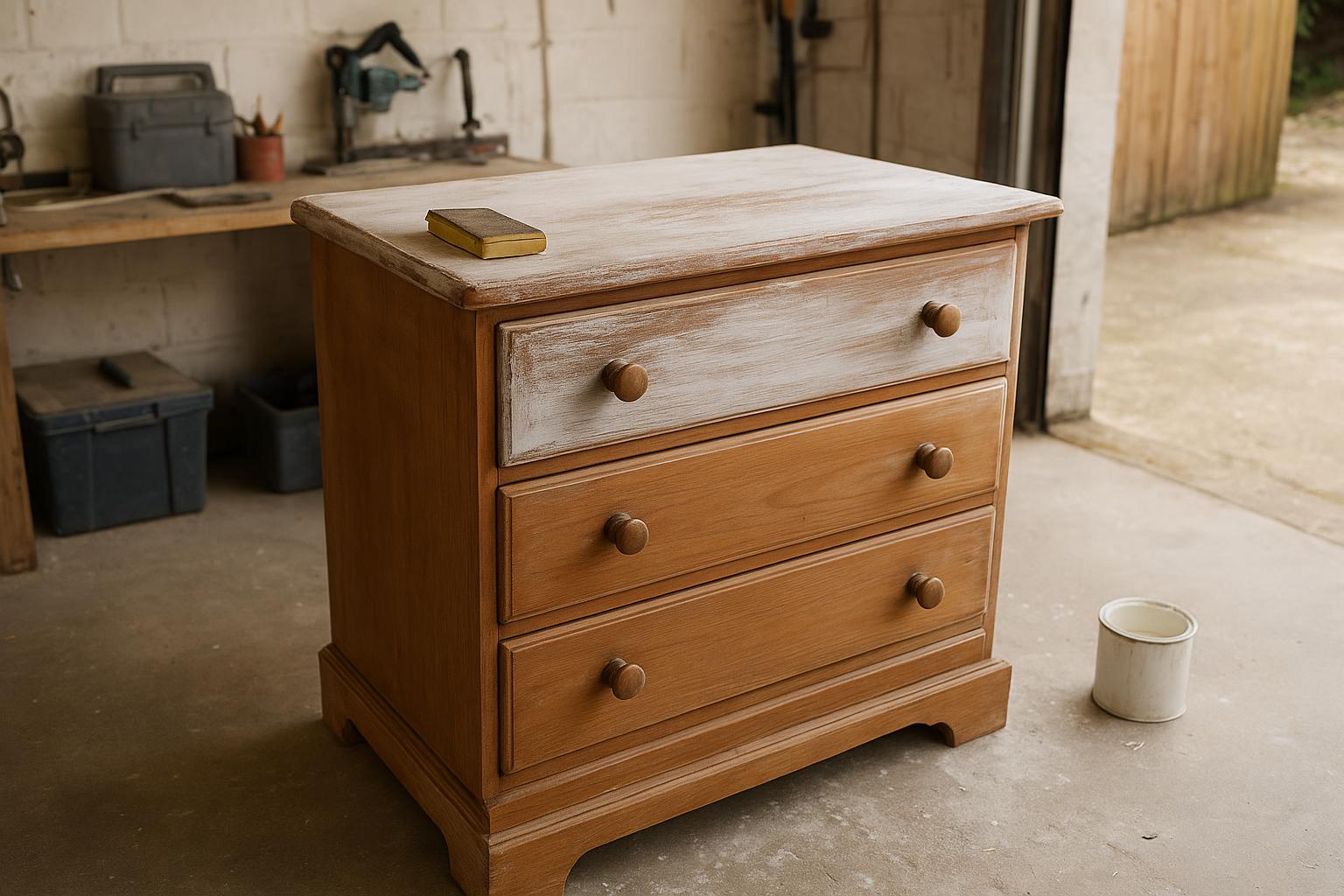
- Repaint a chest of drawers: sand, prime and paint in a colour that suits your room, then fit new knobs or handles for a fresh look.
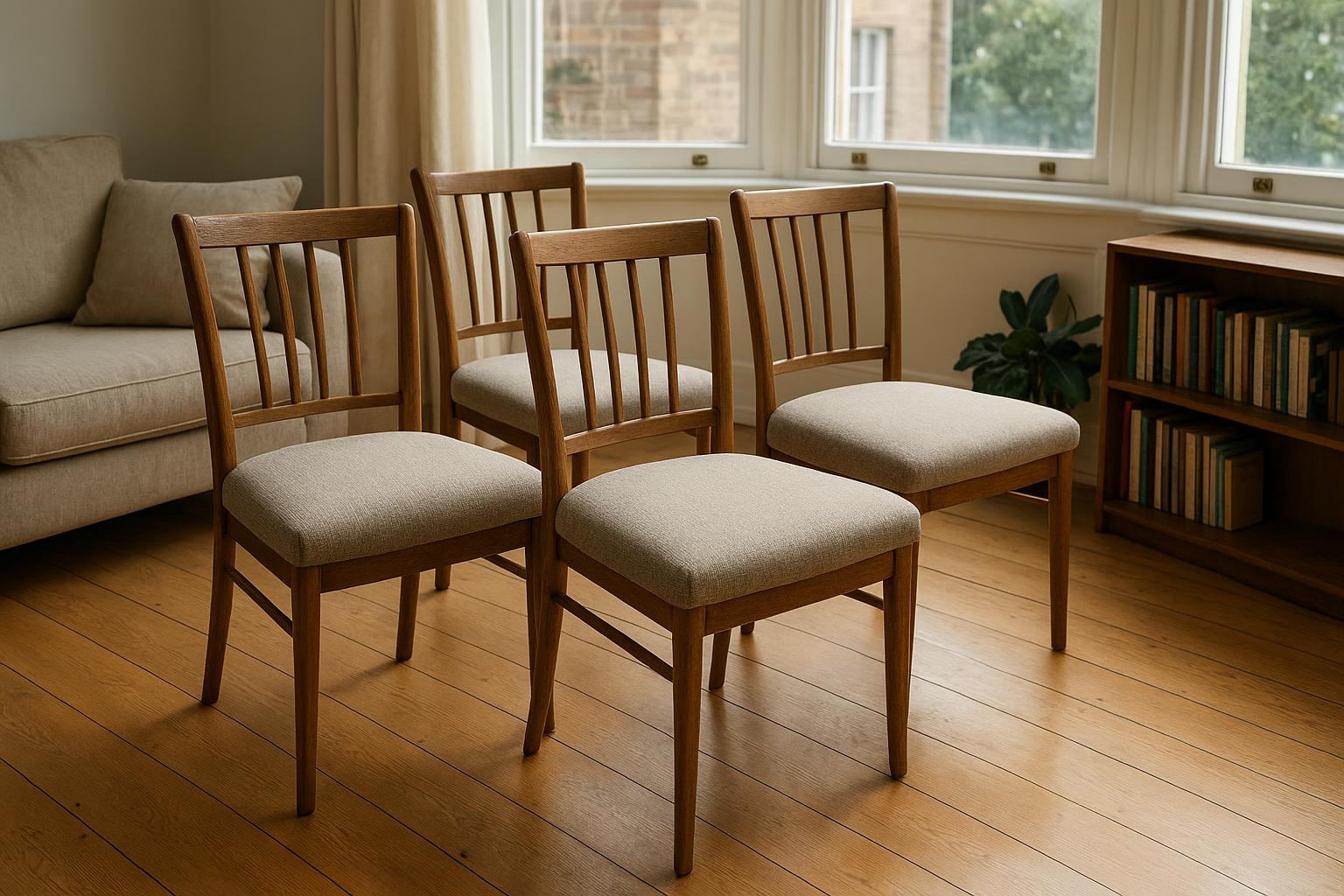
- Reupholster dining chairs: removable seat pads can be recovered with new fabric using a staple gun, often without removing the chair frame.
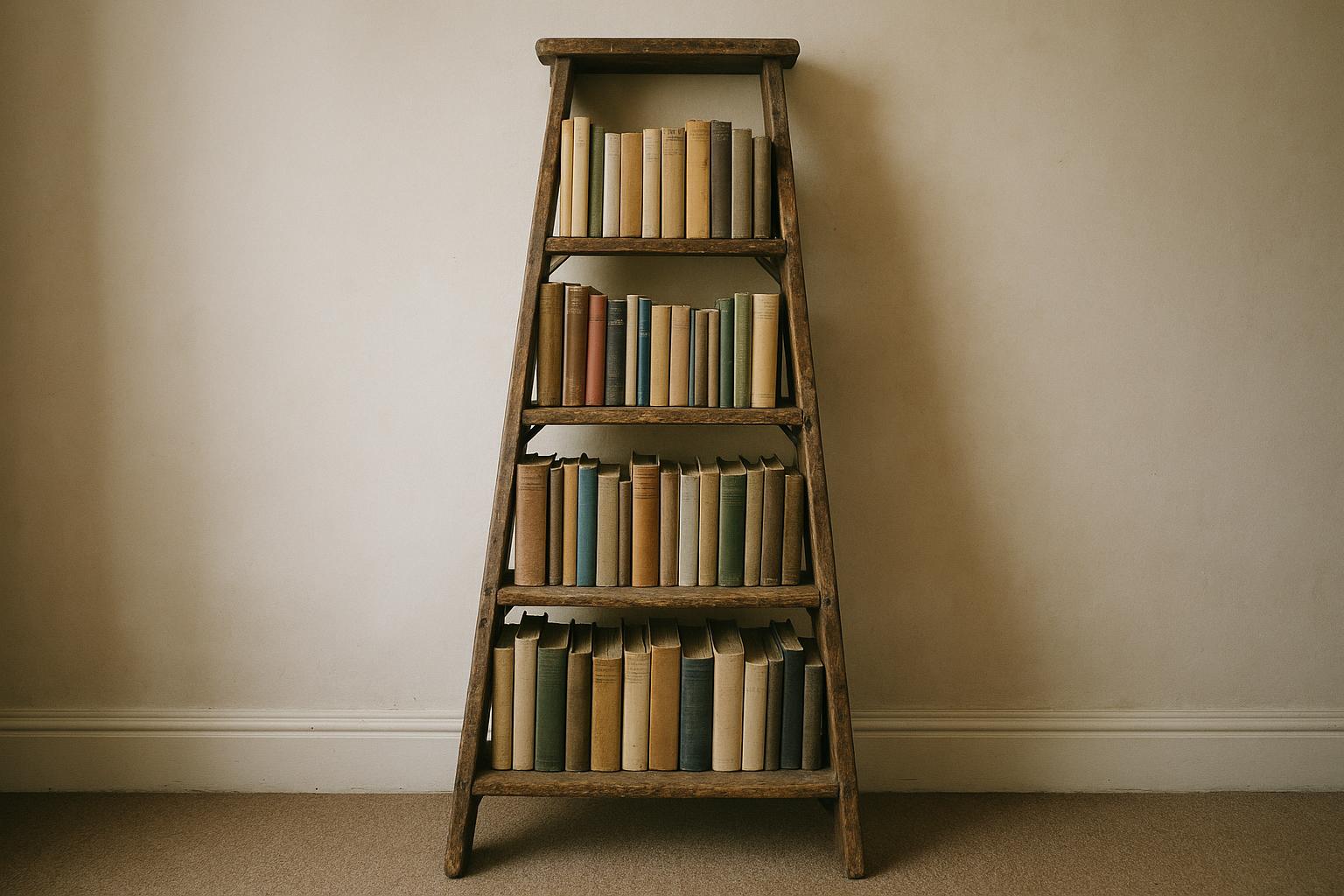
- Turn a ladder or old table into shelving: a wooden ladder leaned against a wall can hold books and plants.
- Convert a cabinet into a vanity or bar: a sturdy sideboard can hold a basin or drinks with simple plumbing or storage changes.
- Cut down a dining table into a coffee table: a solid table with sound legs can be shortened with a saw, provided you cut carefully and keep the legs even.
- Use drawers as wall boxes: pull out old drawers, sand and paint them and fix them to a wall as shelves.
Room-by-room ideas
Match the project to the need.
Think about what you actually need in each room, and look for a piece you already have that could do the job with a small change.
- Hallway: an old bench or a small cabinet can become shoe storage with a new coat of paint and a cushion.
- Kitchen: a sturdy table can be turned into an island, and old crates or drawers can become open shelving.
- Bedroom: a chest of drawers can be painted to match new bedding, and an old headboard can be cut into a bench.
- Garden: a wooden pallet or old drawers lined with plastic can become planters, as long as the wood has not been treated with harmful chemicals.
- Child's room: a solid desk or wardrobe can be repainted with low-fume, child-safe paint, with careful checks that nothing small or sharp is left loose.
A good test of any idea is whether you can picture the finished item in daily use. If you can only imagine it as a nice photograph, it may end up unused.
Finishes, paint and safety
Check before you sand.
Furniture made before the late 1970s may be coated in paint that contains lead. Sanding or scraping lead paint creates dust that is harmful, particularly to children and pregnant women. If you suspect old paint contains lead, buy a test kit, avoid dry sanding, and consider asking a specialist or choosing a method that does not create dust, such as chemical stripping used with care.
Wear a proper dust mask rated for fine particles, eye protection and gloves. Work in a ventilated space, ideally outdoors or in a garage with the door open. Choose water-based paints and finishes where possible because they have fewer fumes and are easier to clean up. Our guide to disposing of paint, varnish and household chemicals explains what to do with leftovers.
Old upholstered furniture is another special case. Foam in older sofas and chairs may contain flame retardants, as explained in our guide to POPs in old sofas. Reupholstering such a piece creates waste that needs correct disposal, so check before you start.
A basic repaint, step by step
The process for a chest of drawers.
Work in a dry, ventilated space and cover the floor. Remove the handles and drawers. Clean the surface with a mild degreaser to remove grease and wax, then rinse and let it dry fully. Sand lightly to give the surface a key, wipe away dust, fill any holes or dents with filler and sand again when dry.
Apply a coat of primer and let it dry according to the instructions. Sand very lightly, wipe clean and then apply two thin coats of paint with the recommended drying time between each. Thin coats look better than one thick coat and are less likely to drip or peel. Leave the piece to cure for several days before heavy use, since paint can feel dry well before it has hardened.
Finally, fit new handles or clean the old ones, and add felt pads under the feet to protect floors. If you used solvent-based products, store leftovers safely and dispose of them properly, as explained in our guide to household chemicals.
What it costs in money and time
A realistic budget.
Upcycling can be cheap, but it is rarely free. A simple repaint might cost the price of sandpaper, primer, paint and handles, which is modest for a small piece. Reupholstery costs more because of the fabric, foam, staples and tools. Professional restoration costs more still, and it may be more than the value of a mass-produced item.
Time is the bigger factor. Sanding, priming, painting and curing a chest of drawers can take several days, because each coat must dry. If you are clearing a property to a deadline, such as the end of a tenancy or the sale of a house, you may not have time to complete the work. In that case, store the piece, sell it as it is or let it go.
Be honest about your skills and available space. If you have never reupholstered before, start with a small stool or a chair seat rather than a full sofa. Many local colleges and community workshops run short courses at modest cost.
Upcycling to sell: is it worth it?
A realistic view of margins.
Some people upcycle furniture to sell. It can work, particularly with solid wood pieces that are in demand, but profit margins are usually modest once you count materials, time, transport and listing fees. Treat it as a hobby that may pay for itself rather than a guaranteed income.
If you do plan to sell, keep records of what you spent, take before and after photographs and describe the work honestly. Buyers value transparency about the paint, finish and any repairs. If you sell regularly or make significant income, check the current HMRC guidance on trading income, because the rules on when casual selling becomes a trade are set out on GOV.UK.
For a single piece from a family home, the simplest route is often to sell it as it is to someone who enjoys the project, and spend your time on the rest of the clearance.
If you do not want to do it yourself
Pass the project on.
Some people do not want a project. A piece that needs work can still be sold, given away or donated. Upcyclers often look for tired solid-wood furniture and will pay or collect for free. Community groups, furniture reuse charities and online marketplaces can all connect you with someone who wants it.
Be honest about condition in any listing, and take clear photographs from several angles. Describe any damage and measurements so that the buyer can decide before collecting. Never put your home address in a public listing, and consider meeting at a safe location for small items.
Charities may not accept items without a fire safety label or if the upholstery is damaged, as covered in our guide to furniture donation. If a charity cannot take it, ask whether they can suggest another organisation, or consider listing it for free.
Repair cafes, workshops and local help
You do not have to do it alone.
Many London boroughs have repair cafes, community workshops or maker spaces where volunteers help people mend furniture and household items. These are a good place to learn new skills, borrow tools and get advice on whether a piece is worth saving.
Some furniture reuse charities also run upcycling workshops and sell restored items. Community groups on social media often share tips and offer free materials such as paint and fabric remnants. If you do not have outdoor space, ask whether a local workshop has room for a larger project.
Professional restorers and upholsterers are another option for pieces with real value or sentimental meaning. Ask for a written quote before you start, and compare it with the cost of a good replacement. If the price is more than the item is worth, it may be better to sell it as it is.
Upcycling and house clearance together
Plan the order of work.
If you are clearing a house, decide what you plan to keep before the crew arrives. Mark the items to keep with a bright sticker or tape and move them to a separate room or storage unit. This avoids the risk of the crew taking a piece you wanted, and it makes the clearance faster.
Take photographs of items you have decided to sell, donate or upcycle. If you are not sure what to do with a piece, give yourself a short deadline, such as one week, to decide. After that, let it go. Indecision is the biggest reason furniture ends up stored in a garage for years.
Tell the carrier which items are already earmarked. A good carrier will respect that, and will also point out pieces that look worth saving or selling. Our guide to pricing by volume shows how removing items from the clearance can lower your quote.
Deciding what to keep when emotions run high
A simple method for hard decisions.
When you are clearing the home of a relative, it can be difficult to separate sentiment from practicality. A simple method is to sort items into four groups: keep, sell, donate and let go. Keep only the pieces you would be happy to use or display in your own home. Take photographs of sentimental items you cannot keep so that you have a record.
Our guides on coping emotionally when clearing a parent's home and dividing family belongings without disputes explain how to make these decisions as a family. Agree the rules before you start, so that no one feels that decisions were made behind their back.
Setting a limit, such as one piece per person or one room's worth of furniture, can also help. It forces you to choose the pieces that matter most, and it prevents the project from spreading into a garage full of half-finished work.
When clearance is the better choice
Not every piece deserves a project.
Some pieces should simply go. Furniture that is damp, mouldy or infested is a risk to other items and to your health. Pieces with broken frames, split boards or serious structural damage may cost more to fix than to replace. Cheap flat-pack furniture that has been moved several times often cannot be taken apart and rebuilt, and foam-filled upholstery in poor condition is rarely worth saving.
If you are short of time, space or energy, it is reasonable to let a piece go. Using a licensed carrier and recycling what can be recycled is a good outcome. Check the licence on our carrier licence check page and keep the waste transfer note.
You are not failing the environment by clearing an item that cannot be reused. The important thing is to avoid fly-tipping and to use a route that treats the material properly.
Safety checks before a reused piece goes back into use
Especially for children's rooms and stairs.
Before you put an upcycled piece back into use, test it. Sit on chairs, press on shelves with a load and check that wardrobes and tall bookcases cannot tip. Tall furniture should be fixed to the wall with brackets, particularly in a home with children, because toppling furniture is a known cause of injury.
Check that no screws, staples or splinters are left sticking out, that drawers run smoothly and that paint has fully cured before items are used for storing clothes. Avoid using old cots or high chairs, which may not meet current safety standards. If you are in any doubt about whether a piece is safe, do not use it.
Frequently asked questions
Common questions about upcycling furniture before a house clearance.
What does upcycling mean?
Upcycling means turning an unwanted item into something more useful or attractive, instead of throwing it away. It is a form of reuse and sits high in the waste hierarchy.
Which furniture is best for upcycling?
Solid wood chests of drawers, tables, chairs, shelving and cabinets with sound frames are the best choices. Cheap chipboard furniture is harder to repair.
Is old paint dangerous to sand?
It can be. Paint on furniture made before the late 1970s may contain lead. Avoid dry sanding, use a test kit and take advice if you suspect lead.
Can I reupholster an old sofa myself?
It is possible but difficult, and older foam may need special disposal. Start with a small chair seat, and read our POPs guide before stripping old upholstery.
How do I know if a piece is a valuable antique?
Check for maker marks, hand-cut joints and an original finish, and ask a specialist. Do not repaint or sand something that might be valuable until you know.
What if I have no time to upcycle before the clearance?
Sell, donate or store the piece, or let it go with a licensed carrier. A short deadline for deciding stops items sitting unused for years.
Will a charity take unfinished furniture?
Some will, but many require items to be complete, clean and compliant with safety labels. Ask before you arrange a collection.