
Direct answer
In a house in multiple occupation or a student house, the tenants share the tenancy and the landlord usually has a duty to provide adequate bin storage, but when everyone moves out, leftover rubbish and furniture can quickly become a problem. Councils can issue notices and fixed penalties for waste left on the street, for overflowing or wrongly presented bins and for fly-tipping, and the person responsible may be the tenants, the landlord or whoever arranged the removal. The safest approach is to agree in writing who clears what, separate each person's belongings from communal items, book a proper collection and keep the paperwork. Rules differ by borough and tenancy, so check your council's website and your tenancy agreement.
Contents
- Why shared-house moves go wrong
- Why more people means more waste
- What counts as an HMO and a student house
- Licences and conditions
- What landlords and agents must provide
- Reporting problems to the landlord
- What tenants are responsible for
- Joint liability and the shared deposit
- What councils can fine for
- Notices you might receive
- Duty of care and who you hand rubbish to
- The friend with a van and the man on social media
- Separating personal, shared and landlord items
- A simple labelling system
- Food, cleaning products and hazardous items
- Pests and smells
- Furniture, mattresses and bulky items
- Reuse before disposal
- Making a group plan
- Roles for the group
- Timing the move-out
- The last day
- Handing back the house and protecting the deposit
- Tips for landlords and agents
- Common mistakes and a checklist
- If you receive a notice or a charge afterwards
- Frequently asked questions
Why shared-house moves go wrong
Everyone leaves, nobody owns the leftovers.
A shared house has a particular kind of end-of-term mess. Several people leave at different times, each takes what is theirs and each assumes someone else will sort the rest. The result is a hallway full of bags, a kitchen of half-used food and cleaning products, a broken chair, a mattress in the garden and a front step of boxes.
In most student and HMO moves, nobody means to cause a problem. The trouble is that responsibility is blurry. Housemates move to different cities, the landlord or agent is waiting for keys and the bins are already full from the last month. By the time anyone looks at the rubbish, the deadline has passed and the pile is on the pavement.
Councils see the same pattern every summer. Waste left outside a house is quickly noticed, and the question of who put it there is not always easy for the tenants to answer. A little planning at the start prevents most of the trouble.
Why more people means more waste
Scale changes the problem.
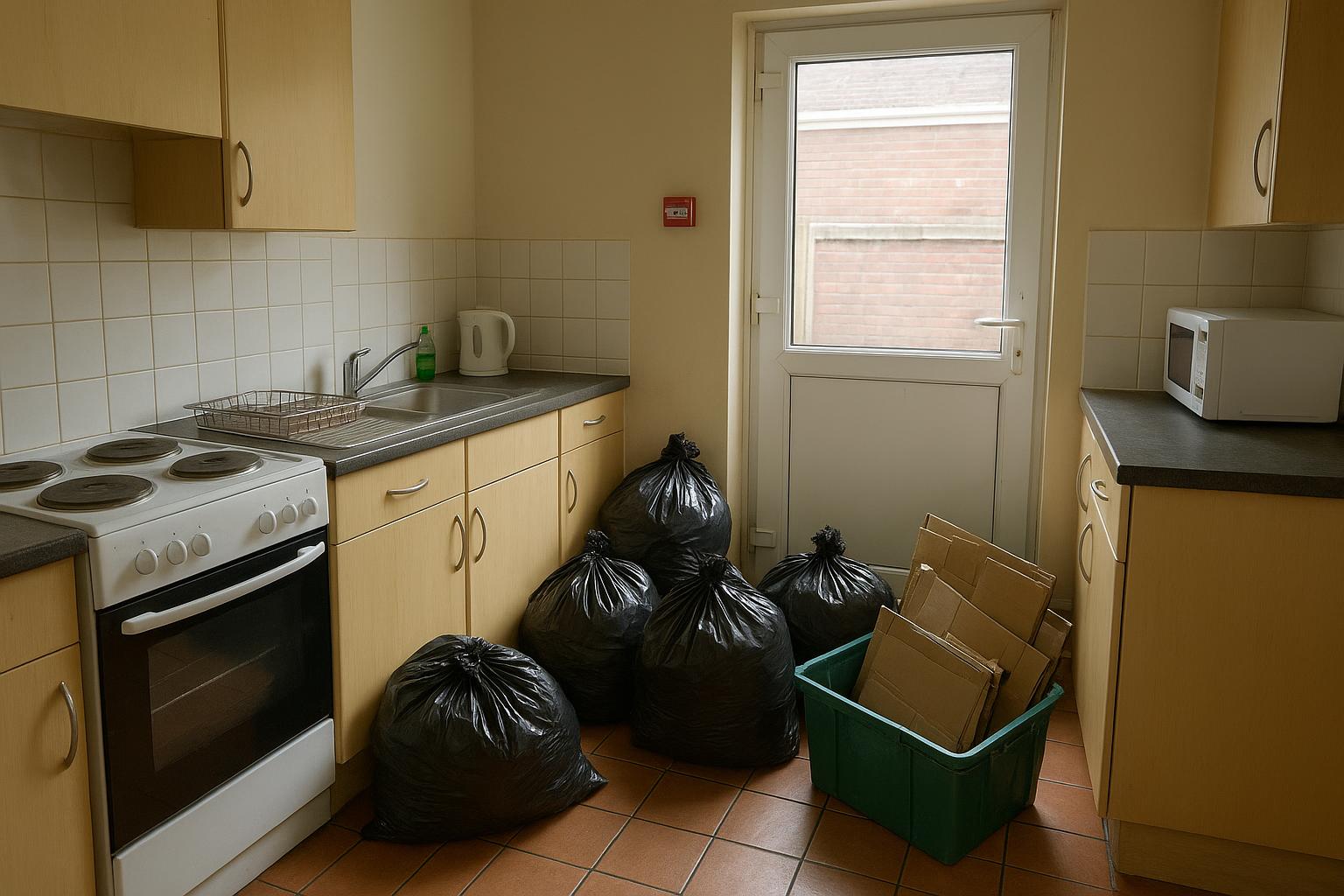
A house with five or six adults produces far more rubbish than a family home of the same size, and at the end of a tenancy it produces more still. There is a stream of cardboard from packing, bags of clothes, old bedding, kitchen items, broken furniture and the contents of a dozen cupboards.
The bin provision at many shared houses was designed for normal weekly use, not for a peak clear-out. Even a well-run household can overflow a standard set of wheelie bins in a day.
Planning for the peak is the key. It might mean booking an extra collection, asking the council about temporary extra capacity or using a carrier for the bulk of the clearance.
What counts as an HMO and a student house
A short definition, not legal advice.
A house in multiple occupation, usually called an HMO, is generally a property occupied by three or more people from more than one household who share facilities such as a kitchen or bathroom. Many student houses fall into this category. Larger HMOs, and HMOs in areas with additional or selective licensing schemes, need a licence from the council.
The rules differ by borough. Some London councils have extra licensing for smaller HMOs, and each licence can carry conditions about waste, including bin provision and arrangements for collection. The council's website sets out its own schemes.
Whether a property is an HMO affects who is responsible for what. It is the landlord who normally holds the licence and has duties to provide waste facilities, but the tenants still have duties about how they use and present the waste.
Licences and conditions
Check the paperwork.
If you are a landlord or agent, check whether your property needs a licence and what the conditions say about waste. Many licences require adequate bin capacity, a clear arrangement for presenting bins and a notice in the property explaining the system.
Tenants can ask to see the licence, or check whether the council keeps a public register. It is a good way to find out what the landlord has promised to provide.
If conditions are not met, the council can take action against the licence holder. That is a reason for landlords to take waste seriously, not only for tenants.
What landlords and agents must provide
Adequate bin storage and a workable system.
For HMOs, the management regulations expect the manager to provide enough bins or other suitable storage for the rubbish produced by the occupants and to arrange for it to be placed where the council collects it. That duty continues through the tenancy, and many licences include specific conditions on waste.
In practice that means the landlord should provide the right number of bins and recycling containers for the number of residents, and should explain the collection days and rules. A house with five tenants and one small bin is likely to have a problem.
If you are a tenant and the provision is inadequate, raise it with the landlord or agent in writing, and keep a record. The council's environmental health or private sector housing team can also advise. Check the current rules for your property type on GOV.UK and your council's site.
Reporting problems to the landlord
Do it in writing.
If the bins are broken, missing or too small, report it by email or through the agent's portal and keep a copy. Include photographs and the date. A written record makes it easier to show that you raised the problem and weren't to blame if the council sends a notice.
If nothing happens, you can contact the council's private sector housing or environmental health team. They can advise on what the landlord has to provide and may act if the property is licensed.
Do not refuse to pay rent as a reaction to a waste problem. There are formal routes for complaints about the condition of a rented property, and Shelter and Citizens Advice explain them.
What tenants are responsible for
Using the system properly.
Tenants are generally expected to use the bins provided, put rubbish out on the correct day, sort recycling as the council asks and keep the waste storage area tidy. In a joint tenancy, tenants can be jointly responsible for obligations under the agreement, which may include leaving the property clean and clear.
That joint responsibility can matter at the end. If one tenant leaves rubbish behind, the landlord may seek to deduct from the shared deposit, which affects everyone. For this reason it is worth sorting waste as a group, not individually.
Check what your tenancy agreement says about cleaning, rubbish and leaving the property. If it is unclear, ask the landlord or agent before you leave, and keep the answer in writing.
Joint liability and the shared deposit
One person's mess, everyone's cost.
In a joint tenancy, the deposit is normally held for all the tenants together, and a deduction for rubbish removal can come out of the shared total. It does not always matter who actually left the pile.
This is why a group plan is helpful. If one housemate has already left and gone abroad, the remaining tenants need to know in advance how to cover the cost and whether the departing tenant has agreed to pay.
If you are the one who is leaving first, clear your own items and leave a note in the group chat saying what you have done. It makes it much harder for anyone to blame you later.
What councils can fine for
Bins, side waste, bulky items and fly-tipping.
Councils have several tools. They can serve notices on householders about how waste is stored and presented, issue fixed penalty notices for some waste offences, and prosecute for more serious ones, such as fly-tipping. The exact powers, procedures and amounts depend on the legislation and the council's policy.
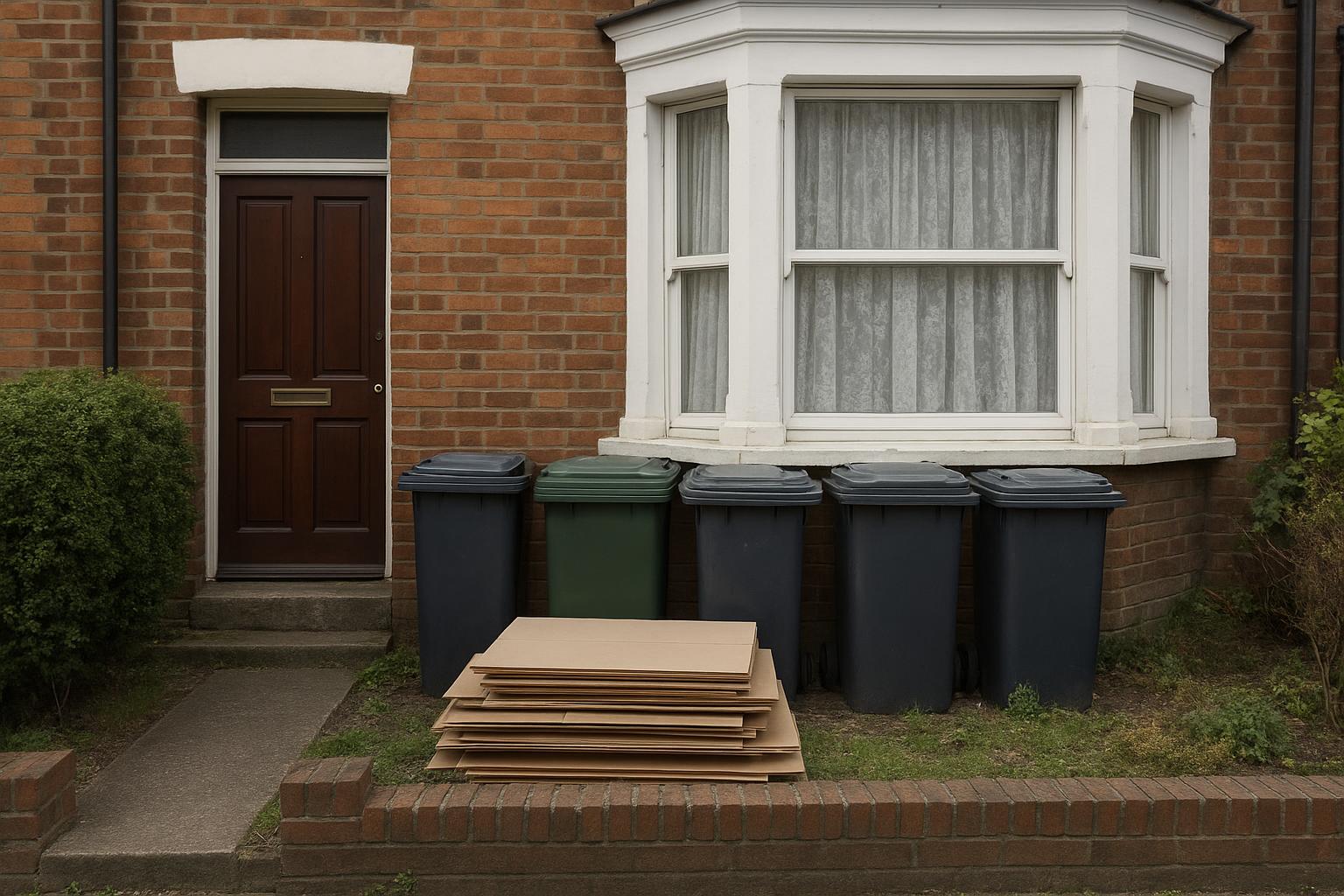
Common problems in shared houses include bins left on the pavement all week, overflowing bins, black bags left beside the bin, mixed recycling in the wrong container, and furniture left outside without a booked collection. Each can attract a notice or a penalty if it continues.
Fly-tipping is a different level of offence. Leaving waste on the street or giving it to someone who then dumps it can lead to a significant fine or prosecution. Our guide to fly-tipping penalties and liability explains what can happen and who may be held responsible.
Notices you might receive
Understand the process.
A council notice about waste is usually a written document that sets out what the council believes is wrong and what you must do by what date. It may be a warning, a notice about the way waste is stored or presented, or a fixed penalty notice.
Read it carefully, note the deadlines and take it to the landlord or agent if you think it is their responsibility. Ignoring a notice can lead to further action, so respond within the time given.
If you think a notice is wrong, the council usually has a process to challenge it. Ask for the evidence, such as photographs and the date, and seek advice from Citizens Advice or a solicitor if the amount is significant.
Duty of care and who you hand rubbish to
You must use someone who is authorised.
Anyone who produces household waste has a duty of care to take reasonable steps to make sure it is passed to an authorised person and disposed of properly. That covers the end-of-tenancy clear-out as well as the weekly bins. A friend with a van who dumps the load on a verge can leave you liable.
In a shared house, the duty applies to each person who produced the waste, and to the person who arranged the removal. Where nobody takes charge, everyone is exposed. Naming one person to arrange the collection, and agreeing it in writing, reduces the risk.
Our guide to householder waste duty of care explains the principle in plain terms, and our guide to waste transfer notes describes the paperwork a legitimate carrier should provide.
The friend with a van and the man on social media
A common trap.
At the end of term, offers of cheap removal appear on student groups and local pages. Some are genuine, some are not. If the person has no waste carrier registration and no paperwork, you cannot be sure where the waste will go.
If the load ends up dumped, investigators may trace it back to the house through items such as letters and parcels inside the bags. That can lead to questions for the tenants, even if they did not dump it themselves.
Our guide to the risks of hiring unlicensed operators explains the problem and what to ask for. You can also check whether a carrier is registered through the Environment Agency's public register.
Separating personal, shared and landlord items
The core task.
Start by dividing what is in the house into three groups: things that belong to one person, things that belong to the household and things that belong to the landlord. Landlord items, such as furnished-let beds, sofas and wardrobes, must stay unless the landlord agrees otherwise. Do not dispose of them, even if they are old.
Personal items are each person's responsibility. A shared list of who is taking what helps. Household items, such as a kettle, a microwave or a television bought together, need an agreement: one person keeps them, they are sold or donated, or they are thrown away.
Photograph the groups before anything is moved. If there is a disagreement later about who had what, a photograph and a message to the group chat is a simple record.
A simple labelling system
Cheap and surprisingly effective.
Use sticky notes or masking tape to label items. One colour for items that are going, another for those staying and a third for items that need a decision. It takes ten minutes and prevents a lot of argument.
Put the label on the item, not on a list, so that anyone who comes through the house can see it. For larger items, take a photograph with the label visible.
If something has no label by the final week, treat it as undecided and discuss it with the group rather than assuming that someone will take it.
Food, cleaning products and hazardous items
Handle with care.
Leftover food, cleaning products and toiletries are a common problem. Food should be eaten, shared, donated if unopened and suitable, or put in the food waste bin where the council provides one. Do not leave open food in bags outside, as it attracts pests and complaints.
Some items are hazardous. Aerosols, batteries, paint, gas canisters, bleach in large quantities and some electrical items should not go in the household bin. Take them to a household waste recycling centre or use the council's service. Our guide on disposing of household chemicals and our guide to recycling old electronics explain the options.
Sharps, medication and anything that could harm a collector need special handling. If you are not sure, ask the council before putting them out.
Pests and smells
Short-term, high impact.
Food left in bins, bags and cupboards at the end of a tenancy attracts pests and creates smells. Foxes, rats and flies are all drawn to rubbish left outside, and the council may treat this as a statutory nuisance if it continues.
Seal bags properly, keep lids closed and do not put out bags more than a day before collection. If your area uses sacks rather than bins, use the correct type and follow the council's rules for putting them out.
Clean the bins and the bin store after the last collection. A tidy bin area is the first thing a landlord or inspector will look at.
Furniture, mattresses and bulky items
Book a collection, do not leave it outside.
Mattresses, sofas, desks and wardrobes are the items most likely to be left on the pavement at the end of term. Do not leave them there. Many councils offer a bulky waste collection, usually for a fee and often needing a booking days ahead. Our guide to council bulky waste versus private clearance compares the options.
Check whether any items are reusable. A sofa in good condition can sometimes be passed on through a local reuse group, and our guides to getting rid of a sofa for free and giving items away free online may help.
If you use a private carrier, ask for a quote, confirm the pick-up time and make sure they are authorised to carry waste. Be wary of anyone offering to take everything for a very low cash price and no paperwork.
Reuse before disposal
Often possible in a university town.
Many university areas have reuse schemes at the end of term, with collection points for items in good condition. Check with the students' union, the university, the local council and local reuse charities. Some run schemes specifically for departing students.
Items that are clean, working and safe have the best chance of being reused. Upholstered furniture usually needs a fire safety label, and our guide to furniture fire safety labels explains why.
Clothes, kitchenware and books are often welcomed, though shops have their own rules. See our guide to recycling old clothes and textiles for ideas.
Making a group plan
Agree it before the end.
A short group plan is the best tool. Pick a date a week before the move-out for a house meeting. List the rooms and the items, agree who takes what and who is responsible for each task, and name one person to liaise with the landlord and with any carrier.
Include costs. If a collection is needed, agree how the bill will be split and who will pay it first. Do not leave the charge to the last person in the house, who may have little time and no cash.
Put the agreement in a group message and ask everyone to confirm. It is not a legal contract but it records what each person said and is helpful if there is a dispute.
Roles for the group
Keep it fair.
Give each person a role that fits. One person talks to the landlord, another books the collection, another sorts the kitchen, another takes photographs, and another checks the meter and keys. Rotate the roles if you can so that nobody carries the burden.
A shared document or group chat is enough to track the tasks. Tick things off as they are done, so everyone can see progress and nobody has to chase.
If a housemate does not take part, remind them politely and set a deadline. If it becomes a problem, tell the landlord that you have made reasonable efforts to organise the clearance.
Timing the move-out
Staggered departures are the problem.
Students and young professionals often leave on different days. Agree what has to be done before the first person leaves and what can wait for the last. A kitchen should be cleared in stages, not on the last night.
Check bin collection days and plan the final bin put-out so that bins are emptied, not overflowing, and are then taken back in. A bin full on the last day, with nobody to put it out, is a classic source of a notice.
If the tenancy ends on a weekend, remember that council collections and recycling centres have set hours. Check opening times and bulky waste booking slots early. Our guide to student moving in London has more on timing and logistics.
The last day
What to leave for the end.
Leave the least risky tasks to the final day. That means the final sweep, the final photographs and the handover of keys. Do the heavy work earlier, so that if something goes wrong, there is still time.
Keep a couple of spare bin bags, cleaning cloths and a brush so that any last-minute mess can be dealt with. A tidy exit is often the difference between a full deposit and a dispute.
Make sure you know who has the keys and when they are being returned. Confirm it with the landlord or agent in writing.
Handing back the house and protecting the deposit
Leave evidence, not leftovers.
Before you hand back the keys, take dated photographs of every room, the garden and the bin area. Photograph the bins after they have been emptied and returned to their place. These help if the landlord claims for cleaning or rubbish removal.
In England, deposits for assured shorthold tenancies must be protected in an approved scheme, and deductions should reflect genuine loss, not general wear and tear. The schemes have free dispute resolution, and the rules can change, so check the current guidance.
If the landlord asks for a clearance charge, ask for the invoice and a description of what was removed. Our guide to end-of-tenancy clearance costs describes what such work can involve.
Tips for landlords and agents
Make it easy for tenants to do the right thing.
If you manage shared houses, a short move-out guide helps. Include bin days, what the council collects, where the recycling centre is and how to book a bulky collection. Provide extra capacity at the end of term where you can.
Offer a clear process for items that tenants leave, and a list of what happens to them. Tell tenants what you will charge for, how you will calculate it and when you will give them invoices.
Landlords and agents also have waste duties of their own. If you clear the property after a tenancy, use an authorised carrier and keep the paperwork. Our guide to invoices and records explains what to keep.
Common mistakes and a checklist
Short and practical.
The usual mistakes are leaving items outside, using unlicensed carriers, disposing of landlord items, leaving one tenant to deal with everything and assuming that the landlord will sort it. Each can lead to a charge or a notice.
Use this checklist as a group.
- Hold a house meeting a week before move-out and write down the plan.
- Separate personal, shared and landlord items, and photograph them.
- Eat, donate or bin food, and take hazardous items to a recycling centre.
- Book a council bulky collection or an authorised carrier for furniture.
- Name one person to deal with the landlord and any collector.
- Empty and return bins on the last collection day.
- Photograph every room and the bin area before handing back the keys.
If you receive a notice or a charge afterwards
Do not ignore it.
If a council notice or a landlord charge arrives after you have left, respond quickly. Contact the sender, ask for evidence and give your side with photographs and messages. Keep all replies.
If you think the charge is unfair, use the deposit scheme's dispute service, or Citizens Advice, for help. If the matter is a council notice, ask about the appeal process and the deadline.
Learn from it for the next tenancy. A short plan, a clear record and an authorised carrier prevent most of the problems, and cost far less than a dispute.
Frequently asked questions
Common questions about shared-house moves and waste.
Who is responsible for rubbish left in a student house?
It depends on the tenancy agreement and who caused it. In a joint tenancy, tenants can be jointly responsible, and the landlord may deduct costs from the deposit.
Can the council fine me for leaving furniture outside?
It may. Councils can issue notices and penalties for waste left on the street, and fly-tipping can lead to larger fines or prosecution. Book a collection instead.
Do landlords have to provide bins in an HMO?
Managers of HMOs are expected to provide adequate waste storage and arrange for it to be put out for collection. Check your licence conditions and council guidance.
Can I throw away furniture the landlord supplied?
No, not without agreement. Furnished-let items belong to the landlord, so ask first and record the answer.
How do I book a bulky waste collection?
Check your borough's website. Many councils take bookings online or by phone, charge a fee and need several days notice.
What about a friend with a van?
Be careful. You still have a duty of care for the waste, so make sure it goes to an authorised site, and consider keeping a record of where it went.
How should we split the cost of a collection?
Agree it in writing before the end of the tenancy, with one person arranging it and everyone paying their share promptly.
