
Direct answer
Fly-tipping can cost a London property owner money in several different ways. The person who dumps waste can face a fixed penalty (council ceiling of £1,000 since July 2023) or prosecution with an unlimited fine and, in serious cases, a custodial sentence. A householder who hands waste to an unregistered carrier can be penalised under the duty of care (ceiling £600), even though they never dumped anything. An owner or occupier of land where waste is dumped may be served a notice to remove it, and clean-up costs can be recovered from the polluter, occupier or landowner. Landlords, executors and managing agents carry the same exposures. The practical protection is to check the carrier on the Environment Agency register, keep records, secure empty land and respond to council letters on time. Check current gov.uk guidance before relying on any figure.
Contents
- Who can be penalised: the dumper, the householder and the property owner
- What counts as fly-tipping, and the main offence
- Fixed penalty notices: the ceilings in plain terms
- The householder duty of care: the liability most owners actually face
- Penalties for the carrier, and why that matters to you
- Fly-tipping on your own land: who has to clear it
- Builders, skips, hazardous waste and neglected sites
- The records that protect you
- If the council writes to you
- Where houseclearance.co fits in
- Frequently asked questions
Who can be penalised: the dumper, the householder and the property owner
Three different people, three different legal routes.
When people search for fly-tipping penalties they usually picture the person who tips a mattress in a lay-by at night. That person can be prosecuted, but they are only one of several people who can end up with a bill or a notice. In England, the law reaches the person who deposits the waste, the person who hands household waste to someone who should not be taking it, and, in some circumstances, the person who occupies or owns the land where the waste ends up.
This guide is written for property owners in London: homeowners, landlords, executors, freeholders and managing agents. It explains the penalties that exist, where the legal responsibility sits, and what practical steps reduce your exposure. It is general information, not legal advice. Penalty ceilings and procedures change, so always check the current gov.uk waste guidance before relying on any figure, and take professional advice if you have received a notice or a letter from your council.
If you want the borough-level picture of how to report dumping, the Hillingdon-focused guide to fly-tipping in Hillingdon walks through reporting and evidence, and our fly-tipping waste removal page explains how already-dumped waste can be cleared. This page concentrates on the penalties and liabilities themselves.
What counts as fly-tipping, and the main offence
Fly-tipping is the illegal deposit of waste on land that is not licensed to receive it.
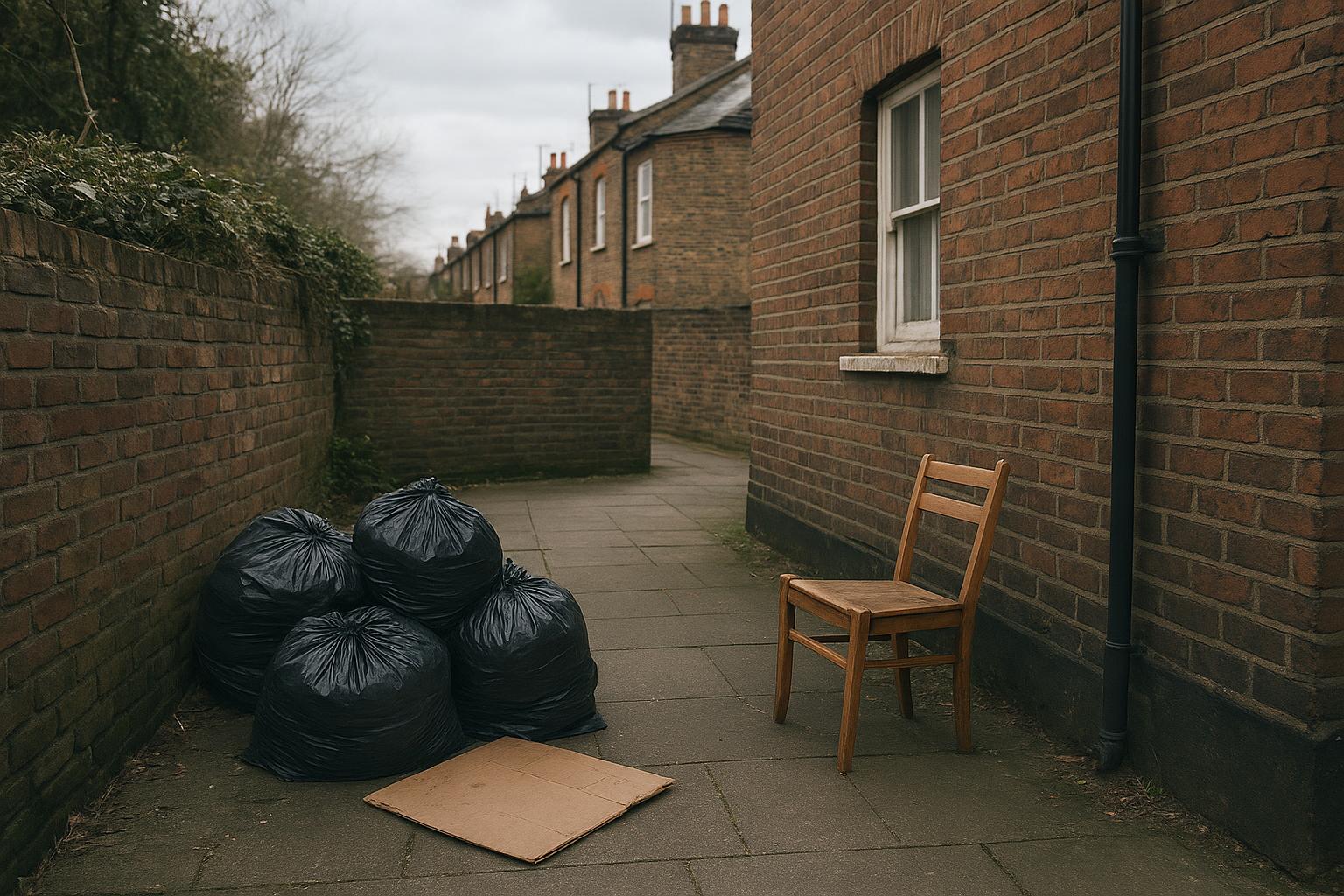
Fly-tipping is not defined by size. A single bin bag left beside a street bin can be fly-tipping, and so can a lorry load of rubble tipped in a field. The core offence is in section 33 of the Environmental Protection Act 1990: it is an offence to deposit controlled waste, or knowingly cause or knowingly permit it to be deposited, on land that does not have an appropriate waste permit or exemption. Household waste is controlled waste, so a sofa dumped in an alley is covered just as much as commercial waste.
Three words in that section matter to property owners. "Deposit" covers the physical act of dumping. "Cause" can apply to someone who arranges or instructs the dumping, even if they were not there. "Knowingly permit" can apply to someone who is in a position to control the land and allows waste to be put there. Whether a particular person fits any of these is a question of facts and evidence, which is why councils and courts look at who had control, who had knowledge, and what records exist.
Fixed penalty notices: the ceilings in plain terms
A fixed penalty is the quick route, with no court appearance if it is paid.
Councils in England can offer a fixed penalty notice as an alternative to prosecution for some waste offences. Paying the penalty discharges liability for that offence, so there is no prosecution and no conviction for it. If it is not paid, the council can pursue the matter in court instead.
Following the Environmental Offences (Fixed Penalties) (Amendment) (England) Regulations 2023, which came into force on 31 July 2023, the ceilings were raised. For fly-tipping itself, a council may set a fixed penalty of up to £1,000, up from a previous maximum of £400. For a householder who fails to meet their duty of care by passing waste to an unauthorised person, the ceiling is up to £600, again up from £400. These are ceilings, not automatic amounts. Each council sets its own level within the permitted range and may offer a lower sum for early payment, so the figure on a notice can differ from one borough to the next.
Because enforcement policy and the legal ranges can be amended, treat any figure you read in an article, including this one, as a pointer. The current official position is on gov.uk, and the council's own enforcement policy will state what it charges and when it offers a penalty rather than prosecuting.
For ordinary property owners, prosecution for the dumping itself is unusual unless they dumped the waste or arranged for it to be dumped. The more common route to a financial consequence for an owner is the duty of care offence, the clean-up notice route, or recovery of clean-up costs, all covered below. Large-scale and organised cases, and those involving hazardous waste, are often handled by the Environment Agency rather than the borough council, while the borough usually handles small and medium incidents on its land and in its streets.
The householder duty of care: the liability most owners actually face
You can be penalised for the dumping you never did.
Section 34 of the Environmental Protection Act 1990 puts a duty of care on anyone who produces household waste. For a householder, the practical meaning is: when you hand waste to someone else, take reasonable steps to make sure it goes to a person who is authorised to take it. For most people, that means checking that a carrier is a registered waste carrier before they remove your belongings.
If your waste is later found fly-tipped and traced back to you, and you cannot show that you took reasonable steps, you can face a fixed penalty for the duty of care failure, with the ceiling described above, or be prosecuted. This is a separate liability from the fly-tipping offence. You may never have been near the dumping site, and still be fined because you handed a van load of furniture to someone you never checked.
Our guides to choosing a licensed house clearance company and the waste carrier licence check explain how to confirm registration, and the blog article on waste carrier licensing and fly-tipping liability covers the same risk from the booking side. The short version is to check the registration on the Environment Agency's public register of waste carriers and brokers, confirm that the name and details match the person who arrives, and keep a record.
Penalties for the carrier, and why that matters to you
Carrying waste without registration is its own offence.
Carrying controlled waste for hire or reward without being registered as a waste carrier is a criminal offence in England, unless an exemption applies. Councils and the Environment Agency run checks on vehicles, and authorised officers have powers to stop and search vehicles suspected of carrying waste illegally and, in some circumstances, to seize them. A carrier caught without registration faces prosecution, and an unlimited fine is available in court.
Why does this matter to a property owner? First, because an unregistered operator is the person most likely to dump your waste, since they have no lawful outlet and no overheads for a licensed transfer station or tip. Second, because the paper trail from an unregistered operator is weak. Third, because the law expects you, as the householder, to check. A carrier's offence does not cancel your duty.
A registered carrier does not guarantee quality of service, and registration is not an endorsement of any particular company. It only means that the company is on the register for transporting waste. You should still ask where the waste will be taken, expect an itemised written quote, and ask for a receipt afterwards. Our guide to waste transfer notes for house clearance explains what paperwork to expect and what to ask for.
Fly-tipping on your own land: who has to clear it
Being the victim of dumping does not always mean someone else pays.
Many owners are caught out here. When waste is dumped on public land, such as a highway, park or council estate, the council is generally responsible for clearing it. When it is dumped on private land, the starting position is different. The government's guidance for councils, fly-tipping: council responsibilities, says that if a landowner reports fly-tipped waste on their land, the council can choose whether to investigate. In other words, there is no guarantee that your borough will clear waste from your back passage, car park, garden or yard.
That guidance also confirms that a council can serve a notice under section 59 of the Environmental Protection Act 1990 requiring the occupier of the land to remove fly-tipped waste and remediate the land, and that clean-up and enforcement costs can be recovered from the polluter, the occupier or the landowner. Failing to comply with such a notice without a reasonable excuse can be a criminal matter in its own right, and the council may be able to carry out the work and recover its costs if you do not.
In practical terms that means the following. If you are the occupier or owner of a site where waste has been dumped, report it promptly to the borough and, if relevant, the police, take photographs, and do not assume that the problem will be cleared for you. If waste is hazardous, such as suspected asbestos sheets, chemical drums, gas cylinders or syringes, do not move it yourself. Tell the council or the Environment Agency and wait for advice. For non-hazardous waste, a licensed carrier can clear it and give you a waste transfer note, which helps if the council later asks what happened.
Waste that tenants produce while living in a home is household waste, and the tenant has the householder duty of care. Problems begin when a tenancy ends, rent stops, or a tenant disappears and leaves a property full. Belongings left behind raise questions about ownership and notice before disposal, and the right steps depend on the tenancy and the circumstances. Do not simply dump items or hand them to the first person who offers a cheap clearance, because a landlord who deals with waste carelessly can face both a duty of care problem and a dispute about the tenant's property. Take advice from a solicitor or a landlord association about the correct notice process before anything is thrown out, and see our pages on landlord and abandoned property clearance and the end-of-tenancy clearance landlord guide.
Waste from a landlord's own work on the property, such as ripped-out carpets, kitchens, plasterboard and rubble from a refurbishment, is generally treated differently from ordinary household waste, because it is produced in the course of a business. Businesses have a stricter duty of care that includes a written description of the waste and keeping a signed transfer note, and gov.uk says to keep a copy of waste transfer paperwork for two years. See the official page on how to dispose of business and commercial waste. Our guides to building waste disposal and builders and renovation waste clearance explain what to ask for.
For flats, communal areas add another layer. Dumping in a shared bin store or stairwell can lead to action against the freeholder, management company or managing agent, depending on the lease and who controls the area. Check what your lease or management agreement says about who must arrange removal of bulky waste, and how residents are told to dispose of it. Executors face the same exposure when clearing an inherited home: see our guide to executor legal responsibilities for property and chattels, and keep the paperwork described in the house clearance invoices and records guide. Many London boroughs offer a bulky waste collection for residents, and our guide to council bulky waste versus private clearance in London sets out how that compares.
Builders, skips, hazardous waste and neglected sites
Other situations where an owner ends up answerable for waste.
If a builder is working on your home, ask who is taking the waste away, ask for their waste carrier registration and ask where it will go. A contractor who says they will "sort it" with no details is a risk, and if waste from your job is later fly-tipped and traced to your address you will be asked what you checked. The same applies to skips: check the skip company is registered and read our guides to skip permit costs, house clearance versus skip hire and building waste disposal. If you would rather take items yourself, tip runs in London explains household recycling centre rules.
Some dumped waste is hazardous, such as asbestos, chemicals, oils, some paints, batteries and certain electrical items. Courts take the type of waste and the risk of harm into account when sentencing. If you suspect hazardous waste on your land, do not break it up or move it. Keep people and pets away, report it to the council or the Environment Agency and use a competent contractor who is authorised to handle that waste.
Neglected sites also attract dumping. An empty or boarded-up property with an overgrown garden can become a magnet for bags and furniture, so visit regularly, photograph the site and keep dated notes, because a record is more persuasive than a recollection if the council asks what you did. Where accumulated waste is linked to hoarding or an owner who is unwell, a supportive approach is usually better than a purely punitive one: see our guide to council intervention in hoarded properties in London. The National Fly-tipping Prevention Group publishes advice on fences, gates, lighting and keeping access points clear, linked from the council guidance above.
The records that protect you
Paper is what turns an accusation into a conversation.
If you are ever asked how your waste left your property, the strongest answer is a set of documents. It does not need to be elaborate. For household waste, a sensible file includes the date of the job, the name and address of the carrier, their waste carrier registration number and a screenshot of the register entry, the quote or invoice, any waste transfer note or receipt, and photographs of what was removed. For a business or landlord, the documents should also include the description of the waste and a signed transfer note, kept for the period gov.uk specifies.
If you are using a marketplace such as houseclearance.co, you will still make the final choice of carrier yourself. We pass the job details to independent, licensed local carriers, who may contact you with quotes. We do not carry out clearances ourselves and we cannot decide for you which carrier to use. Keep the same records as you would for any booking, and use our responsible disposal page to see the standards we expect carriers to follow.
If the council writes to you
Stay calm, read the document and respond on time.
A letter or notice about waste can be alarming, but the first step is to identify what it is. It may be a request for information, a warning letter, a fixed penalty notice, a notice to remove waste from land, or a notice of intended prosecution. Each has different consequences and deadlines.
Check who sent it and under what power. Note the date, the reference and the deadline. Gather your records, such as the carrier details, the quote, photographs and any messages. If the waste is yours and a carrier mishandled it, explain what checks you made, and give the carrier's details. If you believe the waste is not yours, say so and explain why, with evidence. If a notice requires work on your land, ask whether there is a right of appeal and what the time limit is, because appeal windows are often short.
Do not ignore the letter. Unpaid fixed penalties can progress to prosecution, and failure to comply with a notice can itself be an offence. If you are unsure, speak to a solicitor, your local Citizens Advice, or a landlord association if you are a landlord. We cannot advise on your individual case.

Where houseclearance.co fits in
A way to compare licensed carriers, not a substitute for your own checks.
houseclearance.co is a marketplace. You describe the job, we pass the details to independent, licensed local waste carriers, and they may contact you with quotes. We do not carry out the clearance, we do not set prices and we cannot promise that any carrier will take a job. The aim of using a marketplace for this topic is to compare registered operators rather than answer an anonymous advert, but your duty of care stays with you.
When a carrier contacts you, check their registration on the Environment Agency register, ask what paperwork they provide, ask where waste is taken and keep the documents. If you have already had waste dumped on your land and need it cleared, say so in your request and describe what is there, how it is accessed and whether anything looks hazardous. Photographs help carriers to respond sensibly.
Ready to see your price?
When you are ready to move forward, describe the job and we will pass it to vetted, licensed local carriers, who may contact you with quotes.
Frequently asked questions
The questions property owners ask most about fly-tipping penalties and liability.
What is the fine for fly-tipping in London?
It depends on the route. Councils in England can issue a fixed penalty notice for fly-tipping with a ceiling of 1,000 pounds, raised from 400 pounds in July 2023, and each council sets its own amount within the range. If the case goes to court, magistrates can impose an unlimited fine and, in serious cases, a custodial sentence. Check current gov.uk guidance before relying on any figure.
Can I be fined if someone else fly-tips my rubbish?
Yes. If you hand household waste to a person who is not authorised to take it and the waste is later found dumped and traced to you, you can face a fixed penalty for breaching your duty of care, with a ceiling of 600 pounds, or prosecution. The way to protect yourself is to check the carrier is registered and keep records.
Is the council responsible for clearing fly-tipping on my private land?
Not necessarily. Councils clear waste from public land, but when waste is dumped on private land the council can choose whether to investigate, and the occupier or landowner is usually expected to arrange removal. Councils can serve a notice requiring the occupier to remove waste, and may recover costs from the polluter, occupier or landowner.
What is a section 59 notice?
It is a notice under section 59 of the Environmental Protection Act 1990 that a council can serve on the occupier of land requiring unlawfully deposited waste to be removed. Failing to comply without a reasonable excuse can be an offence. If you receive one, note the deadline, ask about appeal rights and take advice.
Can a landlord be liable for waste left by a tenant?
It can become the landlord's problem, because waste left at a property or dumped on land the landlord controls may lead to a clean-up notice or costs. Do not dispose of a tenant's belongings carelessly, as there are separate rules about notice and ownership. Take advice on the correct process and use a registered carrier.
How do I check that a waste carrier is registered?
Search the Environment Agency's public register of waste carriers and brokers, confirm that the name and registration details match the person who will collect your waste, and ask for the registration number in writing. Keep a screenshot or copy of the register entry with your booking records.
What records should I keep after a clearance?
Keep the carrier's name, address and registration number, the quote or invoice, any waste transfer note or receipt, photographs of what was removed and the date. Businesses and landlords have a stricter duty and should keep signed transfer notes for the period gov.uk specifies, currently two years.
What should I do if I find asbestos or other hazardous waste dumped on my land?
Do not touch, break up or move it. Keep people and pets away, report it to your council or the Environment Agency, and use a competent contractor authorised to handle that type of waste. A general clearance carrier is not automatically permitted to take hazardous waste.
Does houseclearance.co carry out the clearance and will it protect me from a fine?
No. houseclearance.co is a marketplace. You describe the job and independent, licensed local carriers may contact you with quotes. We do not clear properties ourselves and cannot guarantee any outcome, so you should still check registration and keep your own records.
What should I do if the council sends me a notice about waste?
Identify exactly what the document is, note the deadline and gather your records. Respond on time, explain what checks you made and give the carrier's details if relevant. Ask about appeal rights, and seek advice from a solicitor or Citizens Advice if money, land or prosecution is involved.
