Direct answer
A free house clearance can be real, but only in narrow circumstances. If the contents have enough resale or scrap value, a buyer may take them away and charge nothing, and charities or reuse groups sometimes collect good-quality furniture without charge. Most ordinary clearances involve waste that costs money to transport and dispose of, so a promise of free removal often hides a fee added on the day, a poor-quality service, or illegal dumping that can leave you in trouble. Householders have a legal duty of care for their waste, so check who is taking it, ask for a written quote, and never accept a vague “it’s free” without understanding how the person is paid.
Contents
- Why “free clearance” sounds so appealing
- How the wording gets stretched
- Myth one: someone will pay to do it for nothing
- The costs behind a normal clearance
- Myth two: everything in a house has resale value
- Where valuable items actually sell
- When a clearance can genuinely be free
- Giving things away in good order
- The catch: how “free” offers usually work
- The conversation on the day
- Your legal duty of care
- What to keep as evidence
- Fly-tipping: the biggest hidden risk
- If you suspect your waste was dumped
- Warning signs in adverts and calls
- Reading reviews with care
- Questions to ask before you agree
- A simple phone script
- What a fair quote looks like
- Using a marketplace sensibly
- Cheaper routes that are honest
- Timing and preparation
- Special care for estates and bereavement
- Frequently asked questions
Why “free clearance” sounds so appealing
The promise meets a real worry.
Clearing a home costs time, energy and often money, so an advert offering to do it for nothing naturally catches attention. This is especially true after a bereavement, when someone is dealing with grief, paperwork and a property that may need to be emptied quickly. The idea that a stranger will arrive, take everything and ask for no payment feels like a relief.
The phrase is used in many ways. Sometimes it means a genuine arrangement where the contents have value and the buyer takes the risk. Sometimes it is shorthand for “free quote”, which is a very different thing. And sometimes it is bait: a low or zero price quoted over the phone that turns into a charge once the crew is standing in your hallway.
This guide separates those cases. It explains the economics behind the claim, shows where a free service is realistic, and lists the checks that protect you. It also links to wider help on typical house clearance cost in London so you can see what an honest quote tends to involve.

How the wording gets stretched
Same phrase, different meanings.
The word “free” in clearance adverts is used loosely. A free quote means you will not be charged to receive a price. Free removal of certain items means the operator will take specific things, such as working appliances or good furniture, without charge. A free clearance suggests everything goes at no cost. These are three separate promises, and only the last one is the one most people hope for.
When you read or hear the word, ask which of the three is meant. A short written message confirming what is free, what is not and what happens to the rest removes most of the ambiguity before anyone arrives. If the business will not put it in writing, that is worth noting.
Myth one: someone will pay to do it for nothing
Disposal has a cost.
Waste does not vanish when it leaves your door. A crew needs a vehicle, fuel, labour, insurance and a place to take the load. Transfer stations and disposal sites generally charge for the waste they receive, and in the UK a business that carries waste is expected to be registered as a waste carrier. Those costs exist whether or not the customer is billed directly.
For a free service to work, someone has to cover them. Usually the money comes from selling or scrapping items of value, from a subsidy, or from cutting corners such as dumping the waste somewhere it should not go. A genuine business that offers free removal should be able to explain, in plain words, how it will pay for the work.
If the answer is vague, treat that as information. A confident, honest explanation such as “we resell good furniture and take it as payment” is very different from “don’t worry about it”.
The costs behind a normal clearance
What a quote usually covers.
A fair quote for a house clearance typically reflects several costs: the crew’s time, the size and number of vehicles, fuel and parking, the disposal charges at the site, and the business’s insurance and registration costs. In London, additional costs such as parking, access restrictions and emissions charges can also apply, depending on the vehicle and the route.
These costs do not shrink just because the customer wants the job to be free. If they are not paid by the customer, they have to be covered by item sales, by cost-cutting or by something less visible. Understanding this makes it easier to judge whether an offer is realistic.
Myth two: everything in a house has resale value
Most contents do not.
People sometimes assume that decades of belongings must be worth something. In reality, much of the average home’s content has little resale value. Second-hand furniture is widely available and often sells for modest sums, large brown wooden furniture has been out of fashion for years, and soft furnishings, mattresses and worn items are usually hard to sell at all.
What does hold value tends to be specific: solid, well-made pieces, certain antiques, designer items, working appliances, jewellery, silver, art, collectables and some vintage items. Even then, the value depends on condition, demand and the buyer’s costs. A clearance firm can only offer credit for what it can realistically sell.
Our guide on valuable antiques in a deceased estate explains why it is worth having anything potentially valuable looked at before the main clearance begins.
Where valuable items actually sell
Expect modest sums.
Items of real value are usually sold through auction houses, specialist dealers, online marketplaces or collectors’ networks. Each takes a commission or margin, so the amount you receive is less than the final sale price. Dealers who buy a whole house of contents have to allow for storage, repair, listing and the risk that some items never sell.
For that reason, a buyer who offers to take a house of general contents for nothing is often making a calculation that a handful of pieces will cover everything else. If your home contains few such pieces, the calculation does not work, and the offer may change once the buyer sees the contents.
When a clearance can genuinely be free
Narrow, but real.
There are situations in which no payment is needed. The most common is when the contents contain enough valuable items that a buyer or dealer is happy to take the lot and treats the saleable pieces as their payment. This is more likely with a house full of good furniture, antiques or collectables than with ordinary household contents.
Another case is a small collection of reusable furniture taken by a charity, community furniture project or reuse scheme. These organisations often only take items in good condition, may have a waiting list, and can decline anything that does not meet safety rules. Our overview of charities that collect large furniture in London explains what is typically accepted.
A third case is giving items away to individuals through community groups. This is free to you but not instant, and it only works for items that people actually want. Our guide to giving things away on Freecycle, Olio and similar platforms covers how that works in practice.
Giving things away in good order
Condition matters.
Whether you donate to a charity or give things to individuals, condition is critical. Clean, undamaged, safe items are easy to place. Stained, broken, damaged or unsafe items are not, and a charity may refuse them. Upholstered furniture and some electrical goods have safety requirements, so check the rules first.
Our guide on why charity shops refuse donations explains what is commonly excluded, which saves you carrying items to a shop that cannot take them. Prepare a small, clearly sorted set of donations rather than a pile of mixed items.
The catch: how “free” offers usually work
Follow the money.
When a free offer does not rest on resale value, the money has to come from somewhere else. The most common patterns are worth knowing, because they explain why the same advert can lead to very different experiences.
- Cherry-picking. The crew takes anything valuable, leaves the rest, and tells you the remainder will cost extra.
- Price added on the day. A free or very cheap phone quote becomes a charge once the crew sees the volume, access or items.
- Dumping. The waste is taken and left somewhere illegal to avoid disposal fees.
- Upsell. The crew finds “hazardous” or “special” items and adds charges that were never mentioned.
- Data and lead selling. The business collects your details to pass to others.
None of these is acceptable in a legitimate service, and each is a reason to ask more questions before agreeing to anything.
The conversation on the day
Where problems appear.
Many disputes begin when a crew arrives, looks around and says that the job is bigger than expected. Sometimes that is fair, because the volume truly differs from what was described. Sometimes it is a tactic. The best protection is a clear written quote based on photos or a visit, with the price, the scope and the conditions for any change stated in advance.
If the price rises unexpectedly, you are allowed to say no and ask the crew to leave. It is better to do that early than to agree under pressure and regret it afterwards. If you feel unsafe or pressured, end the conversation and, if necessary, contact the police or your local Trading Standards service.
Your legal duty of care
You are still responsible.
In England, anyone who produces household waste has a duty of care to make reasonable checks that the person taking it is authorised. That duty does not disappear because the service is free, and a free service is often the one that most needs checking. If the waste ends up fly-tipped, the council can trace it back to the household that produced it.
The practical steps are simple: ask whether the person is a registered waste carrier, look up the registration on the official GOV.UK register, keep a record of who took the waste, and ask for a written description or receipt. Our guide to the householder waste duty of care explains this in more detail, and the waste carrier licence check page shows how to look up a registration.
Penalties for fly-tipping and for failing the duty of care can be significant, and details change, so check current information with your council and on GOV.UK.
What to keep as evidence
A small paper trail.
A simple record protects you. Note the date, the name and phone number of the person, the registration number, the vehicle registration, a description of what was taken and the price paid. A photo of the van and of the items before they leave is also helpful.
If you receive a written quote, invoice or receipt, keep it. Our guide to house clearance invoices and records explains what these documents should include and why they matter if a question arises later.
Fly-tipping: the biggest hidden risk
Free often means untraceable.
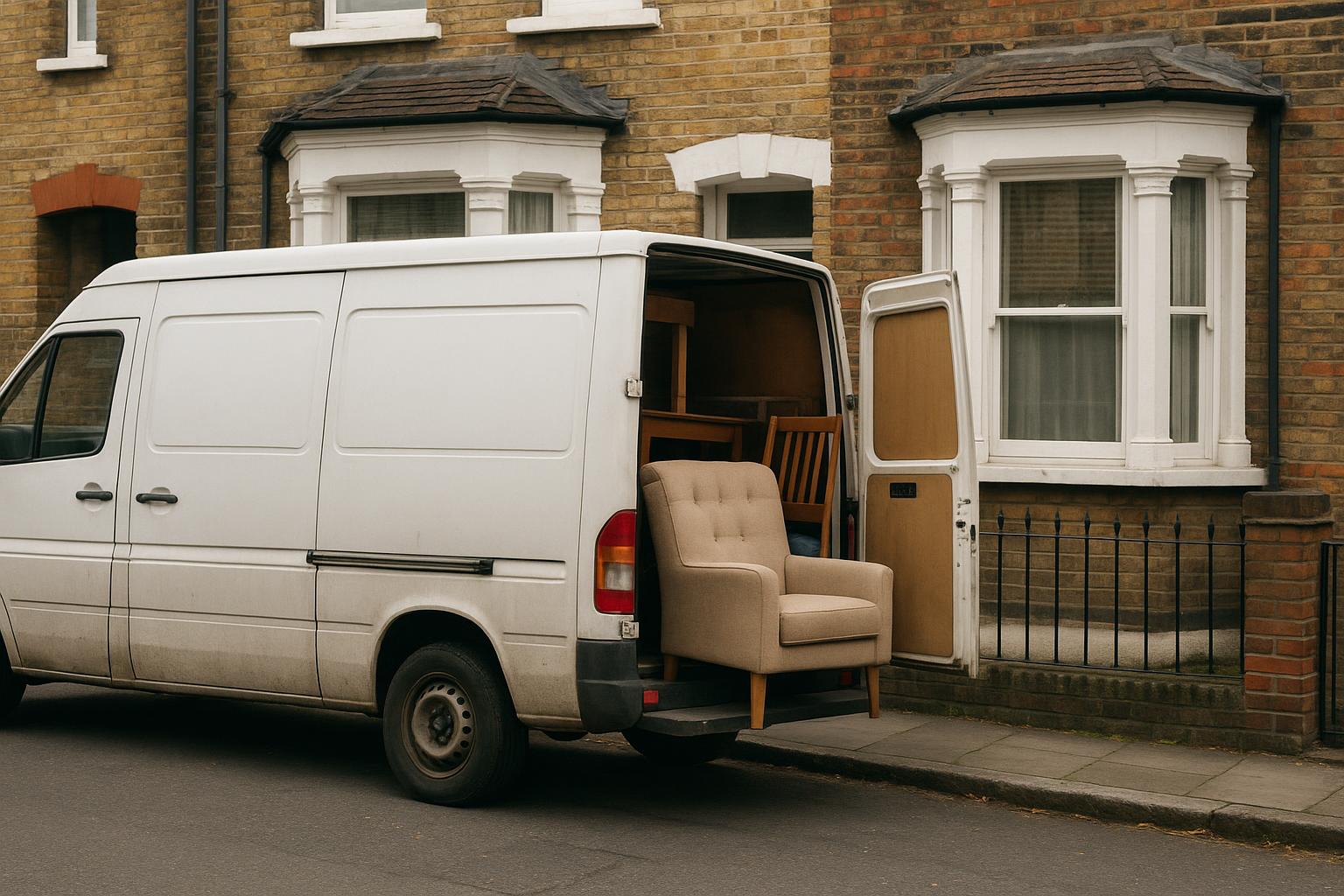
One reason some operators can advertise a free or very cheap service is that they do not pay to dispose of the waste. A load left on a roadside, in a wood or behind a block of flats is a crime, and councils investigate waste found in these locations.
If your rubbish is found, evidence such as old letters, parcels or address labels can lead officers to your door. Even if you did nothing illegal on purpose, you may be asked to show what checks you made. Having a written record, a registration number and a receipt makes a big difference.
Our guide to fly-tipping penalties and liabilities in London explains the position in more detail and why choosing on price alone can backfire.
If you suspect your waste was dumped
Act promptly.
If you later find that waste from your property has been dumped, contact your local council and report what you know. Provide the details you kept, such as the name, number, date and description. Acting quickly and cooperating shows that you took reasonable steps and can make a significant difference to the outcome.
You can also report fly-tipping you see elsewhere through your council’s website. Do not touch suspicious waste, because it may include hazardous material, and do not confront anyone involved.
Warning signs in adverts and calls
Spot them early.
Some patterns appear again and again in problem cases. None of them proves bad intent on its own, but several together are a good reason to walk away.
- The advert has no company name, no address and only a mobile number.
- The person will not give a waste carrier registration number or becomes defensive when asked.
- The quote is given without asking about volume, access or the type of items.
- The price is “free” or unusually low but there is pressure to decide immediately.
- Payment is requested in cash only, with no receipt.
- Reviews are vague, recently created or all say the same thing.
Our guide to the risks of hiring an unlicensed man and van from social media covers the same problems in more depth.
Reading reviews with care
Quality over quantity.
Reviews can help, but they need reading carefully. Look for detail: the type of job, whether the quote matched the final price, how the crew behaved and how problems were handled. Be cautious of lots of short, similar reviews posted on the same day and of profiles with no history.
Do not rely on reviews alone. They do not replace checking the registration, asking questions and getting a written quote. A business with good reviews can still fail the basic checks, and one with few reviews may be perfectly honest.
Questions to ask before you agree
Clear answers, in writing.
A short list of questions will tell you most of what you need. Ask them before the crew arrives and ask for the answers in writing, even if that is just a text message or email.
- How exactly are you paid for this job, and what will I be asked to pay?
- Are you a registered waste carrier, and what is the registration number?
- What happens to the items you take, and where do they go?
- What is not included, and what could add to the price?
- Will I get a written quote and a receipt?
A genuine business can answer these without difficulty. Hesitation, irritation or a sudden change of subject is a signal to stop.
A simple phone script
Keep it short.
You do not need to be confrontational. A short, polite script works: “Before I agree, can I ask how you are paid for this job, whether you are a registered waste carrier and what the registration number is, and whether you can send the quote in writing?”
Make a note of the answers while you talk. If the person is happy to help, you will have what you need. If they become evasive, you have your answer, and you can move on without any awkwardness.
What a fair quote looks like
Transparent, not necessarily free.
For most households, a fair clearance quote is not zero. It is a clear price based on the volume of items, the access, the time involved and the disposal costs, with any credit for resale items shown separately. A good quote explains what is included, notes anything that is excluded and says whether a visit or photos were used.
This is also where comparing several quotes helps. Houseclearance.co is a marketplace where you can request quotes from independent carriers, and each carrier sets its own terms and prices, so you should read each quote carefully and ask the questions above. Our guide on what affects house clearance cost lists the factors that move a price up or down.
If one quote is dramatically lower than the others, work out why before accepting. It may reflect a smaller job, but it may also reflect something you will end up paying for later.
Using a marketplace sensibly
Compare like with like.
When you request quotes through a marketplace, give every carrier the same information: the property type, rooms, volume, access, parking, items of concern and your preferred date. This lets you compare like with like and reduces the risk that one carrier prices a different job from another.
Read the details of each quote, not just the bottom line. Look at what is included, any conditions and whether the carrier has asked sensible questions. A carrier that asks about stairs, parking and hazardous items is usually thinking about the real job, which tends to produce a more accurate price.
Cheaper routes that are honest
Reduce the bill without risk.
If your aim is to reduce cost, there are honest ways to do it. Sell or donate what has value before the clearance, take small loads to a recycling centre yourself, remove items that are easy to move, and make sure access is clear so the crew does not spend time on difficult carrying.
Splitting the job can also help. A clearance of general waste and a separate sale of valuable pieces often produces a better outcome than asking a single operator to do both. You keep control, and you know what has been sold for what.
These steps take effort, but they rarely carry the risks associated with a vague free offer, and they keep you on the right side of your duty of care.
Timing and preparation
Time can save money.
Giving yourself time often reduces the cost. A rushed job leaves little room to sell, donate or sort, and urgent bookings can cost more because of limited availability. Starting early lets you remove easy items, arrange donations and compare quotes calmly.
Preparation also reduces the crew’s time on site. Clear pathways, grouped items, labelled keepsakes and accessible parking all help. Our house clearance checklist provides a practical order of tasks to work through.
Special care for estates and bereavement
Do not rush.
If you are clearing a property after a death, be especially careful. Valuables, documents and sentimental items can be mixed in with ordinary contents, and a hurried clearance can result in important things being lost or sold for less than they are worth.
It is usually sensible to search for papers, jewellery and keepsakes first, and to get anything that might be valuable assessed before arranging general clearance. Our guide on hidden family valuables and documents explains where these are often found.
Executors also have legal responsibilities for the estate’s property, so keep records of what is sold, donated or disposed of and take advice from a solicitor if you are unsure.
Frequently asked questions
Common questions about free house clearance.
Is free house clearance real?
It can be, but only in narrow cases, such as when the contents have enough resale or scrap value that a buyer takes them as payment, or when a charity collects good-quality furniture. Most ordinary clearances have a cost.
Why do some companies offer a free clearance?
Usually because they plan to resell valuable items, because the job is small, or because they use the offer to win the job and add charges later. A legitimate business should be able to explain how it is paid.
What is the catch with free clearance?
Common catches include cherry-picking valuables and charging for the rest, adding fees on the day, using vague quotes, or dumping waste illegally. Always ask how the person is paid and what is not included.
Can I be fined if a free clearance firm fly-tips my waste?
Possibly. As a householder you have a duty of care to check the person taking your waste is authorised. If waste is traced back to you, the council may investigate. Check your council and GOV.UK for current rules.
How do I check a waste carrier?
Ask for the registration number and look it up on the official GOV.UK public register of waste carriers. Keep a note of the name, number, date and what was taken.
Will a charity always collect for free?
No. Charities usually take only items in good condition that meet safety rules and that they can sell or reuse, and some collections have waiting lists. Ask the charity what it accepts.
Should I accept a quote of zero?
Treat it with caution. Ask what exactly is included, whether anything could be added and how the business is paid, and get the answers in writing before agreeing.
How can I lower the cost of a clearance honestly?
Sell or donate valuable items first, take small loads to a recycling centre, make access easy and compare several written quotes so you can see what drives the price.