
Direct answer
A sustainable office clearance can support a company's ESG performance, but it does not automatically raise a rating. ESG raters and reporting frameworks differ, and most look at policies, targets and measured data across the whole business, not one project. An office clearance matters because it produces waste, and waste generated in operations can be reported as part of a company's indirect emissions. The most useful steps are to follow the waste hierarchy, favour reuse, use registered carriers, record quantities and destinations and avoid unsupported claims. Check current reporting requirements and the methodology of any rating you care about, because they change.
Contents
- What ESG ratings are and are not
- Common misunderstandings
- Who asks for ESG information
- Why an office clearance is relevant
- What an office clearance typically contains
- When to plan for sustainability
- Where waste appears in carbon reporting
- Using conversion factors carefully
- Applying the waste hierarchy
- An illustrative approach
- IT and electrical equipment
- What data to collect
- Categories worth tracking
- Landlord and building data
- Weights, volumes and estimates
- Records that stand up to scrutiny
- A one-page clearance summary
- Avoiding greenwashing
- Safer wording for reports
- Writing sustainability into procurement
- Questions for carriers
- The social and governance side
- Limits and honesty
- Frequently asked questions
What ESG ratings are and are not
Many raters, many methods.
ESG stands for environmental, social and governance. ESG ratings are scores produced by data providers and rating agencies that assess how a company manages issues in those three areas. They are used by investors, lenders, customers and sometimes procurement teams.
There is no single UK or global ESG rating. Each provider uses its own methodology, data sources and weighting, and the same company can score quite differently with different providers. Some ratings rely on public disclosures, some on questionnaires and some on a mix.
This matters because it is not possible to say that a particular action will raise a particular score. It is more accurate to say that responsible actions, properly measured and disclosed, support a company's environmental performance and can help it answer questions from raters and customers.

Common misunderstandings
Clear up the myths.
One common myth is that a single high ESG score proves a company is sustainable. In reality, ratings measure how well a company discloses and manages certain risks, and they can be affected by size, sector and how much information is published.
Another is that recycling alone makes a clearance green. Recycling is better than disposal, but reuse and avoiding unnecessary replacement have a greater effect. A clearance that sends perfectly good furniture for recycling has missed an opportunity.
A third is that sustainability claims are safe if they are broadly true. Regulators and customers expect claims to be specific and evidenced, so vague or exaggerated statements can create risk.
Who asks for ESG information
Pressure from several sides.
Investors and lenders use ESG information to assess risk. Large customers include sustainability questions in tenders, and landlords sometimes ask tenants for waste and energy data for their own reporting. Staff and prospective employees also care about how a company behaves.
Smaller businesses may not be rated directly but still receive questionnaires from larger customers. The information requested is often similar: policies, measured data, certifications and examples of action.
An office clearance is a useful example of action, provided that you can describe what you did and show records.
Why an office clearance is relevant
A real stream of waste.
An office move, closure or refit produces a large amount of waste in a short period. Furniture, IT equipment, fixtures, carpets, ceiling tiles, stationery and general rubbish all leave the building at once. How that waste is managed is part of the company's environmental footprint.
For many corporations, one clearance is small compared with the overall operations. But it is a visible, auditable event, and it is the type of activity that stakeholders ask about, particularly when a company is closing or reducing space.
Treating it well gives you a clear story and a clear dataset. Treating it badly can create a reputational and legal problem that undermines your wider sustainability claims.
What an office clearance typically contains
Know your waste streams.
A typical office clearance includes desks, chairs and storage units, IT and AV equipment, kitchen appliances, carpet tiles, partitions, ceiling tiles, lighting, signage, paper records and general waste. Each stream has its own best route.
Furniture can often be reused. IT goes through specialist reuse and recycling. Paper records need secure disposal if confidential. Metals can be recycled. Fixtures and fit-out materials depend on the landlord's requirements and what is feasible.
Our guides to commercial waste rules and what happens to items after clearance give more background.
When to plan for sustainability
Early is better.
The earlier you plan, the more reuse options you have. If you know about a move or closure months ahead, you can run a reuse programme, invite offers from resellers and charities and ask carriers for reporting data. If you leave it to the last week, most of those options disappear.
Add a sustainability step to your project plan at the same stage as booking carriers and notifying the landlord. Give someone responsibility for collecting the data.
A little time at the start also reduces cost, because reuse and recycling are often cheaper than mixed waste disposal when volume is large.
Where waste appears in carbon reporting
Scope 3 in outline.
Under the Greenhouse Gas Protocol, a company's emissions are grouped into Scope 1 (direct), Scope 2 (purchased energy) and Scope 3 (other indirect emissions in the value chain). Waste generated in a company's operations is a recognised Scope 3 category.
Large UK companies and some other organisations have mandatory energy and carbon reporting duties, and many others report voluntarily or because customers ask. What is required depends on size and type of organisation, so check the current rules on GOV.UK or with your auditor.
For a clearance, the useful data is the weight or volume of waste, the material types and the treatment route, such as reuse, recycling, energy recovery or landfill. Your sustainability team can then apply the right conversion factors.
Using conversion factors carefully
Leave it to the specialists.
Converting waste weights into emissions requires factors that depend on material and treatment route. Governments and other bodies publish these, and they are updated from time to time. Your sustainability or finance team should choose the factors and keep the source.
Do not mix factors from different years or sources without noting it, and do not claim savings from avoided emissions unless your reporting framework allows it. Keep the calculation transparent.
If you do not have an in-house team, an environmental consultant can help with a one-off exercise. This guide is not a substitute for reporting advice.
Applying the waste hierarchy
The practical core.
The waste hierarchy prioritises prevention, then preparing for reuse, recycling, other recovery and finally disposal. A sustainable clearance is simply one that moves as much material as possible towards the top of that list, within what is practical and lawful.
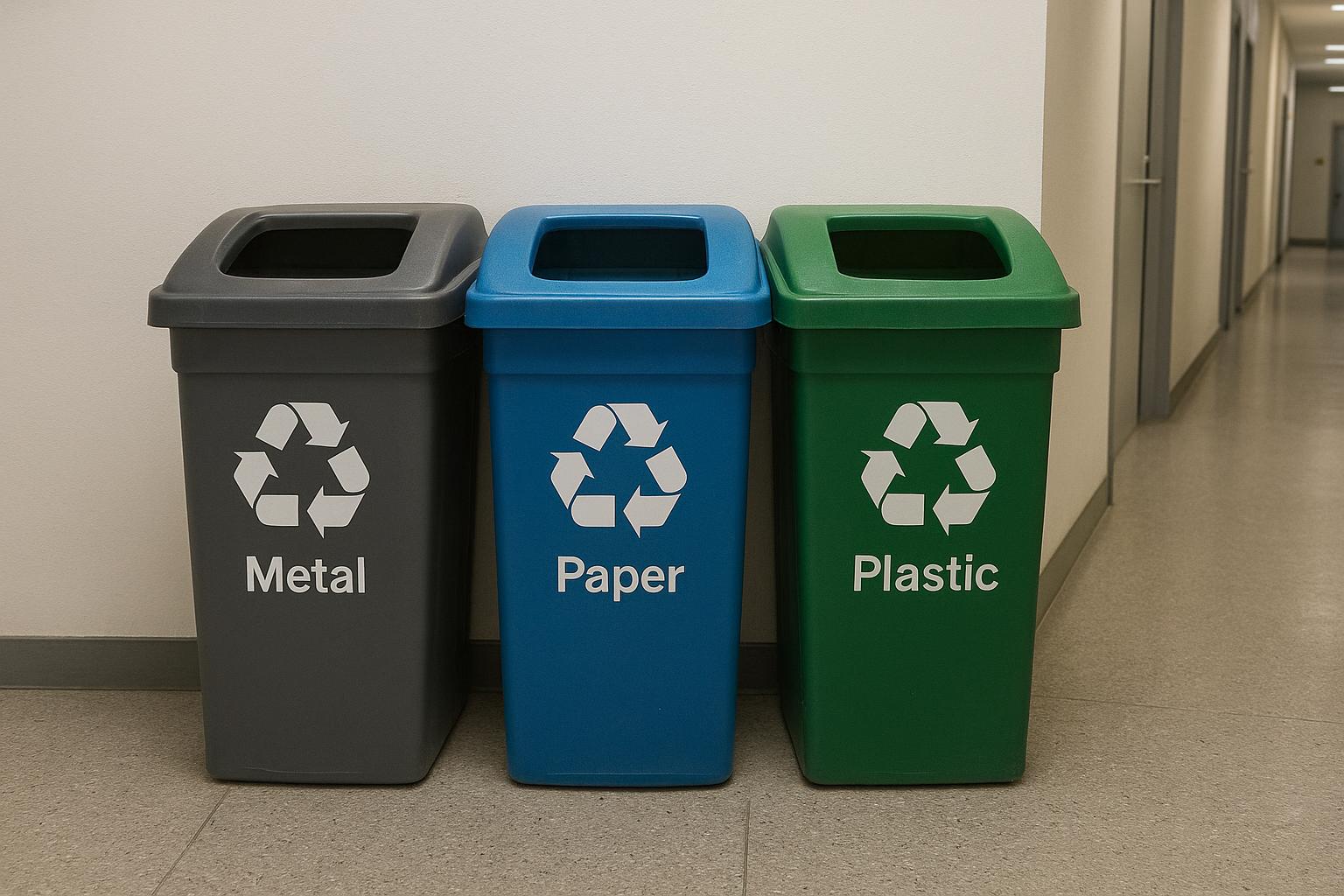
In an office, this means redeploying furniture, selling or donating usable items, sending IT equipment through a proper reuse and recycling process, separating metals and paper and keeping general waste to a minimum.
Our guides on recycling commercial furniture and the circular economy in house clearance explain these routes in more detail.
An illustrative approach
Not a promise of results.
Imagine an office of a hundred workstations closing. A responsible approach might be to offer chairs and desks to staff, invite quotes from a reseller for the best furniture, donate usable items to a community group that has agreed to collect, send IT through a specialist provider, separate metal shelving for scrap and use a registered carrier for the remainder.
The result would not necessarily be a particular percentage reused. It depends on condition, demand and timing. What matters is that each decision is made in order of the hierarchy and that records show where things went.
This example is illustrative only. Every office is different, and you should plan for your own circumstances.
IT and electrical equipment
Handle separately.
IT equipment is electrical waste and often contains data. It should go through a reuse or recycling process that provides a certificate of data destruction and a record of treatment. Our guide on WEEE regulations covers the rules.
Furniture carriers are not normally the right route for computers and phones. Use a specialist IT asset disposal provider, and ask what proportion goes for reuse and what is recycled.
Keep certificates with your clearance records. They answer both ESG and data protection questions.
What data to collect
Simple and reliable.
Ask your carriers and recipients to provide the weight or at least the volume of each category, the date, the destination and the treatment route. Waste transfer notes give a baseline, and receipts from resellers and charities show what was reused.
Where weights are not available, estimates are acceptable if you say clearly that they are estimates and explain the method. Avoid false precision. A range with a note is more credible than an invented figure.
Collect the data as the job goes along, not months later. People remember less, and carriers are slower to respond to old requests.
Categories worth tracking
Keep the list short.
A short, consistent set of categories is easier to maintain than a detailed one. Useful headings include furniture reused, furniture recycled, electrical and IT, metals, paper and card, general waste and anything hazardous.
For each, record the quantity, who took it and the route. Where an item was donated or sold, note the recipient type rather than naming individuals.
If you run several clearances across a property portfolio, use the same categories each time so that totals can be added up for annual reporting.
Landlord and building data
Share and request.
Some landlords and managing agents collect waste data from tenants for their own sustainability reporting, and may ask you for a summary at the end of the project. Equally, ask them whether the building has recycling services or waste data you can use.
If the building has a shared waste contract, check whether your clearance waste can go through it, and what the charge is. Do not assume that building bins are available for large volumes.
Agree who holds which records, so that nothing is lost when the lease ends.
Weights, volumes and estimates
Be honest about quality.
Weighbridge tickets give accurate weights for larger loads. For smaller jobs, carriers may estimate based on volume and material type. Both are valid if the method is stated.
If data is poor, record that and aim to improve next time, for example by asking carriers to provide category weights as part of the contract.
Consistency matters more than perfection. A simple method applied each time lets you compare projects and show progress.
Records that stand up to scrutiny
Evidence, not slogans.
Keep waste transfer notes, carrier registration checks, receipts from resellers, donation acknowledgements, certificates for IT data destruction and any confirmation of treatment routes. Put them in one folder with a short summary.
Our guides on waste transfer notes and checking contractor credentials explain what to ask for.
Records help in an audit, in a customer questionnaire and in a dispute. They also keep your claims honest, because you can only report what you can show.
A one-page clearance summary
Easy to reuse.
Write a short summary with the date, location, scope, carriers used, quantities by category and treatment route, and any limits on the data. Attach the supporting documents.
This summary can be reused for annual reporting, customer questionnaires and internal reviews, and it makes handover easier if the person who ran the project leaves.
Have someone not involved in the project read it and ask questions. Anything they cannot understand is probably a gap in the evidence.
Avoiding greenwashing
Say only what you can prove.
Greenwashing means making environmental claims that are misleading or unsupported. In the UK, the Competition and Markets Authority has published a Green Claims Code that sets out principles for environmental claims, and other regulators have rules on advertising. Check current guidance.
In waste, risky claims include "zero waste to landfill", "100% recycled" or "carbon neutral clearance" without clear evidence of what was measured and how. A carrier's company-wide percentage is not proof of what happened to your load.
Our guides on spotting genuine eco-friendly clearance companies and zero waste to landfill claims explain what to question.
Safer wording for reports
Be specific.
Prefer precise statements such as "furniture from the second floor was offered to staff and a reseller, and the remainder went to a registered carrier, with transfer notes retained" over broad claims such as "we are fully sustainable".
State what is estimated, what is measured and what is outside the scope. If you do not know what happened to a stream, say so and explain how you will improve.
Readers, auditors and regulators respond better to specific, modest and accurate claims than to ambitious ones that cannot be supported.
Writing sustainability into procurement
Ask at the quote stage.
Include questions about reuse, recycling, paperwork and reporting in your request for quotes. For example, ask carriers whether they can provide weights by category, destinations and treatment routes, and whether they take items for reuse.
Weigh these answers alongside price, insurance and availability. A carrier that is open about what happens to waste is usually easier to work with and gives you better reporting material.
houseclearance.co is a marketplace where customers receive quotes from independent carriers, so ask each carrier directly for these details rather than assuming they are the same. Our guide to comparing quotes beyond price may help.
Questions for carriers
A short list.
- Are you a registered waste carrier, and what is your number?
- Can you provide weights or volumes by material?
- Where will each stream go, and what is the treatment route?
- Do you take items for reuse, and who receives them?
- Will you provide a waste transfer note and any receipts?
- Do you subcontract any part of the work?
Include the questions in your request for quotes and compare the responses. Clear, specific answers are a good sign.
Limits and honesty
What a clearance can and cannot do.
A sustainable office clearance is one part of a broader programme. It will not offset poor performance elsewhere, and raters are unlikely to treat it as decisive. Present it as an example of practice, backed by data, not as proof of overall performance.
If your organisation has targets on waste, circularity or emissions, explain how this project contributes. If you do not have targets, this may be a useful prompt to set them.
Keep an eye on changing rules and expectations, and review your approach each year. GOV.UK and your sector body are good places to check for updates.
Frequently asked questions
Common questions about ESG and office clearances.
Will a sustainable office clearance raise our ESG rating?
Not automatically. Raters use different methods and look at the whole business. A well-documented, responsible clearance supports your environmental performance and your reporting but does not guarantee a score change.
Is waste from a clearance part of carbon reporting?
Waste generated in operations is a recognised Scope 3 category under the Greenhouse Gas Protocol. Whether you must report depends on your organisation, so check current rules with your auditor or GOV.UK.
What data should we collect from carriers?
Weights or volumes by material, collection date, destination and treatment route, plus a waste transfer note and any receipts from reuse recipients.
Can we claim zero waste to landfill?
Only if you can evidence it for your own waste, including what happened to every stream. A carrier's company-wide figure is not enough. Be cautious with such claims.
Is reuse better than recycling?
Generally yes, because reuse sits higher in the waste hierarchy. Recycling is the next best, and disposal is the last choice.
Do donations count as ESG benefit?
They can support the social side if they are real, documented and agreed with the recipient, but they should not replace compliance with waste law.
What are the legal basics for business waste?
Businesses have a duty of care: use registered carriers, keep waste transfer notes and describe the waste accurately. Check GOV.UK for current rules.
Does houseclearance.co report ESG data for us?
No. It is a quote-matching marketplace and independent carriers do the work, so ask each carrier for the data you need.

The social and governance side
Not just environment.
ESG is broader than waste. The social side includes safe working conditions for contractors, fair treatment of staff affected by an office closure and community benefit, such as donations to local charities. Governance includes proper procurement, compliance with waste law and transparent reporting.
A clearance supports those goals when it is run safely, with insured and registered contractors, and when reuse benefits are shared with local groups where possible. Treat contractor safety and legal compliance as seriously as recycling rates.
Avoid presenting donations as a headline benefit unless they are real and documented, and do not name organisations without their agreement.