Direct answer
A weekend declutter works if you plan the logistics on Friday evening, work in focused blocks of 90 to 120 minutes with breaks, and treat disposal as part of the job rather than an afterthought. A sensible plan is to prepare and gather supplies on Friday, tackle one or two high-impact areas on Saturday, deal with sorting leftovers and removal on Sunday, and finish with a short reset. Be realistic about scope: one flat or a few rooms is achievable, a full house is not. Book any collection in advance, set a rule for "maybe" items, and keep important documents and valuables out of the discard pile.
Contents
- Be realistic about what a weekend can do
- A ten-minute audit to choose your scope
- Friday evening: prepare for 45 minutes
- Logistics worth sorting on Friday
- Decision rules that keep you moving
- A faster test for clothes and household items
- Saturday morning, 9:00 to 12:00: the highest-impact area
- A step-by-step wardrobe sort in 90 minutes
- Saturday afternoon, 13:00 to 17:00: the second area and the paper pile
- Working through a kitchen or living room
- Sunday: finish, remove and reset
- A Sunday finish checklist
- Exits: donate, sell, recycle, dispose
- If you have more than expected
- Tools and supplies
- Labels and simple systems
- What to do when you get stuck
- Keeping it going on a busy week
- A simple monthly reset
- Common mistakes
- Frequently asked questions
Be realistic about what a weekend can do
Choose a scope you can finish.
A weekend gives you roughly twelve to fifteen usable hours of effort, once you allow for meals, rest and everything else life requires. That is enough to make a visible difference to a one-bedroom flat, or to two or three rooms of a larger home. It is not enough to declutter a four-bedroom house, a loft and a garage.
Pick a scope that fits. Good targets for one weekend are the bedroom and wardrobe plus the hallway, the kitchen plus the living room, or the home office plus the spare room. If you have a larger job, plan a series of weekends and treat each one as a project with its own start and finish.
Finishing matters more than covering ground. A half-sorted room is often worse than the one you began with, so aim to leave every area you touch either complete or neatly boxed for the next session.

A ten-minute audit to choose your scope
Look before you commit.
Walk through your home with a notepad and give each area a score from one to three. One means a quick tidy, two means a moderate sort and three means a major job. Add up the time you think each will take, using a figure of about 60 to 90 minutes for a score of two, and three hours or more for a three.
If your list totals more than about twelve hours, trim it. Choose the areas that bother you most, or those you use every day. Leave the loft, garage and storage spaces for another weekend unless they are small.
Take a few photographs before you begin. They help you see progress, and they remind you what you decided to do.
Friday evening: prepare for 45 minutes
The setup that saves hours.
The most useful thing you can do on Friday is remove obstacles. Decide your scope, collect your supplies and sort out the exits. You do not need to start sorting. You need to make sure that on Saturday morning nothing stops you.
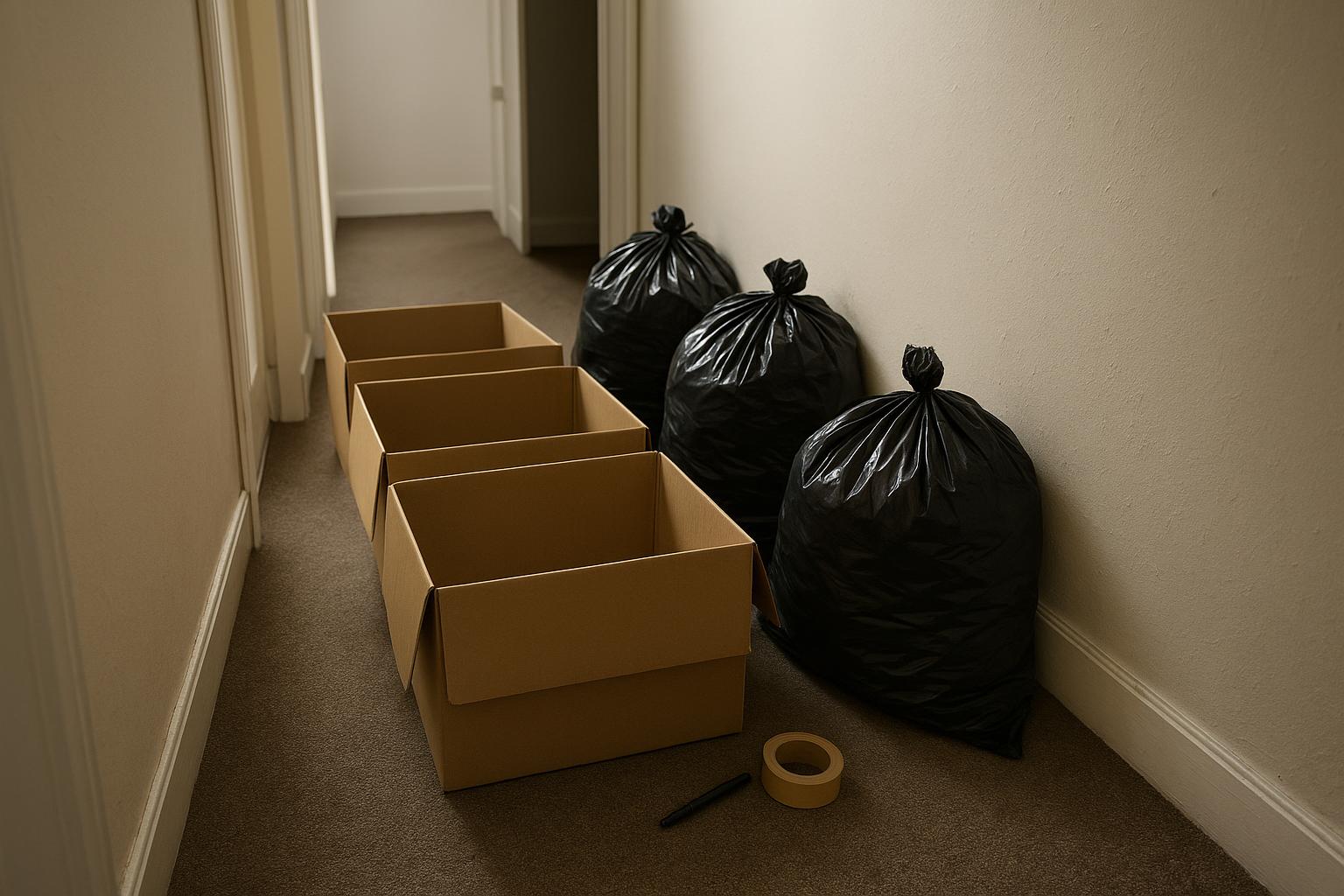
Collect bin bags, a roll of tape, a marker, a few strong boxes and some cleaning cloths. Label four containers: keep, donate or sell, recycle and rubbish. Add a fifth box labelled "check" for papers, possible valuables and anything you are unsure about.
- Choose the rooms or categories you will cover.
- Check your council's recycling and bulky waste rules, and note collection days.
- Look up the opening hours and access rules for your nearest recycling centre.
- Pick a charity shop or two and check what they accept.
- Book a collection if you expect bulky items, and confirm the date.
- Clear a space where sorted items can wait, such as the hall or a spare room.
Our house clearance checklist has a fuller list if the job is larger than expected.
Logistics worth sorting on Friday
Remove the surprises.
Check whether your recycling centre needs a booking, proof of address or has rules about the type of vehicle that may enter. Rules vary between London boroughs, so look at the relevant council website. Our guide to Harrow tip and recycling centres is one example of how access rules work in practice.
If you are donating, call or check online to see whether the shop is open on Sunday and what it accepts. If you need a collection, ask what is included, what is excluded and how waste is handled, and get the quote in writing.
Tell anyone who shares your home what you are doing and when. A warning on Friday avoids arguments on Saturday, and it gives people a chance to claim anything they care about.
Decision rules that keep you moving
Agree them before you start.
The biggest time sink in decluttering is hesitation. Set rules in advance so that you are not debating every object. A simple set works well: if it is broken and has been for a year, it goes; if it is expired, it goes; if you have two of the same thing, keep the better one; if you have not used it in a year and have no specific reason to keep it, it goes.
Use the "check" box for anything that needs a second opinion, such as papers, sentimental items or objects that might be valuable. Do not decide those in the moment. They are for Sunday evening, or for another weekend.
If you are decluttering with a partner or family, agree who decides what. Each person decides about their own belongings. Shared items are decided together, and nobody discards another person's things without asking.
A faster test for clothes and household items
Use practical questions.
For clothes, ask four questions: does it fit, is it in good condition, have I worn it in the last year and would I buy it again today. Two or more no answers means it is probably time to let go.
For household items, ask whether you use it, whether you have a better one and whether it is worth the space it takes up. A duplicate that has been in a cupboard for years rarely comes into use.
For gifts and items you feel guilty about, remember that the gift served its purpose when it was given. You are not obliged to keep it forever, and a charity shop can often give it a second life.
Saturday morning, 9:00 to 12:00: the highest-impact area
Start with what you will notice most.
Begin with the area that will make the most difference to your daily life. For many people it is the wardrobe and bedroom, because clothes are quick to decide and the result is visible. For others, it is the kitchen or the hallway.
Work in two blocks of about 90 minutes with a break in between. In each block, take everything out of one storage area, such as a wardrobe, sort it into your labelled containers and put the keepers back in an order that makes sense. Do not spread things across the whole room, or you will create a bigger mess than you started with.
At the end of the morning, take bags of rubbish and recycling out of the house, and move donation boxes to the door or the car. Taking things out at once is what makes the progress real.
A step-by-step wardrobe sort in 90 minutes
Stay in the same spot.
Take everything out of the wardrobe and drawers and put it on the bed. In the first 20 minutes, remove anything obviously damaged, stained or out of size. Put these into rubbish, recycling or donate bags straight away.
In the next 40 minutes, go through the remainder item by item, using your four questions. Be strict about duplicates, and try on anything you are unsure of. Put keepers back in groups, such as tops, trousers and knitwear.
Use the last 30 minutes to check shoes, bags and accessories, and to take the bags out. Our guide to recycling old clothes and linens helps you find a place for worn items.
Saturday afternoon, 13:00 to 17:00: the second area and the paper pile
Use the energy you have left.
After lunch, move to your second area. Many people choose the living room, the home office or the kitchen. Use the same method, one storage area at a time.
Allow 45 to 60 minutes for papers, which need more care and are tiring. Sort into four piles: shred, recycle, action needed and keep. Put anything you cannot decide quickly in the check box. Our secure document shredding guide explains how to dispose of personal papers safely.
Finish by 17:00 so that you still have the evening. A hard stop prevents burnout, and gives you a sense of completion. If you have a charity drop-off or a recycling centre trip to make, do it now or first thing on Sunday.
Working through a kitchen or living room
Break it into zones.
For a kitchen, work in zones: cupboards with food, cupboards with crockery, drawers, under the sink and the fridge. Take out one zone at a time, check dates, discard damaged or duplicate items and wipe shelves before replacing what stays.
In a living room, start with surfaces and shelves, then drawers and cupboards. Books, DVDs, magazines and ornaments often make up most of the volume. Be especially honest about items you keep out of habit. Our guide to donating old books and textbooks covers where books can go.
If you find items that look valuable, put them in the check box. Do not give them away in a rush.
Sunday: finish, remove and reset
Turn sorting into a result.
Sunday morning is for finishing. Take the third area, or finish the unfinished one. Then deal with the exits, since sorted items that remain in the house do not improve it.
Deliver donations, take recycling and special items to a centre and list any items you want to sell, with a date by which unsold items will be donated. If you have bulky items, check your collection is booked. If not, compare options, including your council's bulky waste service and private clearance. Our guide to council bulky waste versus private clearance can help.
In the afternoon, clean the spaces you have cleared, put keepers back with a logic that you can maintain and spend 20 minutes on the check box. End with a short walk-through, and take a photograph of the finished areas. It is a useful reminder of what you achieved.
A Sunday finish checklist
Close each loop.
Use a short list to make sure that nothing is left half-done. Check that every bag is out of the house, that every donation has a destination and that every sell item has a listing or a deadline.
- Rubbish and recycling taken out or booked for collection.
- Donations delivered or placed in the car.
- Items for sale photographed and listed, with a date to review.
- Special items, such as batteries and paint, set aside for the right route.
- Check box reviewed once, and a date set for the rest.
- Cleared areas wiped and the keepers put back in order.
If you have finished, take a moment to appreciate it. A short note of what worked, and what you would do differently, will help the next time.
Exits: donate, sell, recycle, dispose
Have a destination for everything.
Every sorted item needs a destination. Donations go to charity shops or textile banks. Items to sell go on a marketplace with a deadline. Recycling goes in household recycling or to a centre. Rubbish goes in your bin or to a collection.
Check what each place accepts. Charity shops often refuse electricals, large furniture or items in poor condition, as explained in our guide to why charity shops refuse donations. Recycling centres often have access rules and may require proof of address or restrict vans, so check before you load the car.
Our guides on tip runs in London and preparing bulky items for collection help with the logistics.
If you have more than expected
Plan for the extra.
Weekend declutters often uncover more bulky items than people expect, such as old furniture, broken appliances and mattresses. These cannot always go in a normal bin, and some are subject to special rules, such as WEEE for electricals.
If you need help removing larger items, you can request quotes from independent carriers through houseclearance.co and compare what each includes. Our guide to how to arrange rubbish clearance in London sets out the steps.
Alternatively, check whether your council collects bulky waste. Many do, for a fee, and book in advance. Compare the cost and the lead time before you decide.
Tools and supplies
Keep it simple.
You need less equipment than you think. A pack of strong bin bags, a few sturdy boxes, tape, a marker, gloves and cleaning cloths are enough for most weekends. A step stool helps for high shelves.
A phone is useful for photographing items you want to sell, and for scanning documents. A timer helps you keep to your blocks. Music or a podcast can make the work less of a chore, as long as it does not slow you down.
If you plan to do heavy lifting, wear sturdy shoes, bend your knees and ask for help with awkward items. Our guide on moving heavy furniture safely has practical tips.
Labels and simple systems
Make decisions visible.
Label your boxes with large, clear writing, and put them where you can see them. Colour-coded bags help. For instance, use blue for recycling, black for rubbish and clear for donations.
Keep a notebook open on a table. Use it to record anything you need to follow up, such as an item to look up the value of, a document to check or a charity to call. Writing it down frees your mind to concentrate on the next decision.
A short checklist on the wall can help if several people are involved. Tick items off as they are done, and everyone can see progress.
What to do when you get stuck
Keep momentum.
Getting stuck is normal. If you find a task that stops you, such as a box of photographs or a bag of letters, put it in the check box and move on. Do not let one item derail the weekend.
If you are tired, take a break and eat. Tiredness makes decisions slower and worse. Ten minutes outside can help more than another hour of pushing through.
If you find that you are struggling emotionally, or the volume feels overwhelming, it is fine to scale back. If clutter is causing distress or you are worried about hoarding, our guide on hoarding disorder and step-by-step clearance explains where to find support.
Keeping it going on a busy week
The 10-minute habits.
A weekend declutter has little value if the clutter returns by the following weekend. Build a few small habits to keep the result. Use a "one in, one out" rule for clothes and kitchen items, so that new purchases replace old ones.
Keep a donation bag in a cupboard or by the door. When something is no longer needed, drop it in. When the bag is full, take it to a charity shop on your way to or from work.
Spend ten minutes on a Sunday evening putting things back and clearing surfaces. Small, regular resets are easier than another major clear-out, and they keep the home ready for whatever comes next, including a move or a sale.
A simple monthly reset
Prevent the next big clear-out.
Choose one day each month for a 30-minute reset. Take one drawer, shelf or cupboard and do a quick sort. Over a year, you cover most of the home without a major effort.
Check your donation bag and take it out. Review the check box. Take a look at any area that has started to fill up again, and clear it before it becomes a problem.
If you are planning a move or a sale in the future, this habit means that you will have much less to deal with when the time comes. Our guide on staging a house for sale explains why a decluttered home presents well.
Common mistakes
What derails a weekend.
The usual mistakes are trying to do too much, starting without supplies, leaving no time for removal and making sentimental decisions when tired. Another is bringing everything out of every room at once, which leaves you in a mess at the end of day one.
Some people sort without a destination for each pile, and then bags stay in the hall for weeks. Others rush papers and throw out something important. Each of these is avoidable with the preparation on Friday and the rules above.
If you run out of time, stop at a logical point and label what is left. A tidy half is better than a chaotic whole.
Frequently asked questions
Common questions about a weekend declutter.
How much can I really declutter in a weekend?
Usually a one-bedroom flat or two to three rooms of a larger home, if you plan the logistics. A whole house, loft and garage is better split across several weekends.
Should I start with the biggest or the easiest room?
Start with the area that will make the biggest difference to your daily life, which is often the bedroom or wardrobe, because decisions are quick and the result is visible.
What do I do with things I cannot decide about?
Put them in a "check" box with a date on it. Review it once at the end of the weekend, and if you still cannot decide, set a deadline for a later session.
How do I get rid of bulky items?
Options include your council's bulky waste service, a recycling centre if you have a suitable vehicle and meet its access rules, or a private collection from an independent carrier. Book ahead.
Is it worth selling things?
Only if the item is worth the effort. Set a minimum value and a deadline, and donate or dispose of anything that has not sold by then.
Can I do this with a partner or family?
Yes. Each person decides about their own belongings, shared items are decided together and nobody discards another person's things without asking.
How do I stop clutter coming back?
Use a one-in, one-out rule, keep a donation bag ready and spend ten minutes each week putting things back and clearing surfaces.
What should I not throw away in a hurry?
Identity documents, property and tenancy papers, insurance, tax and pension records, medical records and anything that could be valuable. Put them in the check box and review them properly.