Direct answer
UK law does not give a simple list of jobs that must use a waste chute, but the Work at Height Regulations 2005 say that materials must not be thrown or tipped from a height where that could injure someone, and that, where it is necessary to prevent danger, materials should be lowered in a controlled way, for example through an enclosed chute. In practice, a chute or similar controlled system is usually the sensible answer for debris from upper floors, particularly on larger refurbishments, but a hoist, a goods lift or bagging and carrying may be acceptable for smaller jobs. The choice should come from a risk assessment by the principal contractor or the person in control of the work, and you should check building rules, the lease, the council and the skip arrangements. This guide is general information, not legal or safety advice.
Contents
- The question people actually ask
- What clients should ask a contractor
- What the regulations say
- Plain-English version
- Doing the risk assessment
- Two worked scenarios
- How a waste chute works
- Setting up a chute safely
- When a chute is usually sensible
- Occupied buildings and shared stairs
- Size and volume
- Alternatives to a chute
- Using internal stairs
- Existing communal rubbish chutes
- What happens when a communal chute is blocked
- Permissions: landlord, lease, council and highways
- Neighbours and public safety
- Dust, noise and what is in the waste
- Reducing dust in practice
- Skips, grab lorries and where the waste goes
- Weight, loading and overfilling
- Keeping records
- Frequently asked questions
The question people actually ask
"Are chutes mandatory?" is the wrong starting point.
Homeowners, landlords and small builders often ask whether a mechanical waste chute is required for a refurbishment. The honest answer is that no general rule makes a chute compulsory for every job. What the law does require is that waste and materials are not allowed to fall freely from height in a way that could injure people or damage property, and that the risks of the job are assessed and controlled.
A chute is one of the standard ways to control the risk when debris has to come down from an upper floor. Other ways include hoists, goods lifts, carrying down internal stairs and using enclosed skips or rubble sacks. Which one is right depends on the height, the amount of waste, the building, the people nearby and the way the project is run.
This guide explains the principles in plain English and points to the official sources. It is not a substitute for advice from a competent health and safety adviser, principal contractor or designer on a real project.

What clients should ask a contractor
Practical questions.
If you are the client, ask the following before the work starts:
- How will waste be moved from upper floors to the skip?
- Is a chute, hoist or lift planned, and who will operate and inspect it?
- How will the area below be separated from the public?
- What permissions, if any, are needed for scaffolds and skips?
- How will hazardous items, dust and noise be controlled?
- Who is the registered waste carrier and where will waste go?
A contractor who has planned these things will answer easily. Vague answers are a warning sign.
What the regulations say
Work at height and construction rules shape the answer.
The Work at Height Regulations 2005 set out duties to avoid danger from falling objects. Among other things, they say that materials and objects should not be thrown or tipped from height if doing so is likely to cause injury, and that where it is necessary to avoid danger, materials should be lowered through a chute or in another controlled way, and areas where there is a risk of falling objects should be controlled or fenced.
The Construction (Design and Management) Regulations 2015 apply to most construction projects, including refurbishment. They put duties on clients, designers, principal contractors and contractors to plan, manage and monitor the work so that risks are controlled. On projects with more than one contractor, a principal designer and principal contractor must normally be appointed, and for domestic clients, duties are usually passed to the contractor or designer, though the details depend on the project.
The Health and Safety Executive (HSE) publishes guidance on both sets of rules, as well as on construction waste. The text above is a summary and the regulations can change, so check the current HSE guidance and take advice.
Plain-English version
The principles in short.
Do not drop things on people. Do not throw debris from windows. Control the area below. Plan how waste leaves. Use competent people and suitable equipment. If a chute or hoist is the best way to achieve that, use one. If another method achieves it just as well, that can be acceptable.
Doing the risk assessment
Height, people, route and amount of waste.
A sensible assessment looks at how high the waste must travel, what it consists of, who might be below or nearby, how the area is separated from the public, how the waste reaches the skip or vehicle and how long the work will last. It also asks whether there is a safer way to avoid creating waste at height in the first place.
For a one-storey extension or a ground-floor kitchen, waste can usually be carried or barrowed out. For a third-floor flat, a loft conversion or a refurbishment of a block, the case for a chute or hoist becomes stronger. Large volumes of heavy debris, such as plaster, tiles and rubble, increase the risk of dropped loads.
The assessment should be written down, shared with the workers and updated if conditions change. A client who hires a contractor should ask to see how they plan to get the waste off the site.
Two worked scenarios
Illustrative only.
Scenario one is a small kitchen refit on the ground floor of a terraced house. Waste is bagged and carried out through the front door to a skip. A chute would add nothing, and the risk is mostly manual handling and dust.
Scenario two is the full strip-out of a second-floor flat above a shop, with plasterboard, lath and plaster, old fittings and a lot of rubble. The stairs are narrow and shared. Here a chute from a window to a covered skip, with a barrier and a banksman, or a scaffold hoist, may be the safer system, subject to permissions and a risk assessment.
How a waste chute works
A closed tube that guides debris into a container.
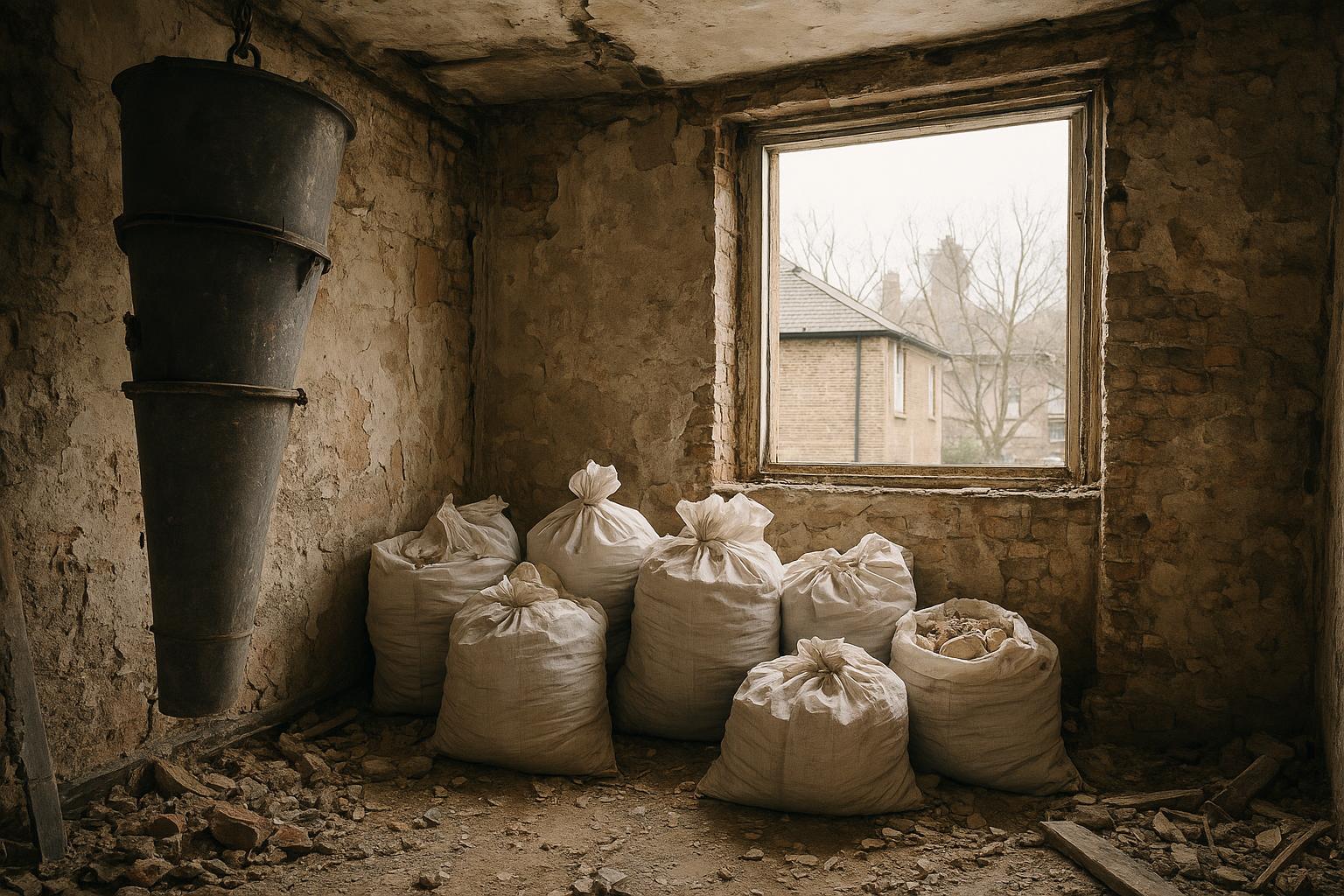
A typical builders' waste chute is a series of tapered sections, usually plastic or metal, linked together to form a continuous enclosed tube from an upper-floor opening or scaffold to a skip or container below. A hopper at the top receives the waste, and the sections reduce its speed as it falls. The chute is supported by the scaffold or a frame and is tied so it cannot move.
Chutes are not intended for large or heavy single items. Sharp or oversized items can damage the chute or block it. Operators normally keep the opening controlled, make sure the container is positioned under the chute and the area below is barriered, and cover the skip to reduce dust and stop debris blowing out.
Mechanical systems, including waste hoists and conveyors, may be used on larger sites. These need a competent person to operate and inspect them, and the equipment must be suitable and maintained.
Setting up a chute safely
Good practice points.
Common good practice includes securing the chute to a scaffold or frame at each section, fitting a hopper with a guard, keeping the lower end inside the skip or a controlled enclosure, covering the skip, barriering the area and keeping people out of the drop zone. Inspect the chute each day and after bad weather. Do not overfill or push blocked material with bare hands.
When a chute is usually sensible
Common cases.
A chute is usually the sensible choice when waste has to leave a building from an upper floor and there is no suitable lift or internal route, when the amount of waste is large, when the building is occupied and the stairs cannot be used safely, or when the work is on a street where people pass below.
It is particularly useful for strip-out work, loft conversions with a scaffold already in place, and refurbishments of flats in houses or small blocks where the stairs are narrow. It can also reduce handling and so reduce manual handling risk and time on site.
In many cases a contractor will already have a scaffold, which makes a chute easy to fit. Where there is no scaffold, the cost and practicality of erecting a frame for the chute should be weighed against alternatives.
Occupied buildings and shared stairs
Extra care where people live.
If other people live or work in the building during the refurbishment, the case for a controlled external or dedicated route is stronger, because dust, noise and debris on shared stairs affect everyone. Residents with children, older people or mobility needs may rely on the stairs more heavily if the lift is restricted.
Agree working hours, protect communal areas and tell residents in advance. Where the building is a block of flats, the managing agent will often set rules for contractors, such as protecting lift cars, limiting delivery times and requiring a deposit against damage.
Size and volume
Think in loads.
A rough count of how many skips of waste the job will produce helps to decide. A handful of bags can go down stairs. Several tonnes of plaster and rubble from an upper floor is a different problem. The more waste, the stronger the case for a chute or hoist.
Alternatives to a chute
Hoists, lifts, bags and stairs.
Alternatives include rubble sacks carried down stairs, a goods lift or building lift where one is available and authorised, a scaffold hoist, a telehandler or crane for larger sites, and a grab lorry or skip positioned close to the entrance. For small jobs, a van that is loaded and removed regularly may be enough.
Each has its own limits. Lifts may be restricted or protected from construction debris. Carrying down stairs creates manual handling risk, damage to finishes and dust. Cranes and hoists need competent operators and often permits. Our guide to high-rise flat clearances without a working lift covers some of the stair-based problems.
Never use a window or balcony as a free-fall route, and never use a communal bin chute for builders' waste. The latter is designed for household rubbish and is easily blocked or damaged.
Using internal stairs
Protect them first.
If the stairs are used, protect treads, walls and banisters, keep bags small and manageable and clear the route daily. Avoid carrying heavy sacks of rubble, which may split. Make sure fire escape routes are not blocked.
Existing communal rubbish chutes
Not for refurbishment waste.
Blocks of flats often have a communal refuse chute for household bags. These are designed for small bags of domestic waste. They are not intended for plaster, rubble, glass, wood offcuts, paint or building debris, which can cause blockages, noise, fire risk and damage to the system.
If you are refurbishing a flat in a block, check the building rules and ask the managing agent how builders' waste should be handled. Many blocks require contractors to remove waste themselves and prohibit using the communal chute. Ignoring this can lead to charges for clearing a blockage or damage.
For a general overview of what is household and what is commercial waste, see our guide to commercial versus household waste laws.
What happens when a communal chute is blocked
Costs and delays.
A blocked communal chute may need specialist clearing, affects all residents and can lead to a charge to the person responsible. If you think a blockage has happened, tell the managing agent immediately and do not try to clear it yourself.
Permissions: landlord, lease, council and highways
Check before putting anything on a wall or road.
If you rent or own a leasehold flat, your lease may restrict works and require consent from the freeholder or managing agent, and fixings to the external walls or common parts are usually not allowed without permission. Ask for written approval before attaching anything.
If the chute is on a scaffold over or next to a pavement, or if a skip is on the road, a licence or permit from the local highway authority may be needed. In London that is usually the borough council. See our guides to skip permit costs and skip hire in London for the basics.
Neighbours should be warned of noise, dust and any temporary restrictions, and listed building or conservation area rules may affect external fixings. A short call to the council planning or building control team can clear up doubts.
Neighbours and public safety
Keep the public in mind.
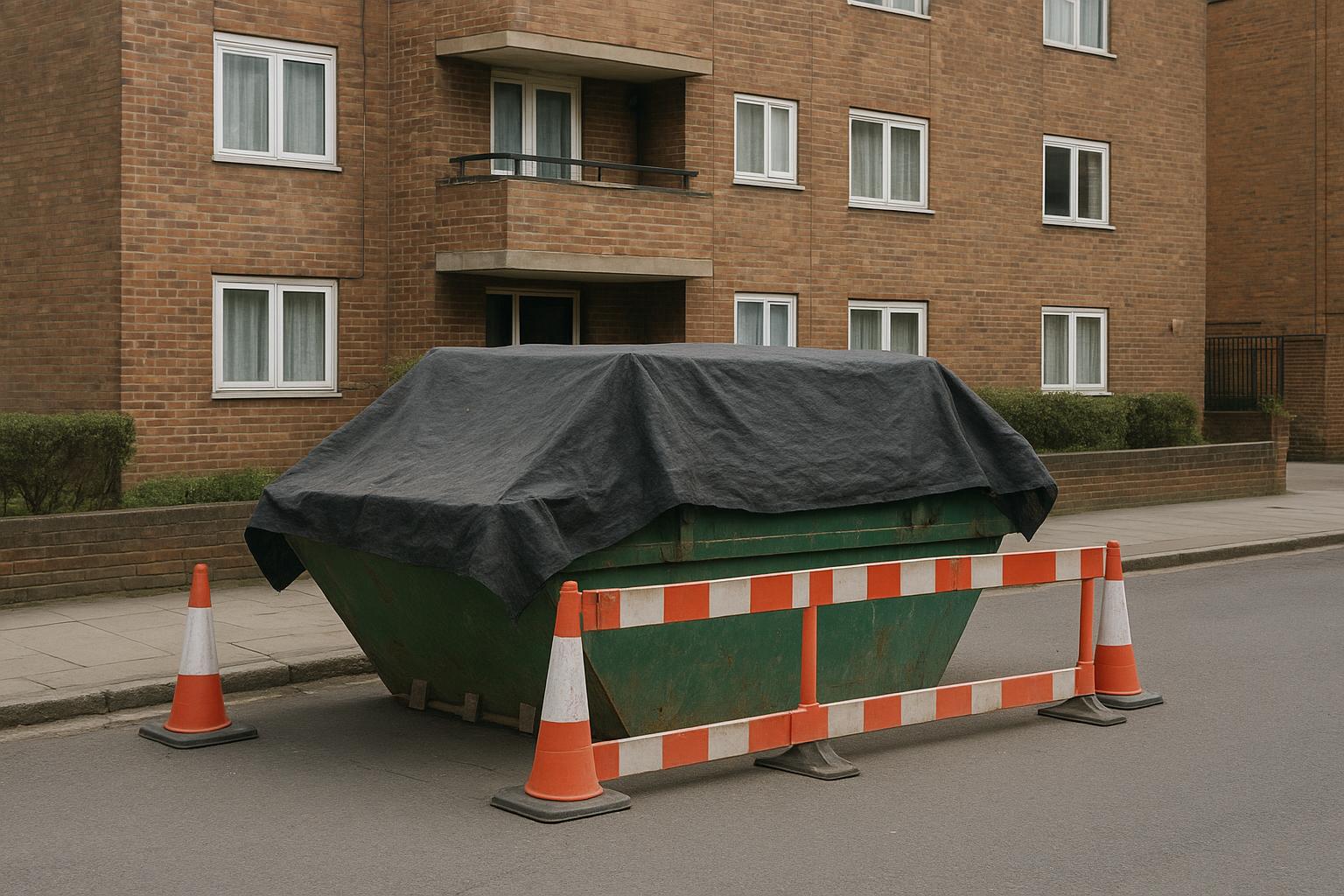
Where the chute or skip is near a pavement, use barriers, signs and lighting as required, keep the pavement clear for pedestrians and avoid work at busy times. Check that the skip is lit at night if it is on the road. The council or the skip supplier can advise on what is required.
Dust, noise and what is in the waste
Control what is going down.
Waste from refurbishment may contain dust and, in older buildings, asbestos. Before strip-out work in a building built before the year 2000, an asbestos survey that is suitable for refurbishment work is normally expected, and materials must not be sent down a chute until it is clear they are safe. See the HSE guidance on asbestos for the current rules.
Dust control is important. Damp down debris, cover skips, use enclosed chutes and avoid dry sweeping. Noise from debris falling in a chute can be significant, so consider working hours and neighbours. Wear suitable PPE, as described in our guide to mandatory PPE for heavy-duty clearances.
Do not mix hazardous items, such as paint tins, batteries or gas cylinders, with general debris. Our hazardous waste guide explains why they must be separated.
Reducing dust in practice
Simple steps.
Damp debris lightly before it goes into the chute, avoid dropping loose dust from a height and use covered skips. Keep windows and doors closed on neighbouring floors if possible and clean up around the base regularly. Wear a suitable face mask, as required by your risk assessment.
Skips, grab lorries and where the waste goes
The chute is only half the system.
A chute needs a container at the bottom, usually a skip, that is the right size and in the right place. Heavy materials such as rubble and plaster fill a skip quickly and can overload it, so sizing and weight limits matter. See our guides to maxi skips, grab hire and tippers and building waste disposal.
Waste must be taken by a registered waste carrier to a licensed site. As the producer or the person arranging it, you have a duty of care, as explained in our duty of care guide. Ask for the carrier's registration and keep a waste transfer note. Costs for a renovation job are covered in our builders and renovation waste clearance cost guide.
Site waste management plans are no longer a legal requirement in England, but planning how waste will leave the site is still good practice and may be a condition of a contract or building rules.
Weight, loading and overfilling
Heavy waste fills skips fast.
Rubble, soil, plaster and tiles are very heavy for their volume. A skip that looks half full may already be near its safe weight limit, and an overloaded skip may be refused by the lorry driver. Ask the supplier about weight limits and whether heavy waste needs a specific type of skip, and do not load above the top of the sides. Keep prohibited items such as paint, gas cylinders, electrical items and asbestos out of the skip.
Mixing heavy and light waste can make a chute blockage more likely, and wet plaster or sticky materials may clog the tube. Break large pieces down before they go in and feed the chute steadily rather than in surges.
Keeping records
Paperwork matters.
Keep the permit, the skip supplier details, waste transfer notes, risk assessment and any consent from the landlord or council. If there is a dispute or an incident, these records are the first thing people ask for.
Frequently asked questions
Common questions about waste chutes on refurbishments.
Is a waste chute legally required for refurbishments?
There is no blanket rule. The Work at Height Regulations 2005 require that materials are not thrown or tipped from height where that could cause injury, and that they are lowered in a controlled way where necessary. A chute is one standard way to do that.
Can I throw rubble out of a window into a skip?
No, not where it could injure anyone or damage property. Use a chute, hoist or another controlled method, and keep the area below barriered.
Can I use the communal rubbish chute in my block?
No, not for builders' waste. Communal chutes are for household bags and can be blocked or damaged by debris. Check with the managing agent how contractors should remove waste.
Who decides whether a chute is needed?
It should come from a risk assessment by the person in control of the work, such as the principal contractor, following HSE guidance. A client should ask the contractor how waste will be removed.
Do I need permission to fit a chute?
You may need consent from the landlord or managing agent, and a licence from the council if a scaffold or skip is on the highway. Ask before work begins.
Are there alternatives to a chute?
Yes, including hoists, goods lifts, carrying sacks down stairs, a crane or grab lorry, and frequent van collections for small jobs.
What about asbestos in the debris?
In older buildings, a suitable asbestos survey is normally needed before refurbishment, and suspect materials must not be sent down a chute. Check the HSE guidance.
Who takes away the waste from the skip?
A registered waste carrier. Check their registration and keep a waste transfer note to show you met your duty of care.