Direct answer
In England, waste is hazardous if it has properties listed in law, such as being toxic, flammable, corrosive, carcinogenic or harmful to the environment. In a house, that usually means asbestos, solvent-based paints and chemicals, pesticides, lead-acid and some other batteries, fluorescent tubes, gas cylinders, aerosols, oils, fridges and freezers, and older TVs and monitors. A clearance firm may refuse them because its waste carrier registration, vehicle, insurance, tip permits or onward contracts may not cover them, and because mixing them into a general load can put the crew, the load and the firm at risk. Ask before booking, and arrange separate disposal for anything on the list.
Contents
- What "hazardous waste" means in law
- The household exemption, and where it stops
- Items in a typical house that are classed as hazardous
- Lithium batteries: the fastest-growing fire risk
- What about "empty" containers and half-used products?
- Why clearance firms may refuse these items
- How hazardous items affect the price of a clearance
- What a careful crew does when it finds something on the day
- Asbestos: the one that should never be improvised
- How to dispose of each type properly
- How to prepare before the crew arrives
- Special cases: garages, allotments, workshops and older homes
- Questions to ask a clearance firm
- Common mistakes and what they can lead to
- Frequently asked questions
What "hazardous waste" means in law
A legal category, not just a general feeling that something is dangerous.
In England, waste is classified using the List of Wastes together with the hazardous waste rules made under the Environmental Protection Act 1990 and the Hazardous Waste (England and Wales) Regulations 2005. Rather than relying on whether something looks dangerous, the system gives waste a code and then asks whether it has one or more hazardous properties. These include being explosive, oxidising, flammable, irritant, harmful, toxic, carcinogenic, corrosive, infectious, toxic for reproduction, mutagenic or ecotoxic. Some wastes are hazardous automatically because they are listed as such, and others are hazardous only when they contain enough of a dangerous substance.
This matters in a house clearance because a single property can contain both ordinary and hazardous items side by side. A wardrobe and a half-empty tin of solvent-based paint look like part of the same job, but legally they are different kinds of waste with different handling, different documents and different places they can go.
Waste regulations can change, and the detail also differs slightly between England, Wales, Scotland and Northern Ireland. The Environment Agency and GOV.UK pages on hazardous waste are the reference points; the aim of this guide is to explain how the rules apply in practice to a London house clearance rather than to replace them.
The household exemption, and where it stops
Householders have more freedom than businesses, but the carrier does not.
Hazardous waste produced by a private household is generally not subject to the consignment note system that applies to businesses and other producers. That is why you can take a tin of paint or a tube to a council recycling centre without paperwork. It does not mean household hazardous waste can go into any bin, skip or van. Councils set their own rules on what their sites accept, and a collector who takes the waste on still has duties of its own once it has it.
The exemption also stops at the property boundary of a private home. If the clearance is of a commercial unit, a landlord's let property after a business tenant, a workshop, a salon or a shop, the waste may be commercial and the stricter rules, including consignment notes for hazardous items, may apply. Mixed-use buildings, such as a flat above a shop, are the borderline cases to check with the council.
Your own duty of care continues either way. You are responsible for making sure the waste is passed to someone authorised to take it, as explained in the guide to householder waste duty of care.
Items in a typical house that are classed as hazardous
Most of them are in the garage, shed, kitchen cupboard or loft.
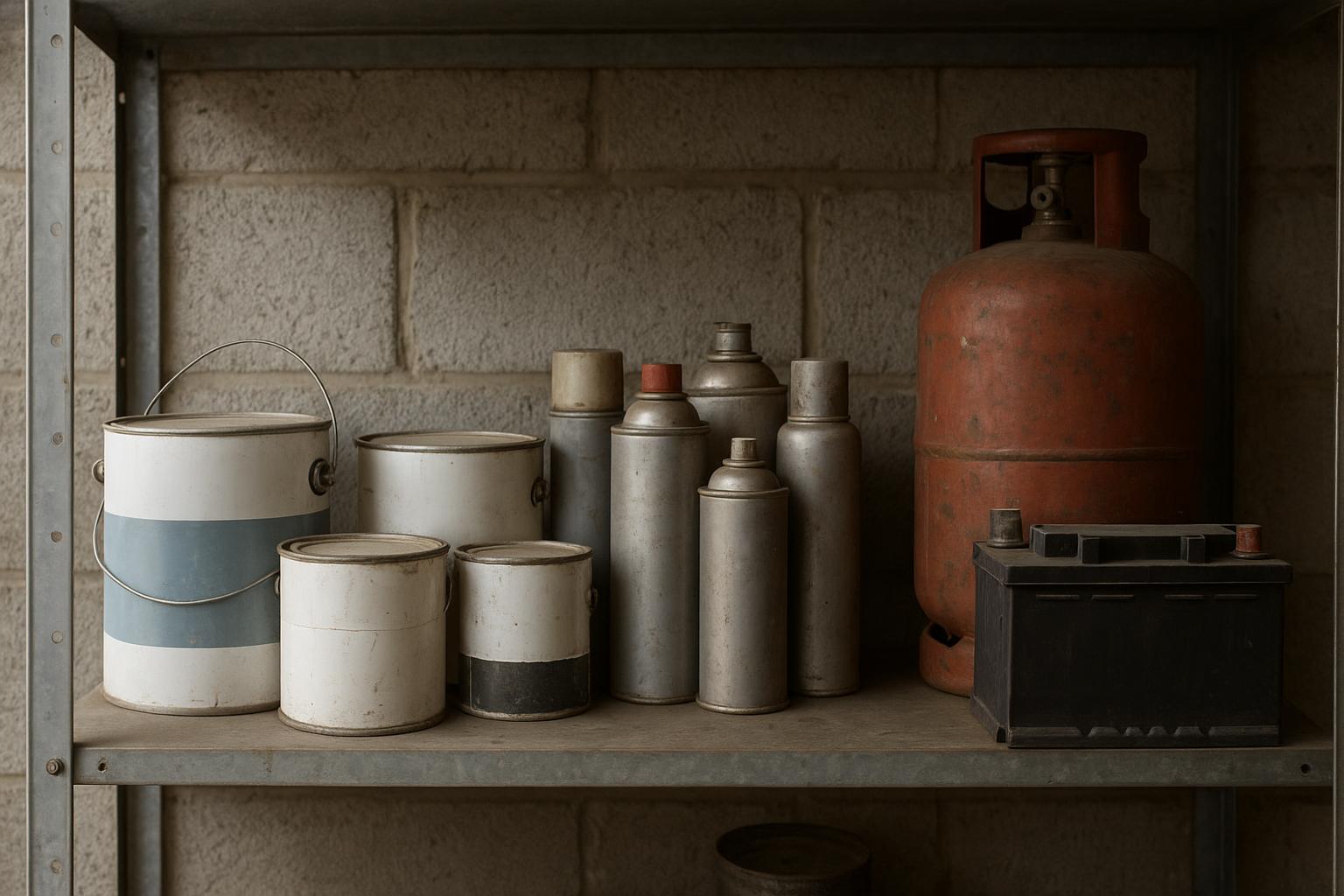
The following are the items that most often turn up in a clearance and are normally treated as hazardous or as needing specialist handling:
- Asbestos. Textured ceiling coatings, old insulation board, pipe lagging, cement sheeting on garages and sheds, and some old floor tiles and their adhesive. Never break, drill or sand suspect material.
- Solvent-based paint, thinners, white spirit, varnish and wood treatments. Dried-out water-based paint is generally treated differently from liquid or solvent-based products, but check with the site that will take it.
- Batteries. Lead-acid car batteries, and lithium and other rechargeable batteries, which can start fires if damaged or crushed in a compactor.
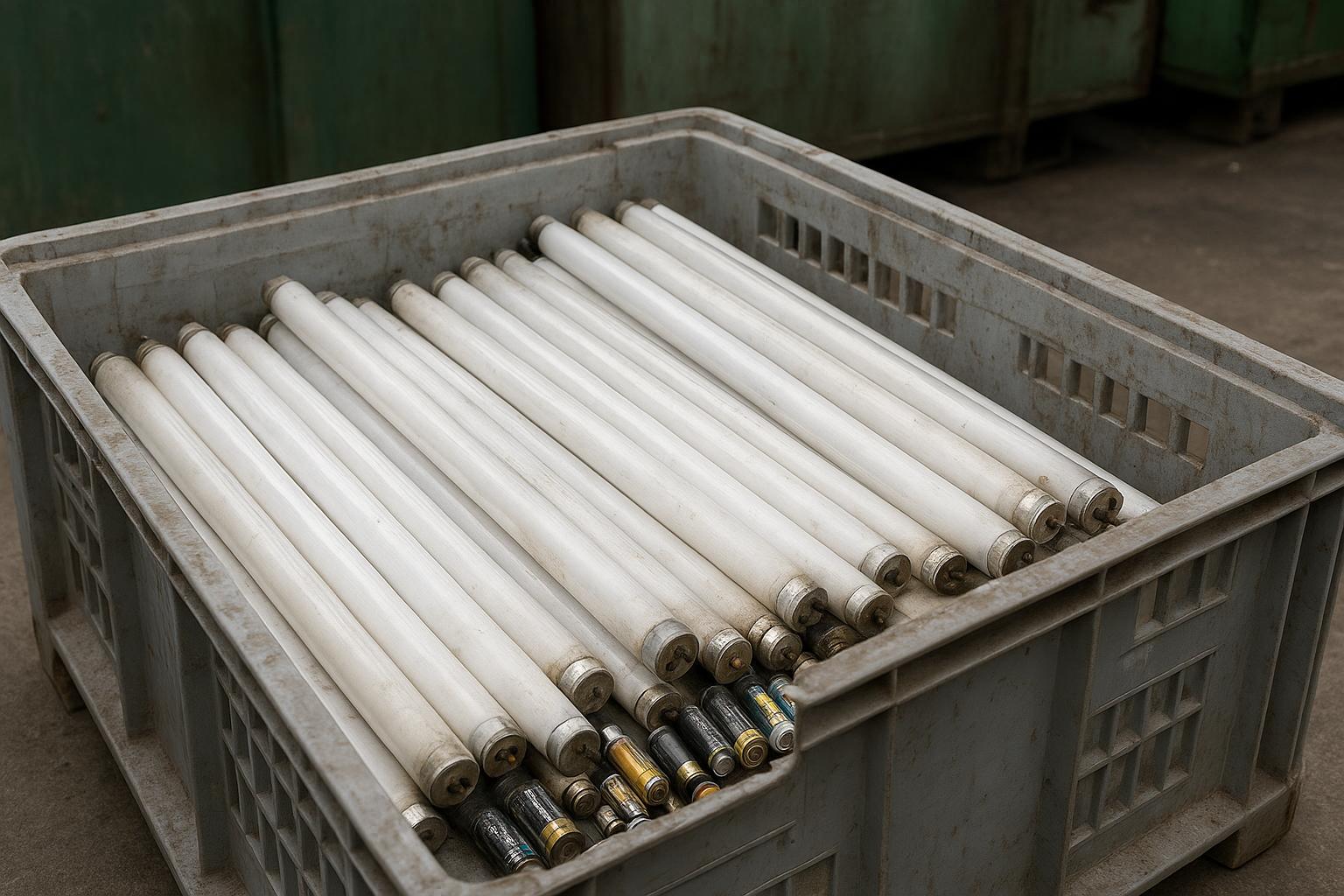
- Fluorescent tubes and some energy-saving lamps, which contain small amounts of mercury.
- Gas cylinders, including camping gas, patio heater bottles and welding gas.
- Aerosols that are not empty, and spray paints.
- Pesticides, weedkillers, pool chemicals and bleach-type products in bulk.
- Oils and fuels: engine oil, petrol, diesel, heating oil and cooking oil in quantity.
- Fridges, freezers and air-conditioning units containing refrigerant gases.
- Older cathode-ray tube TVs and monitors.
- Medical waste such as sharps, which need a separate route.
- Some electrical items that fall under WEEE rules (small electricals, tools and appliances), which have their own recycling routes.
Lithium batteries: the fastest-growing fire risk
Small cells in everyday items add up in a clearance.
Lithium-ion batteries are now in vape devices, power tools, e-bikes and scooters, laptops, phones, toothbrushes, cordless vacuums and even greetings cards and toys. When they are crushed, punctured or short-circuited in a compacting vehicle or a skip they can overheat and ignite, and waste fires caused by batteries are a recognised problem for the UK waste industry. A house clearance often turns up drawers of old phones, chargers and tools, plus an e-bike battery in the shed, so it helps to treat all of it as battery waste.
Keep batteries separate from the general load, do not leave them in appliances that are going into a compactor, tape over exposed terminals on loose cells, and take them to a recycling point. E-bike and scooter batteries are larger and more serious: if one is swollen, hot, or has been in a fire or flood, keep it outside, away from buildings and flammable items, and contact your council or the manufacturer for advice before moving it.
What about "empty" containers and half-used products?
Rules of thumb for the grey areas.
An empty, dry paint tin is usually treated as scrap metal at many sites, while a tin with liquid paint is not. A completely empty aerosol is commonly accepted for recycling, while one that still hisses or rattles with contents is not. Dried-out, hardened water-based paint may be accepted in residual waste by some councils, but liquid or solvent-based products generally are not. As each council and site sets its own acceptance rules, it is best to check the local page rather than assume, and to avoid decanting or combining products, which can make them harder to dispose of and create a reaction.
If you are clearing a property after a bereavement or a long tenancy, expect to find old stock: half tins of paint from decades ago, rusted solvents, unlabelled jars, garden chemicals and sometimes items no longer available legally. These should never be tipped into the general load, and if the contents are unknown, ask the council how to handle them.
Why clearance firms may refuse these items
It is rarely about being difficult. It is usually about what their licences and contracts allow.
A house clearance firm that quotes for general rubbish has usually priced and arranged the job around loading furniture and bags into a van, taking the load to a transfer station and recycling or disposing of it there. Hazardous items break that pattern for several reasons:
- Registration and authorisation. A firm may be registered as an upper-tier waste carrier for ordinary waste but not set up to carry certain hazardous types, and its tip or transfer station may not accept them.
- Insurance. Policies often exclude pollution, asbestos and some hazardous materials.
- Safety. A leaking container, damaged battery or unmarked bottle can injure a crew or contaminate a load. Asbestos in particular is a serious long-term health risk when fibres are released.
- Contamination of the load. A single bottle of solvent can make a load of otherwise recyclable material non-compliant at the receiving site.
- Disposal cost. Hazardous items often need a specialist disposal route with its own charges, which a standard clearance price does not include.
- Fire risk. Lithium batteries and aerosols in a compacted van or skip are a known cause of waste fires.
A firm that refuses is often being responsible, and a firm that will take anything without asking questions is worth a second look. A crew that quietly puts paint, gas bottles or batteries into the general load is passing the problem on, and under duty of care some responsibility may come back to you.
How hazardous items affect the price of a clearance
Surprises on the day are the usual cause of disputes.
A typical clearance price is built from the volume of waste, the time the crew will need, access, parking and disposal costs. Hazardous items add handling and disposal costs and may require a separate trip or carrier. If a quote has been given without knowing about them, the crew may reasonably decline to take them or add a charge. To avoid disagreements, describe the garage, shed and loft honestly, give an approximate number of tins, bottles, batteries and cylinders, and ask the firm to confirm in writing whether those items are included.
Our guide to house clearance pricing by volume explains how a quote is normally constructed, and the risks of hiring unlicensed man and van services explains why a very low price often hides the fact that nothing is being disposed of properly.
What a careful crew does when it finds something on the day
Good practice is simple and visible.
- Stops and checks before lifting or moving an unknown container.
- Asks you about it, and photographs it where the label is readable.
- Keeps it separate from the general load and does not compact it.
- Tells you what they will not take and why, and what the alternatives are.
- Keeps vehicles ventilated and does not leave containers in sun or near heat.
- Records what was taken in the paperwork they give you.
If a crew member discovers something that looks like asbestos, a leaking drum or an unknown powder, the safest response is to stop, leave it, and contact the council or a specialist. A refusal at that point is a sign of good judgement, not obstruction.
Asbestos: the one that should never be improvised
The rules are strict and the risk is long-term.
Asbestos was widely used in UK buildings until it was banned, and it is still found in many older London homes, garages and outbuildings. It is only dangerous when fibres are released, which happens when material is damaged, broken or disturbed. That is why a clearance crew should never carry out or tolerate rough demolition of suspect materials.
If you suspect asbestos, stop work in that area, do not sweep or vacuum dust, and get the material identified by an accredited surveyor or laboratory. Licensed contractors are required for the higher-risk types of asbestos work under the Control of Asbestos Regulations 2012, while small quantities of low-risk material, such as a few pieces of cement sheeting from a garage, can sometimes be handled by a householder following Health and Safety Executive guidance and double-wrapping before disposal. Many councils have their own rules about whether household asbestos is accepted at their recycling centres, in what quantity, and whether you must book, so check before you travel.
A standard clearance firm will not normally remove asbestos, and you should not assume one will. If you need a room cleared that contains suspect material, resolve the asbestos first and then arrange the clearance. If you have been given a quote that appears to include asbestos at a normal clearance price, ask to see the carrier's waste carrier registration and its disposal route in writing.
How to dispose of each type properly
Different items go to different places, and most of them are free for householders.
Most London boroughs run household waste and recycling centres that take a range of hazardous items from residents, sometimes with limits on quantity or a need to book. The details vary by council, so the council's own page is the final word. As a general guide:
- Paint, chemicals and oils: take to a council recycling centre in sealed original containers, or ask the borough whether it runs a collection. Never pour them down a drain or on the ground.
- Batteries: shops that sell batteries must usually take small ones back, and recycling centres take car batteries and rechargeables. Tape the terminals of lithium batteries before handing them in.
- Fluorescent tubes: recycling centres and some retailers.
- Gas cylinders: return refillable cylinders to the supplier; recycling centres may take others.
- Fridges and freezers: collected by the council on request, taken back by a retailer when you buy a new one, or taken to a recycling centre.
- CRT TVs and monitors: recycling centres and WEEE collection points.
- Asbestos: only through the route your council or an accredited contractor confirms.
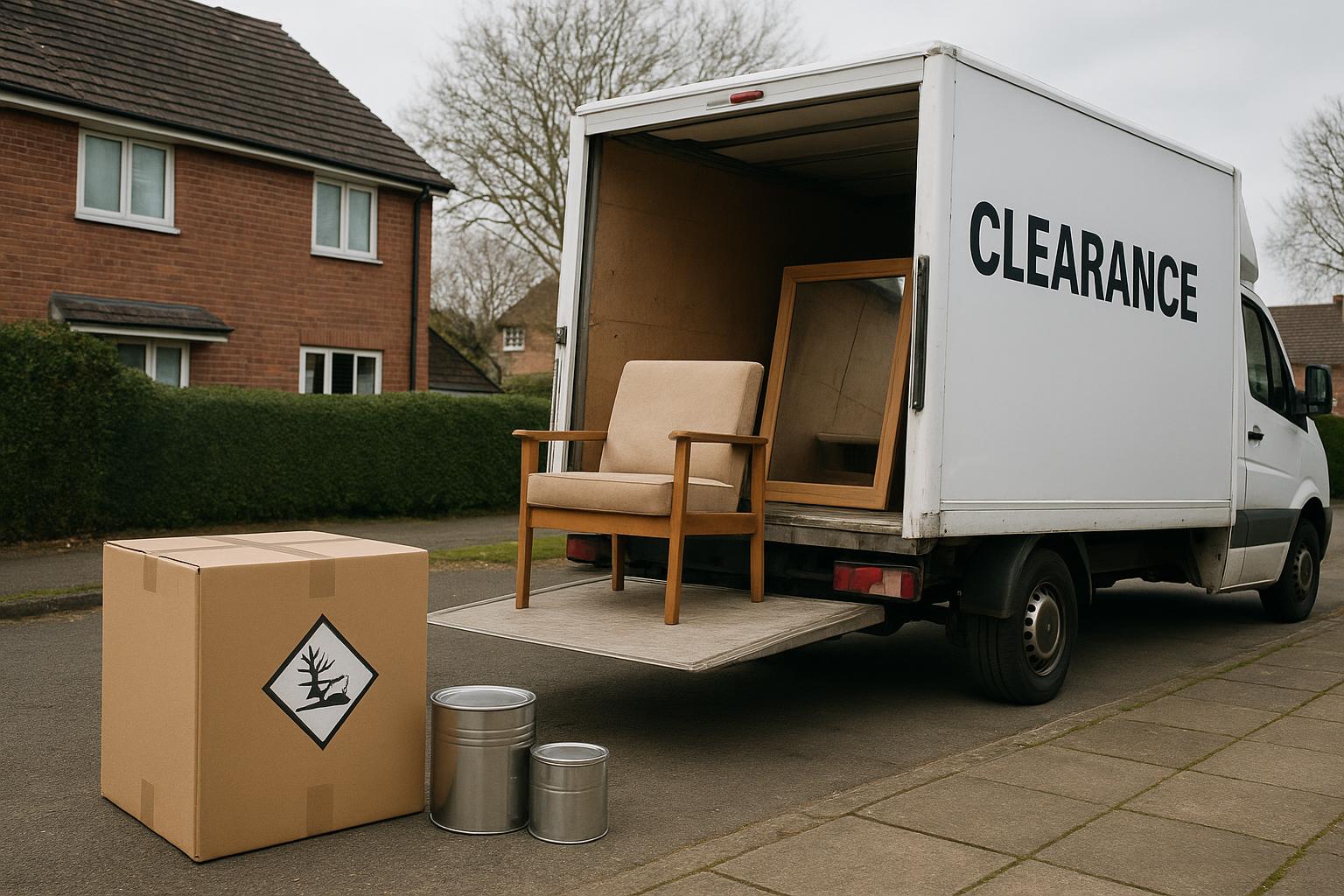
If a clearance firm is taking away most of the contents, you can usually agree that the hazardous items are set aside and dealt with separately. Some carriers will take them for an extra charge when they hold the right authorisation and can show you a transfer note or receipt. If they offer, ask to see the paperwork and where the items will go.
How to prepare before the crew arrives
Ten minutes of sorting saves arguments and extra charges on the day.
Walk through the garage, shed, loft, under-sink cupboards and any outbuildings. Put anything on the list above into one place away from the general waste, keep it in its original container where possible, and note roughly how much there is. Do not mix products or decant them into unlabelled bottles. Leave lids tight and wear gloves when handling.
Photograph the items and mention them when you ask for quotes, so that the price reflects the real job. A good clearance quote should say whether hazardous items are included, excluded or charged separately. If you are comparing offers, request clearance quotes and describe what is in the garage honestly. If you are unsure whether something counts, contact the council or the Environment Agency rather than guessing.
Special cases: garages, allotments, workshops and older homes
Where hazardous items concentrate.
Garages and sheds hold most of the problem items: paint, oil, weedkiller, batteries, gas bottles, and sometimes asbestos cement roofing or wall panels. Allotments often contain chemicals, treated timber, fuel for strimmers and burnt material. Workshops and studios may hold solvents, resins, glues, photographic chemicals and old equipment. Older homes are more likely to contain textured coatings, lagging, old gas appliances and electrical items from before current safety standards.
If the property has been empty for a long time, expect more surprises, and give yourself time to look carefully before the crew arrives. See our guide on hoarded property and council intervention and biohazard clearance for the extreme end, where specialist help is more likely to be needed.
Questions to ask a clearance firm
These separate the careful operators from the careless ones.
Before you hire, ask:
- Are you a registered waste carrier, and can I see the registration number? Our guide on choosing a licensed house clearance company explains how to check it.
- Do you take paint, chemicals, batteries, gas bottles or fridges, and if so what do you charge?
- Where will the waste go, and will I get a waste transfer note? See waste transfer notes for house clearance.
- What do you do if you find something hazardous on the day?
- Does your insurance cover the types of waste in this property?
The honest answer is usually a simple one. A professional will tell you what they will and will not take and will not be offended by being asked.
Common mistakes and what they can lead to
Most problems come from convenience.
- Putting paint tins, aerosols or batteries into a skip. Skip companies commonly prohibit them, and a contaminated skip can be refused or charged extra.
- Pouring solvents, oil or chemicals down a drain, which can cause pollution and may lead to enforcement action.
- Burning treated wood, paint or unknown material.
- Handing hazardous items to an unlicensed collector who then fly-tips them. As explained in the guide to fly-tipping penalties and liabilities, responsibility can come back to the person who gave the waste away.
- Assuming a "man with a van" will take anything. See the risks of hiring unlicensed man and van services.
- Disturbing suspected asbestos before it has been identified.
If something goes wrong, report it early. For fly-tipped hazardous material, contact the council or the Environment Agency rather than moving it yourself.
Frequently asked questions
Common questions about hazardous waste in house clearances.
What counts as hazardous waste in a house?
Typically asbestos, solvent-based paint and chemicals, pesticides, lead-acid and other batteries, fluorescent tubes, gas cylinders, aerosols, fuels and oils, fridges and freezers, and older CRT TVs and monitors.
Why would a house clearance company refuse paint or chemicals?
Because their waste carrier registration, insurance, vehicle, tip permits or onward contracts may not cover hazardous items, and mixing them with a general load can create safety and compliance problems.
Can I put paint tins in a skip?
Most skip companies prohibit liquid paint and chemicals. Dried water-based paint is sometimes accepted, but check with the skip firm. A council recycling centre is usually the safer route.
Will a clearance firm remove asbestos?
A standard clearance firm normally will not. Asbestos needs identification and, depending on the type and quantity, a licensed or specialist contractor. Resolve it before the clearance.
Do I need paperwork for household hazardous waste?
Private households are generally exempt from the consignment note system, but a carrier who takes the waste still has duties, and you should keep any receipt or transfer note as evidence of where it went.
Where do I take old batteries, tubes and gas bottles?
Council recycling centres and many retailers take batteries and tubes. Refillable gas cylinders usually go back to the supplier. Check your borough's rules, as sites differ.
What should I do if I find something I cannot identify?
Do not open, mix or move it more than necessary. Keep it in its container, away from heat and children, and ask your council or the Environment Agency how to dispose of it.