Direct answer
A wait and load clearance sends a van to the property, the crew loads your items and leaves the same day, so it normally needs only somewhere legal to stop for a short time. A skip stays on the road, so if it is placed on a public highway the person hiring it generally needs a skip permit or licence from the highway authority, plus the skip must meet lighting and marking rules. Parking restrictions, loading rules and controlled parking zones apply to both, and fines or removal can follow if the rules are ignored. Rules differ between London boroughs and Transport for London roads, so check with your council before booking.
Contents
- Two different ways of clearing a property
- How volume tips the balance
- How wait and load works on the street
- Multiple trips and return visits
- How a skip on the road works
- Lighting, marking and safety
- Who applies for the permit
- Keeping the paperwork
- Timing and lead times
- Busy periods
- Controlled parking zones and loading rules
- Red routes and Transport for London roads
- Where penalty risks arise
- If you receive a penalty notice
- Side-by-side comparison
- Thinking about total cost
- If you have private space
- Talking to neighbours
- When a mix works best
- Sequencing a larger project
- Checks before you book
- Getting the answers in writing
- Waste carrier registration
- Checking the skip company
- Common mistakes
- What to do if things go wrong
- Frequently asked questions
Two different ways of clearing a property
Short stay against long stay.
A wait and load service, sometimes called a man and van or clearance van service, sends a crew to your property to load waste and take it away. The vehicle is usually on site for the duration of loading and then leaves. A skip is a container delivered to your address and left for a period, usually days, while you fill it yourself.
That difference in time on the street changes the rules. A vehicle stopping briefly to load is treated like any other vehicle, subject to parking and loading restrictions. A skip left on the road becomes an obstruction in law unless it is authorised, so the highway authority regulates it.
Which is better depends on the job, the street, the volume and who will do the lifting. Our guide to house clearance versus skip hire compares the two in general terms, and this article focuses on the street and penalty side.

How volume tips the balance
Think about how much you have.
A small number of bulky items, or the contents of a flat, rarely justifies a skip on the road. A van with a crew can usually manage it in one or two trips. A large garden project or a big building clear-out may fill a skip faster than a van can carry it.
If you are unsure, send photos to carriers and ask what they think. Our guide on house clearance pricing by volume shows how volume drives cost for a crew.
How wait and load works on the street
The crew needs space and time.
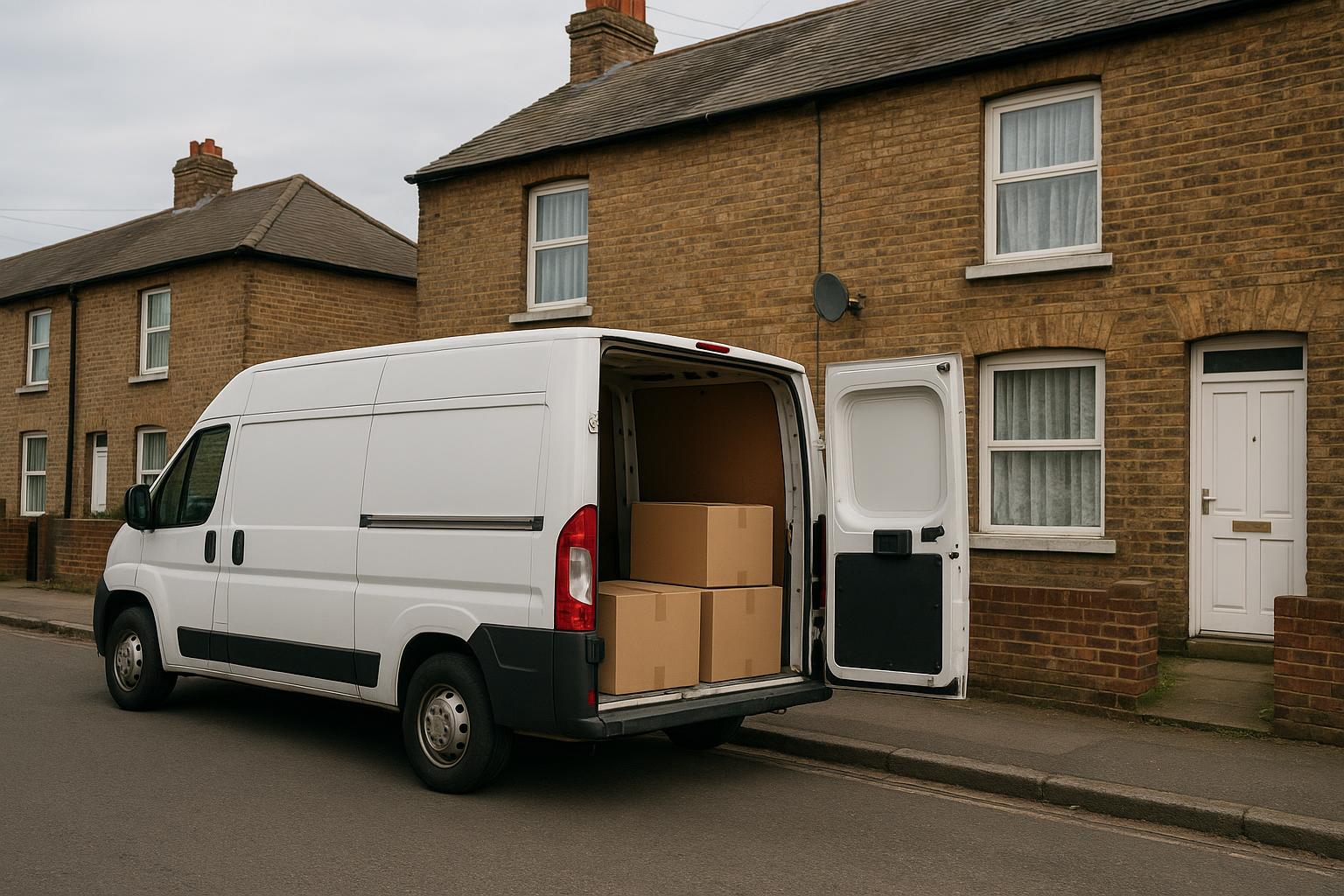
With a wait and load clearance, the crew arrives, parks as close as is allowed, carries items out and loads the van. The time on the street might be one to several hours depending on the volume. When the van is full, it leaves for a disposal site, and for a larger job it may return.
The main practical question is where the van can legally stop. On a residential street, that might be a resident bay, a pay and display bay, a single yellow line outside restricted hours, or your own driveway. Each has rules, and they vary between boroughs and roads.
Because the stay is short, there is no need for a permit to place equipment on the road, but parking restrictions still apply. A crew that cannot park close may need to carry items further, which can increase the time and the price.
Multiple trips and return visits
Plan for the return.
On a larger job, the van may have to leave and return. That means the parking space is needed again, and if it has been taken by another vehicle, the crew may have to find a new spot. A suspension or a private space can help here.
Ask the carrier how many trips it expects and how it plans to manage parking between them. A clear plan reduces the risk of delays and extra charges.
How a skip on the road works
Authorised or not.
If a skip is placed on private land, such as a driveway or garden, a permit is not usually needed, although you should check any restrictions on your property. If it is placed on a public road or pavement, it generally needs permission from the highway authority, which in most of London is the borough council, and in some cases Transport for London.
The permit sets conditions: where the skip can be placed, how long it can stay, and the safety measures required. These typically include lighting at night, reflective marking, cones and the skip company’s identification. The person responsible for the skip must follow them.
Our guide to skip permit cost explains what you can expect to pay and how the process works, and the skip hire London cost guide covers the hire side.
Lighting, marking and safety
Not optional.
Skips on the road are a hazard, particularly at night. Conditions usually require that they are marked, reflective and lit, and positioned so as not to obstruct traffic or pedestrians. Check what your permit requires and make sure the skip company complies.
Do not place items on the road beside a skip, do not overfill it above the sides and do not use it for anything that breaks the rules. These are common reasons for complaints and enforcement.
Who applies for the permit
Usually the person hiring the skip.
In many cases, the skip hire company applies for the permit on the customer’s behalf, and the cost is included or added to the quote. In others, the customer must apply. Check with the company before you book, and do not assume that the permit is included.
Responsibility matters, because if a skip is on the road without a permit, the council may take enforcement action against the person who placed it or arranged it. Ask for a copy of the permit and keep it, and make sure the skip is placed exactly where the permit says.
If anything changes, such as the dates or the location, ask the company or the council whether the permit needs amending. Do not move a skip without checking.
Keeping the paperwork
Have it to hand.
Keep a copy of the permit, the skip company’s details and any messages about the booking. If a council officer or neighbour asks, you can show that the skip is authorised. If something goes wrong, the paperwork also helps resolve it quickly.
Photograph the skip when it is delivered and when it is collected, showing its position and condition. This is useful if any damage is claimed.
Timing and lead times
Do not leave it to the last minute.
Permits do not usually appear instantly. Councils set their own processing times, and some need several working days. If the job has to happen soon, ask the council or the skip company what is possible.
Parking suspensions, which are needed if a bay must be cleared for a vehicle or skip, generally need notice too, and signs may have to be in place for a set period beforehand. Details vary by borough, so check your council’s website.
For a wait and load clearance, there is usually no permit lead time, but if you want a parking space cleared for the van, the suspension notice period applies. Our guide on parking suspensions for house clearances explains the process.
Busy periods
Demand affects availability.
Skip permits and suspensions can take longer in busy periods, and skip companies may have less availability. Spring and summer, when many people clear gardens and do building work, are typically busy.
If your timing is flexible, booking early gives you more choice and often a calmer process. If it is not, tell the company at the start so it can advise on what is realistic.
Controlled parking zones and loading rules
Know your street.
In a controlled parking zone, parking is limited to certain users or times, and rules can differ from one street to the next. Yellow lines usually mean parking is not allowed, with loading rules showing when loading is permitted. Red routes and some main roads have stricter rules, and stopping is often prohibited.
Loading is not the same as parking. Where it is permitted, it usually applies for a limited time and for active loading, not for waiting around. Signs and road markings tell you what is allowed, and the rules on each sign apply.
Our guide to parking a clearance truck in controlled parking zones goes into this in detail.
Red routes and Transport for London roads
Stricter rules apply.
Red routes and some major roads in London are managed by Transport for London rather than the borough, and stopping is often prohibited or tightly controlled. If your property is on or near one, ask the carrier how it plans to load, and check TfL’s current information.
Loading on these roads may be limited to specific bays or times, and enforcement is active. A short stop that would be fine on a side street can lead to a penalty on a red route.
Where penalty risks arise
Both options have them.
For a wait and load van, the risk is mostly a parking or loading penalty charge notice if the vehicle stops where it should not or stays too long. Charges can fall on the registered keeper of the vehicle, which is usually the carrier, and a carrier may pass a charge on if the contract allows it. Ask before booking.
For a skip, the risks are different. A skip placed without a permit can be removed by the council, and the person responsible may face a fine or recovery costs. A skip that is not properly lit or marked can also lead to enforcement and, more importantly, can cause accidents.
Both options can lead to disputes with neighbours if access is blocked. Talk to people nearby in advance if you can. Rules and penalty amounts change, so check your council’s current information instead of relying on a figure from an article.
If you receive a penalty notice
Do not ignore it.
If a penalty charge notice arrives, read it carefully. It will state the reason, the amount, the deadline for payment at a reduced rate and how to challenge it. If you believe it is wrong, follow the challenge procedure within the time limit.
If the notice was issued to the carrier, tell them what happened and ask how they handle it. Keep any photos or evidence, such as signs, markings and time-stamped messages, as they can support an appeal.
Side-by-side comparison
Choose by the job.
Here is a simple way to think about the practical differences.
- Time on the road. Wait and load is short, a skip is days.
- Permit. Wait and load needs none for the vehicle, a skip on the road generally does.
- Labour. Wait and load includes the crew, with a skip you load it yourself.
- Parking. Wait and load needs a short legal stop, a skip needs a location you can use for days.
- Waste type. Skips have restrictions on what can go in them, and clearance crews have their own rules.
- Best for. Wait and load suits house contents and furniture, a skip suits large volumes of building or garden waste over time.
Neither is better in every case. The right choice depends on what you are clearing, the street and your own capacity to lift and load.
Thinking about total cost
Look beyond the headline price.
A skip quote may not include the permit, suspension, lighting or extra days. A wait and load quote may not include parking, stairs or certain items. Ask each company to list what is included and what is not.
Add up all the likely costs for each option and compare them on the same basis. A cheaper headline price can become more expensive once extras are added. Our guide on what affects house clearance cost covers how a price is built.
If you have private space
A driveway changes everything.
A private driveway or forecourt can make both options easier. A van can park on it and a skip can sit on it without a highway permit. You still need to be sure the surface can take the weight and that nothing blocks access for emergency vehicles or neighbours.
If your driveway crosses a pavement, the crew or skip company must take care not to damage the kerb or footway. Some councils have rules about vehicles crossing a dropped kerb, so ask if you are unsure.
If the property is leasehold or part of a managed development, check the lease or with the managing agent before putting a skip on a shared area.
Talking to neighbours
A small courtesy that helps.
Tell neighbours when a van or skip will be there, how long it will take and whom to contact if there is a problem. People are usually more understanding if they know in advance, and it can prevent complaints to the council.
If your clearance will block someone’s drive or parking space, speak to them directly and agree a time. It is also worth making sure the crew knows not to block access.
When a mix works best
Combine the strengths.
For larger projects, some people use both. A skip handles heavy, bulky waste such as rubble, old fittings and garden material, while a wait and load crew removes furniture, appliances and household contents. This can reduce the time the skip is on the street.
Check what can and cannot go in a skip. Items such as mattresses, fridges, televisions and some chemicals are often restricted, and the skip company can tell you what it allows. Our guide to maxi skip hire and mini skip hire helps you choose a size.
Plan the sequence: remove valuables and keepsakes first, then use the crew for household items, and use the skip last for the heavy waste.
Sequencing a larger project
Order matters.
For a large property, a sensible order is to remove valuables and keepsakes, arrange charity or reuse collections, then use a wait and load crew for the main contents, and finally a skip for any heavy waste. This keeps the skip on the road for a shorter time and reduces the risk of mixing categories.
Our house clearance checklist provides a fuller plan.
Checks before you book
Five minutes of calls.
Before you confirm either option, run through some simple checks. They take a few minutes and can prevent a lot of trouble.
- Where will the vehicle or skip go, and is it legal to stop or place it there?
- Is a permit or suspension needed, who applies and how long will it take?
- Who pays if a penalty charge notice or removal occurs?
- Is the carrier or skip company registered to carry waste?
- What cannot go in the skip or on the van?
- What is the plan if access is blocked on the day?
Write down the answers and keep them with your quote.

Getting the answers in writing
A message is enough.
You do not need a formal contract. A text or email that confirms the date, the place, who handles the permit, what is included and the price is a useful record. Keep it with the permit and your quote.
If the company refuses to confirm anything in writing, treat that as a warning. Reliable businesses are usually happy to put the key points in a message.
Waste carrier registration
Your duty of care applies to both.
Whether you hire a wait and load crew or a skip, the person taking your waste should be a registered waste carrier. You have a duty of care to check, and councils can act against households whose waste is dumped illegally.
Ask for the registration number, check it on the GOV.UK public register and keep a record. Our guide on householder waste duty of care explains what is expected, and the waste carrier licence check page shows how to look up a number.
This applies even if the permit and parking are arranged perfectly. A permit allows the skip on the road. It does not make the carrier authorised to take your waste.
Checking the skip company
Same principle.
Skip hire firms that carry waste need registration just like clearance carriers. Ask for the registration number and check it on the GOV.UK register. Also ask where the waste goes after collection, and whether they sort and recycle it.
A reliable company will explain this openly. Our guide to skip bags may also be useful if you only have a small amount of waste and no space on the road for a skip.
Common mistakes
Avoid these.
Several mistakes appear again and again in disputes about parking and skips.
- Assuming a skip on the road needs no permit.
- Placing a skip in a different spot from the one the permit states.
- Leaving a skip on the street without lighting or marking at night.
- Assuming a van can stop anywhere for loading.
- Not telling neighbours or the crew about parking issues in advance.
- Overfilling a skip or placing restricted items in it.
- Ignoring a penalty notice and missing the time to pay or appeal.
Most of these are avoidable with a quick phone call and some planning.
What to do if things go wrong
Act early.
If a skip or van is causing a problem, speak to the company straight away. They may be able to move or collect it quickly. If you have received a notice from the council, respond within the time limit and keep your evidence.
If you suspect the waste has been mishandled, contact your council and keep a record of what happened. Acting promptly shows that you took reasonable care.
Frequently asked questions
Common questions about parking, wait and load, and skip permits.
Do I need a permit for a wait and load van?
Usually no permit is needed for the vehicle itself, but parking and loading restrictions apply. If you want a bay cleared, you may need a parking suspension from the council.
Do I need a permit for a skip in London?
If the skip is placed on a public road or pavement, you generally need a skip permit or licence from the highway authority. A skip on private land usually does not, but check any restrictions.
Who applies for the skip permit?
Often the skip hire company applies on your behalf, but not always. Ask before you book, and ask for a copy of the permit.
Can a clearance van park on a yellow line?
Only where the signs and markings allow loading, and usually for a limited time. Rules vary by street, so check the signs and your council’s information.
Who pays if a parking penalty is issued?
The charge normally goes to the registered keeper of the vehicle. Whether it is passed on depends on your agreement, so ask the carrier before booking.
What happens if a skip is on the road without a permit?
The council may take enforcement action, which can include removal and costs. Check current rules with your council.
Which is cheaper, a skip or a wait and load clearance?
It depends on the volume, the waste, the permit and whether you want to do the loading. Compare written quotes for your own situation.
Do I still need to check the waste carrier?
Yes. A permit does not replace your duty of care. Check the carrier’s registration on the GOV.UK register and keep a record.