
Direct answer
A parking suspension is a temporary closure of a parking bay by the council so that a vehicle, such as a clearance truck, can use the space. You normally apply to your local borough through its website, giving dates, the exact location, the vehicle and the reason. Councils charge a fee, require notice in working days, and put up signs ahead of the date. Because every London borough sets its own process, fee and notice period, check yours early. For short jobs where a vehicle only needs to be allowed to wait in a restricted place, a dispensation may be offered instead.
Contents
- When you actually need a suspension
- Alternatives to a suspension
- The usual application process
- What to have ready before you start the form
- A step-by-step walk-through
- Notice periods, fees and signs
- What can go wrong with a suspension
- Safety and access on the day
- Telling neighbours and the street
- Suspension or dispensation?
- Related permits you may come across
- Is a suspension worth the fee?
- Who should apply, and what to tell your carrier
- Timing your application around the clearance date
- Keeping records of the booking
- Special cases: flats, estates and managing agents
- Final checklist for clearance day
- Frequently asked questions
When you actually need a suspension
Not every clearance does.
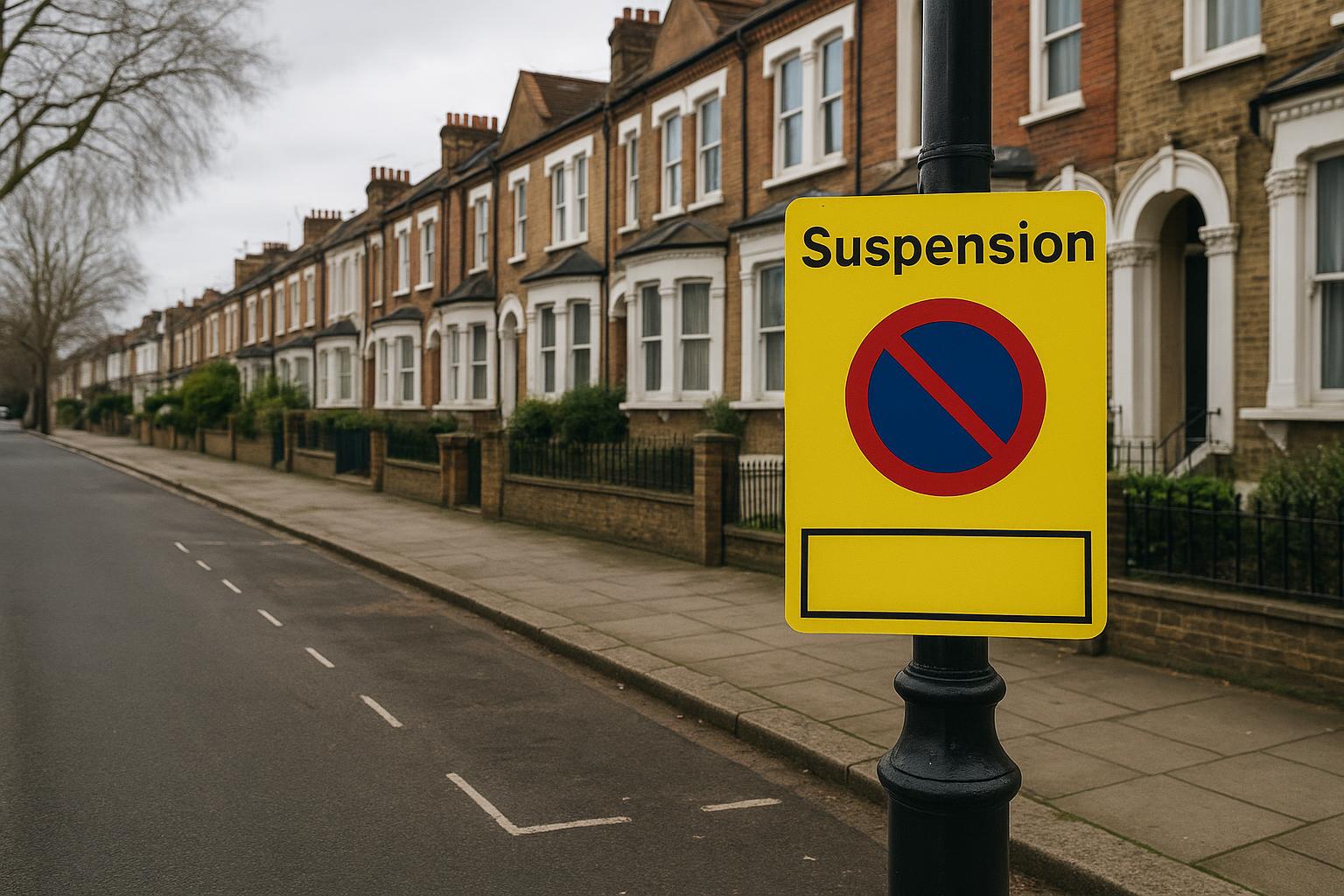
Many clearances do not need one: a van can often load briefly in a bay or on a loading-permitted yellow line, or park on a side street with a short carry. A suspension becomes worth considering when parking is scarce, the property is on a controlled parking zone street with resident-only bays, the clearance is large enough to need a big vehicle or a skip lorry for several hours, or the carry from door to vehicle needs to be short because of the volume or the weight of the items. Our guide to parking a clearance truck in a CPZ explains the underlying rules.
Alternatives to a suspension
Cheaper or quicker ways to solve the same problem.
Before paying for a suspension, consider whether another approach would do the job:
- A smaller vehicle with more trips. A van can often park legally in a nearby bay or on a side street, at the price of more carrying time.
- A different day or time. Outside controlled hours, or on a day with fewer cars, the problem may not exist.
- A nearby loading bay or paid bay. Using a pay-and-display bay for the permitted stay and moving the vehicle at the limit works for short jobs.
- A dispensation. If offered by your council, it allows a named vehicle to wait where it would normally be restricted.
- Private land. A driveway, forecourt or a neighbour's space, with the owner's written permission, can hold a van without any council involvement.
- Splitting the job. Two shorter sessions on different days may avoid the need for a long reservation.
The right answer depends on volume, access and budget. Tell the carrier what you are considering and ask what they recommend, since they know how long the job will really take.
The usual application process
Online, through your borough, with details of the vehicle and dates.
London parking is managed borough by borough, so there is no single national form. As a rule you will find the application on your council's website under parking suspensions, and it will ask for some or all of the following:
- The exact address and the length of kerb or number of bays needed.
- The date or dates and the start and end times.
- The reason, for example a house clearance, removal or skip delivery.
- The vehicle registration, or confirmation that it will be supplied later.
- Your contact details and payment.
Ask your carrier for the vehicle registration and the size of vehicle before you apply. If you are still comparing quotes, you can request clearance quotes first and note parking in the job description.

What to have ready before you start the form
Applications go faster with the facts to hand.
Gather these first so that you can complete the form in one sitting:
- The full address and, if the council uses them, the street name and nearest house numbers for the bay.
- Your estimate of the length of kerb needed. A standard parking space is roughly the length of a family car, and a larger vehicle needs more than one space; ask the carrier for the vehicle length.
- The exact dates, with a start time that allows for set-up and an end time that allows for finishing late.
- Vehicle registration number or numbers, which the carrier can supply once they have confirmed the booking.
- The reason for the suspension in plain words, such as "house clearance".
- A payment method.
- Photographs of the bay and the signs, if the form allows attachments.
Allow time for a longer job than you expect. Applying for a day and finding at 3pm that the crew needs another hour is more annoying than adding a small buffer at the start. If your clearance may spill into a second day, check whether you can add a day at a later stage or whether you must apply separately.
A step-by-step walk-through
The usual order of events.
- Confirm the clearance date with your carrier. Do not apply until the date is firm.
- Find your council's suspension page. Search for the borough name plus "parking suspension" or "bay suspension".
- Check eligibility and notice. Read the minimum notice, any restrictions on the type of bay and the maximum length of suspension.
- Complete the application. Enter the address, dates, times, vehicle details and reason.
- Pay the fee. Keep the receipt and any reference number.
- Wait for confirmation. The council may email approval or ask for more information.
- Look for the signs. The council or its contractor places notices on the bay before the date.
- Send photos to your carrier. Confirm the vehicle registration and arrival time.
- On the day, check that the bay is empty. If a vehicle remains in the suspended bay, contact the council's parking team rather than confronting the owner.
- Afterwards, keep the paperwork in case of a query about the fee or a notice.
Notice periods, fees and signs
Councils set these themselves, so check yours.
Councils generally require a minimum number of working days' notice, charge a fee per bay, per day or per hour, and then place temporary notices at the bay before the suspension starts so that other drivers have time to move. We do not quote fees or notice periods here because they differ by borough and change from time to time; the council's own parking pages give the current figures. Apply as early as you can, particularly if the clearance date is fixed, such as the day before a probate sale or the end of a tenancy, and leave time for a possible refusal.
Once signs are up, vehicles parked in the suspended bay may be ticketed or towed, so do not apply for dates you may need to change without checking how the council handles rescheduling or refunds.
What can go wrong with a suspension
Things to plan for.
A suspension is not a guarantee that the bay will be empty. Cars left in a suspended bay may not have been moved because the owner did not see the sign, was away, or ignored it. Councils have procedures for dealing with this, which can include issuing a notice and, in some cases, removing the vehicle, but they take time and you should not expect an instant solution. Contact the council's parking service early in the day if there is a problem, quote your reference number and send photos.
Other problems include a late approval that arrives after the date, a bay that is shorter than needed because of a dropped kerb or a tree, a vehicle that arrives with a different registration from the one you gave the council, and a clearance that overruns the booked hours. Ask the council about each of these in advance, particularly whether you can change a registration, extend by a few hours or cancel and get a refund. A short email at the time of application, setting out your plan, often prevents most of these problems.
Safety and access on the day
The suspension is only part of a safe clearance.
A reserved bay helps, but you still need to keep the pavement clear and the work safe. Keep a clear route for pedestrians. Do not leave heavy items leaning against railings or a wall where they could fall. Protect floors, stairs and doorways, and keep children and pets away from loading. If you are on a busy road, stay on the pavement side of the vehicle and use a spotter when reversing. Carriers on our network are independent businesses responsible for their own health and safety, but a customer who points out hazards, such as a loose paving slab or a low branch, helps the crew work safely.
Telling neighbours and the street
Short notice avoids friction.
Even with official signs up, a short note to nearby households is a good idea. Say which day the bay is reserved, roughly what hours the van will be there and give a contact number in case a resident has a problem with access. People who rely on the bay, such as carers, delivery drivers or residents with young children, will appreciate knowing about it in advance, and a courteous message reduces the number of cars left in the suspended space. If you know a neighbour who often parks in that bay, a quick conversation the week before is the most reliable reminder of all.
Suspension or dispensation?
Two different tools for different problems.
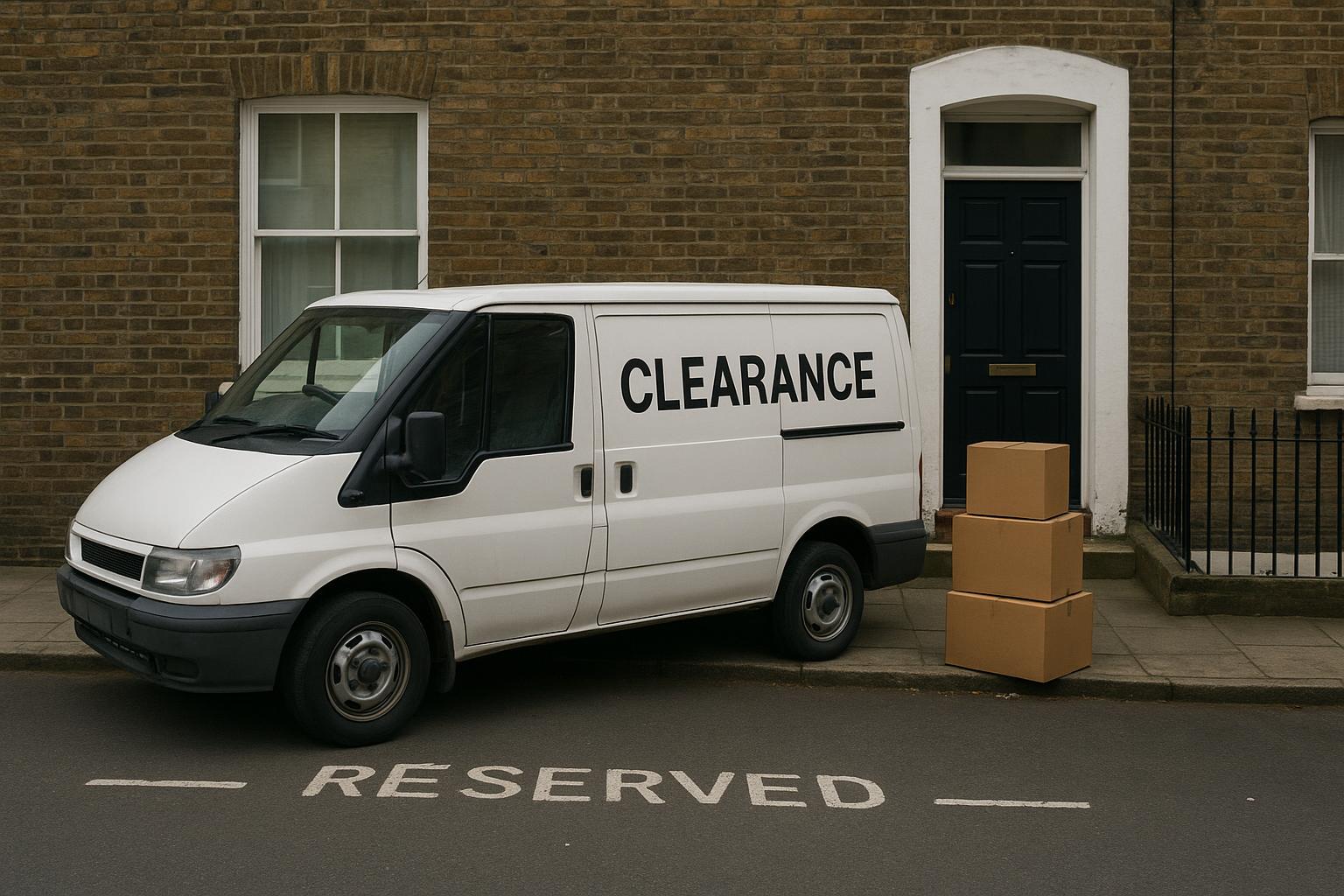
A suspension reserves a bay for you by temporarily taking it out of normal use. A dispensation is a permission that allows a specific vehicle to park or wait in a place where it would normally be restricted, for example while loading a larger job. Some councils offer both, some use different names, and some offer only one. If your street has a resident-only bay, a suspension is the more common answer; if it is a short wait in a limited-waiting bay, ask the council whether a dispensation is available.
Related permits you may come across
A few other terms on council websites.
While looking through your council's parking pages you may see other options with similar-sounding names. A visitor permit lets a resident's guest park in a resident bay, but it is normally intended for cars, not commercial vehicles. A trade or business permit is for businesses that need to park near the places they work, typically requiring evidence of the business. A temporary traffic order is a separate, more formal process used for road closures and long-term works, and generally not needed for an ordinary clearance. A skip licence is required if a skip is placed on the public highway, and the skip company normally arranges it, but you should confirm. If you are hiring a skip as part of the clearance, our skip hire page explains how this fits with a clearance.
When in doubt, call the parking team and explain what you need to do. They deal with these requests every day and can tell you which route applies.
Is a suspension worth the fee?
A simple way to decide.
A suspension fee is a certain cost; the cost of not having one is uncertain. Compare the fee with the likely extra labour from a longer carry, the risk of a penalty charge notice, the disruption to neighbours, and the chance that the job runs over time. For a small van job on a quiet street the fee is unlikely to pay off. For a multi-hour clearance in a busy resident-only street, it often does, particularly if the carrier would otherwise price in extra time. Ask your carrier for a quote with and without a reserved space so you can see the difference.
Our guide to pricing by volume and the prices page explain the other factors that make up a clearance quote.
Who should apply, and what to tell your carrier
Agree it in writing before the day.
The person who controls the property usually applies, because the council wants a contact for the address. Tell your carrier the dates you have booked, send a photo of the signs once they are up, and ask them to confirm the vehicle registration matches. If the carrier says they will arrange the application themselves, agree who pays the fee and what happens if the council refuses.
It is also worth reading how to choose a licensed house clearance company and our guide to house clearance pricing by volume to understand how vehicle size and access influence the quote.
Timing your application around the clearance date
Fixed deadlines make early applications essential.
Clearances often have hard deadlines: the end of a tenancy, completion on a sale, a probate valuation date, the day before a refurbishment starts. When the date cannot move, the suspension application is a task for as soon as the date is set, not a week before. A refusal or a delay on the council side can otherwise leave you with no space on the day and no time to apply again.
Consider building in a spare day. If the clearance is booked for a Friday and the suspension is only valid for that Friday, a carrier delay leaves you with an open-ended problem. Some councils let you apply for a range of dates and use only the days you need, others charge per day booked; read the terms. It is also worth asking the carrier how likely it is that the job overruns, particularly in a property with heavy furniture, a loft or basement, or accumulated belongings. A hoarded or very full property can take much longer than a standard clearance, and our guide to clearing a hoarded home explains why.
If the date does change, tell the council as soon as possible. Some will amend or refund in line with their policy, and the signs on the street should be updated so that residents are not inconvenienced for no reason.
Keeping records of the booking
Paperwork protects both sides.
Save the council's confirmation, your payment receipt, the reference number, photographs of the signs once they are in place, and your message to the carrier confirming the vehicle registration and arrival time. If a notice is issued despite the suspension, or if a vehicle remains in the bay and the council is slow to act, these records are your evidence. If you are an executor or agent acting for someone else, keep the paperwork with the estate or client file, because the fee may be a legitimate expense to account for.
Special cases: flats, estates and managing agents
Not every bay belongs to the council.
If your property is in a block, on a private estate or behind a gate, the council may not control the parking at all. In that case ask the managing agent or landlord for loading arrangements. Many blocks have a loading bay, a service entrance or a booking system, and some require a deposit or limit the hours for removals and clearances. If the street outside is council-controlled, a suspension may still be useful for the vehicle, while the managing agent controls access to the building itself.
If you are an executor or a landlord organising a clearance, be clear who is making the application and who holds the paperwork. For executors, see our guide to executor responsibilities; for landlords, the landlord and abandoned property clearance page explains the service.
Final checklist for clearance day
Seven things to confirm.
- Suspension approved, with a reference and dates.
- Signs in place at least a few days before.
- Vehicle registration matches the one given.
- Carrier has the photos, address and arrival time.
- Neighbours or managing agent informed.
- Plan B if the bay is occupied.
- All paperwork saved, including the carrier's waste transfer note.
With the parking sorted, the rest of the clearance is a matter of working through the list. For a broader view of the steps, see how houseclearance.co works.
Frequently asked questions
Common questions about council parking suspensions for clearance day.
How do I apply for a parking suspension in London?
Apply through your local borough council, usually via the parking suspensions page on its website. You will normally need the address, dates, times, the vehicle details and a payment.
How far in advance should I apply?
Councils set their own notice periods, usually counted in working days, so check yours and apply as early as you can. Last-minute applications may be refused.
How much does a parking suspension cost?
The fee is set by each borough and can change, so check your council. We do not quote a figure because it varies.
What is the difference between a suspension and a dispensation?
A suspension reserves a bay by closing it to other users. A dispensation lets a specific vehicle wait or park where it would normally be restricted. Availability and naming differ by council.
Can I reserve a space with cones or bins?
Generally no. Leaving objects on the public highway to hold space is usually not allowed and councils can remove them. Use an official suspension instead.
