
Direct answer
If a clearance crew damages the structure or fixtures of a property through carelessness, the person responsible is normally the carrier who did the work, and public liability insurance is the cover designed to pay for third-party property damage and injury. It is not compulsory for a clearance business, so some carriers do not have it, and policies have limits, exclusions and excesses. Before you book, ask for a copy of the certificate and check the limit and dates. On the day, photograph the property, report any damage straight away and keep everything in writing. Rules and policies differ, so check the policy wording, your own buildings or home insurance, and take advice for larger losses.
Contents
- How damage happens in a clearance
- High-risk jobs
- Who is legally responsible
- Negligence and accidents
- What public liability insurance is
- Limits, excess and exclusions
- Other policies that may be involved
- Sole traders and staff
- What counts as the property structure
- Fixtures you did not mean to remove
- Before you book: questions to ask
- Comparing quotes fairly
- Checking a certificate
- Expired and mismatched certificates
- Rented homes, leaseholds and shared buildings
- Tenants and deposits
- On the day: protecting the property
- Practical protection measures
- If damage happens
- Repairs and who arranges them
- Making a claim or complaint
- Time limits and records
- Common mistakes and a checklist
- What a good outcome looks like
- Frequently asked questions
How damage happens in a clearance
Narrow spaces, heavy items, quick work.
Clearance work involves moving large, heavy items through spaces that were never designed for them. Sofas turn corners in narrow hallways, wardrobes come down stairs, fridge freezers go through doorways with an inch to spare. Even careful crews sometimes catch a door frame, chip a banister, scratch a floor or crack a tile.
The most common damage is cosmetic: scuffed paintwork, marked plaster, scratched flooring and broken door handles. More serious damage includes cracked stair spindles, damaged ceilings from items hit on the way down, broken windows, burst pipes when radiators or units are removed, and damaged electrics when appliances are disconnected badly.
Knowing the risk is the first step. The second is knowing who bears the cost when it happens, and what you can do before the job to make a successful claim possible.
High-risk jobs
Where the chance of damage is greatest.
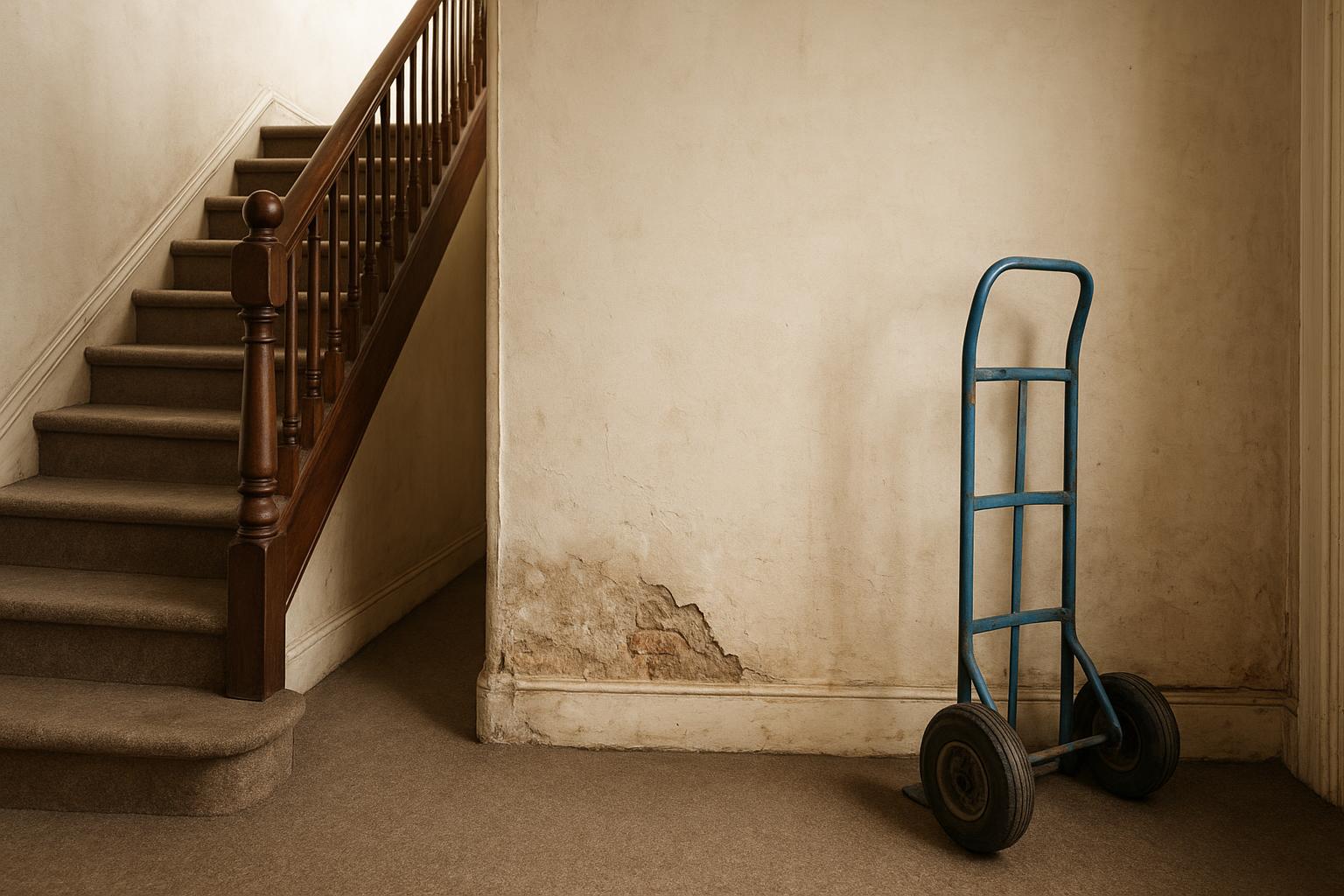
Some jobs carry more risk than others. Top-floor flats without lifts, tight spiral staircases, period properties with fragile plaster, properties with polished or reclaimed floors and houses with narrow turns all raise the odds that something will be marked. So do large items, such as pianos, large wardrobes and sofa beds.
Strip-out work, such as removing built-in wardrobes, kitchen units or sheds, carries a different risk. Taking items off walls can pull away plaster, and disconnecting plumbing or electrics without a qualified person can lead to leaks or damage.
If your job falls into one of these groups, say so when you ask for quotes. Our guides on piano disposal and fitted wardrobe removal explain the practicalities of two of the harder cases.
Who is legally responsible
Usually the person who caused the damage.
In general, if someone damages your property through a lack of reasonable care, they are responsible for putting it right or paying for the repair. A clearance crew working in your home is under a duty to take reasonable care, and if the work is done for payment, the Consumer Rights Act 2015 also expects services to be provided with reasonable care and skill.
Who the crew works for matters. If you booked an independent carrier, the contract is normally with that carrier, and they are the party responsible for the crew. If you used a quote-matching service, the carrier is still the person doing the work. Our guide to booking platforms versus direct companies explains how that relationship usually works.
This guide is general information, not legal advice. If a loss is large, or liability is disputed, speak to a solicitor, a consumer advice service or your insurer.
Negligence and accidents
Not every mark is a claim.
A claim for damage usually depends on showing that the crew did not take reasonable care. A genuine accident despite proper care may still lead to a payment, but a dispute is more likely if the carrier says that the damage was unavoidable or was already there.
This is why photographs before work matter. They help to show the state of the property at the start and let you distinguish new damage from old. Without them, it becomes your word against theirs.
Wear and tear in the course of normal work, such as slight scuffs on a skirting board in a hallway used daily, can be hard to claim for. A significant dent, a broken fixture or a cracked tile is a different matter.
What public liability insurance is
Cover for harm to other people and their property.
Public liability insurance protects a business if a member of the public is injured, or their property is damaged, because of the business's activities. For a clearance company, it can respond if the crew damages a wall, a floor, a staircase or a neighbour's car, or if someone trips over equipment.
It is not legally compulsory in the UK in the way that employers' liability insurance is for most businesses with employees, so you cannot assume that every carrier has it. Many reputable carriers do, and some customers, landlords and managing agents will require proof before allowing access.
Public liability cover is usually written with a limit per claim, such as a stated sum, and often with an excess that the business pays first. Our guide to man and van insurance covers the other types of cover you may see mentioned.
Limits, excess and exclusions
Read the small print.
Every policy has a limit per claim, and the limit may be lower than the cost of a serious loss. A carrier with a limit that suits small van jobs might not have enough cover for a large property. Ask what the limit is and compare it with the value of the property and its contents.
Most policies carry an excess, the amount the policyholder pays before the insurer pays. For small damage, the cost of repair may be below the excess, so the carrier pays directly. That is normal, but it means you should deal with the carrier first, not only the insurer.
Exclusions matter too. Policies may exclude damage caused by work at height, work outside the declared activities, deliberate acts, or failure to follow safety requirements. If the carrier takes on work that is not covered, the insurer may refuse the claim.
Other policies that may be involved
Employers' liability, goods in transit and your own cover.
Public liability is only one policy. Employers' liability insurance covers injuries to the carrier's own staff and is normally compulsory for businesses that employ people, with some exceptions. It does not cover your property. Goods in transit insurance covers items being carried, which matters more for moves than clearances.
Your own insurance may also respond. A homeowner's buildings insurance may cover accidental damage to the structure, depending on the policy. A tenant's contents policy covers belongings, not the building. A leaseholder may be affected by the building's block policy and the freeholder's rules.
Check what your own policy says before you need it. If you claim on your own insurance, your insurer may seek to recover the cost from the carrier, but that is for them to arrange and may affect your premium or excess.
Sole traders and staff
Who is actually on the job?
Many small carriers are sole traders or use casual helpers on the day. This does not necessarily make them less careful, but it affects which insurance applies. If the carrier uses helpers, ask whether the policy covers them and whether employers' liability is in place where the law requires it.
Check who will arrive. A crew of two with proper kit is likely to be safer in a flat than one person trying to carry a heavy wardrobe down the stairs. If the carrier plans to subcontract part of the job, ask for the same proof of insurance.
Information about compulsory employers' liability cover, and who needs it, is published by the Health and Safety Executive and on GOV.UK. Check current rules if this matters to your job.
What counts as the property structure
Walls, floors, stairs, fixtures and fittings.
In everyday language, the structure of a property means the parts that make up the building: walls, ceilings, floors, staircases, windows, doors and the roof. Fixtures and fittings, such as built-in wardrobes, kitchen units, radiators, bathroom suites and light fittings, are often treated separately but are normally part of the property.
The distinction matters for insurance. A buildings policy normally covers the structure and permanent fixtures, while contents cover is for items you could take with you. A policy for a business might split these differently, and a policy wording is the only reliable source.
Serious structural damage, such as a cracked load-bearing wall or a damaged chimney breast, needs a surveyor, not just a repair. If there is any doubt that the structure is safe, stop work and get advice before anyone continues.
Fixtures you did not mean to remove
A source of disputes.
Disputes arise when a crew removes something that was meant to stay, such as a shelf, light fitting or built-in unit. If the item belongs to the property, particularly in a sale or rental, removing it can cause problems for the owner or the landlord.
Walk through the property and point out what stays. Tape or label items that are not to go, and put a note in writing. If you are selling the property, check the sale agreement to see what is included.
If you are clearing a property for someone else, such as an executor, make sure the instructions are clear. Our guide to executor responsibilities explains the difference between chattels and fixtures in an estate.
Before you book: questions to ask
Get answers in writing.
When you compare carriers, ask whether they hold public liability insurance, who the insurer is, what the limit of indemnity is and when the policy expires. A reputable carrier will not mind giving you a copy of the certificate. Check that the name on the certificate matches the name of the business that will do the work.
Ask if the cover applies to the type of work you are booking. Some policies exclude certain activities, such as work at height, demolition or the removal of fixed items. A carrier who is going to take out a kitchen or strip out a bathroom needs a policy that covers it.
Ask what the carrier does if something is damaged and what the process is. A clear answer is a good sign. Our guide to choosing a house clearance company includes other questions worth asking.
Comparing quotes fairly
Cheapest is not always cheapest.
When quotes differ widely, ask why. A lower price may reflect a smaller crew, no insurance, no protection materials or an unrealistic estimate. A higher price may include more people, better equipment and cover. Compare what is included, not just the figure.
Ask each carrier the same questions and compare the answers. It is reasonable to prefer a slightly higher quote from a carrier who gives a clear, written description of insurance, process and what happens if there is a problem.
Our guide to house clearance costs in London explains what affects a quote, and why a very low price should prompt questions.
Checking a certificate
What to look at.
A certificate is a summary, not the policy itself. Check the insured business name, the policy period, the limit of cover and the description of the business activities. A certificate that has expired, or a limit that is very low for the size of your property, is not a comfort.
If you are unsure about a certificate, you can contact the insurer or broker named on it to confirm that the policy is current. Do not rely on a screenshot sent only by message if the stakes are high.
Remember that houseclearance.co is a marketplace and does not check or guarantee the insurance of independent carriers. The responsibility for asking, and for checking what you are shown, remains with you. Our guide to the risks of hiring through social media explains why this matters more with informal operators.
Expired and mismatched certificates
Common red flags.
Red flags include a certificate that has expired, a name that does not match the business, a certificate for a different kind of work, a cover limit that seems very low, or a reluctance to provide any document at all. None of these proves that a carrier is unreliable, but each deserves a question.
Some carriers say that they are insured but only have cover for transport, not for work at a property. Ask which policy they hold and whether it covers damage to a customer's premises.
If a carrier says they will send a certificate later, ask for it before the day. It is much harder to press for it after the work has been done.
Rented homes, leaseholds and shared buildings
Other people's rules apply.
If the property is rented, the building may belong to a landlord, and damage to it is the landlord's concern as well as yours. Check your tenancy agreement before using a clearance crew, and tell the landlord or agent if there is any damage. A tenant who hides damage may face deductions from the deposit.
Leaseholders and residents in flats often have to follow rules on the use of lifts, stairs and shared areas. Damage to communal areas is usually the responsibility of the person who caused it, and the managing agent may require proof of insurance before work is allowed.
For blocks with a concierge or a managing agent, ask what they need. They may require a certificate in advance, a deposit or protective coverings in the hallway.
Tenants and deposits
Do not let a dispute fall on your deposit.
If you rent, damage caused by a clearance crew you hired may be treated as damage caused by you. A landlord can claim from the deposit for damage beyond normal wear and tear. This is a good reason to tell the landlord, take photographs and put the carrier on notice quickly.
Check your tenancy agreement for rules on alterations and the removal of fixtures. If you are removing an item that the landlord supplied, such as a wardrobe or a sofa, ask for permission and record it.
If a dispute arises, the deposit scheme provides a free dispute resolution service. Keep evidence and keep it organised.
On the day: protecting the property
Simple steps that reduce damage and disputes.
Walk through the property with the crew leader before work starts and point out vulnerable areas such as narrow stairs, delicate floors, loose banisters and fragile fixtures. Take dated photographs of the main routes, doors and floors, and any existing damage.
Agree what protection will be used. Floor coverings, corner guards and door protectors are all common. Agree which items are being removed and which are staying, particularly built-in furniture and fixtures, so that nobody takes something off the wall by mistake.
Be available during the work, or have a trusted person present. If something is damaged, it is easier to deal with at the time than days later.
Practical protection measures
Low-cost, effective.
There are simple ways to reduce damage. Remove pictures, mirrors and loose items from walls and shelves along the route. Lift rugs and loose mats to avoid tripping. Open doors fully and, if possible, remove them from hinges for very wide items. Clear a path from room to door before anyone starts.
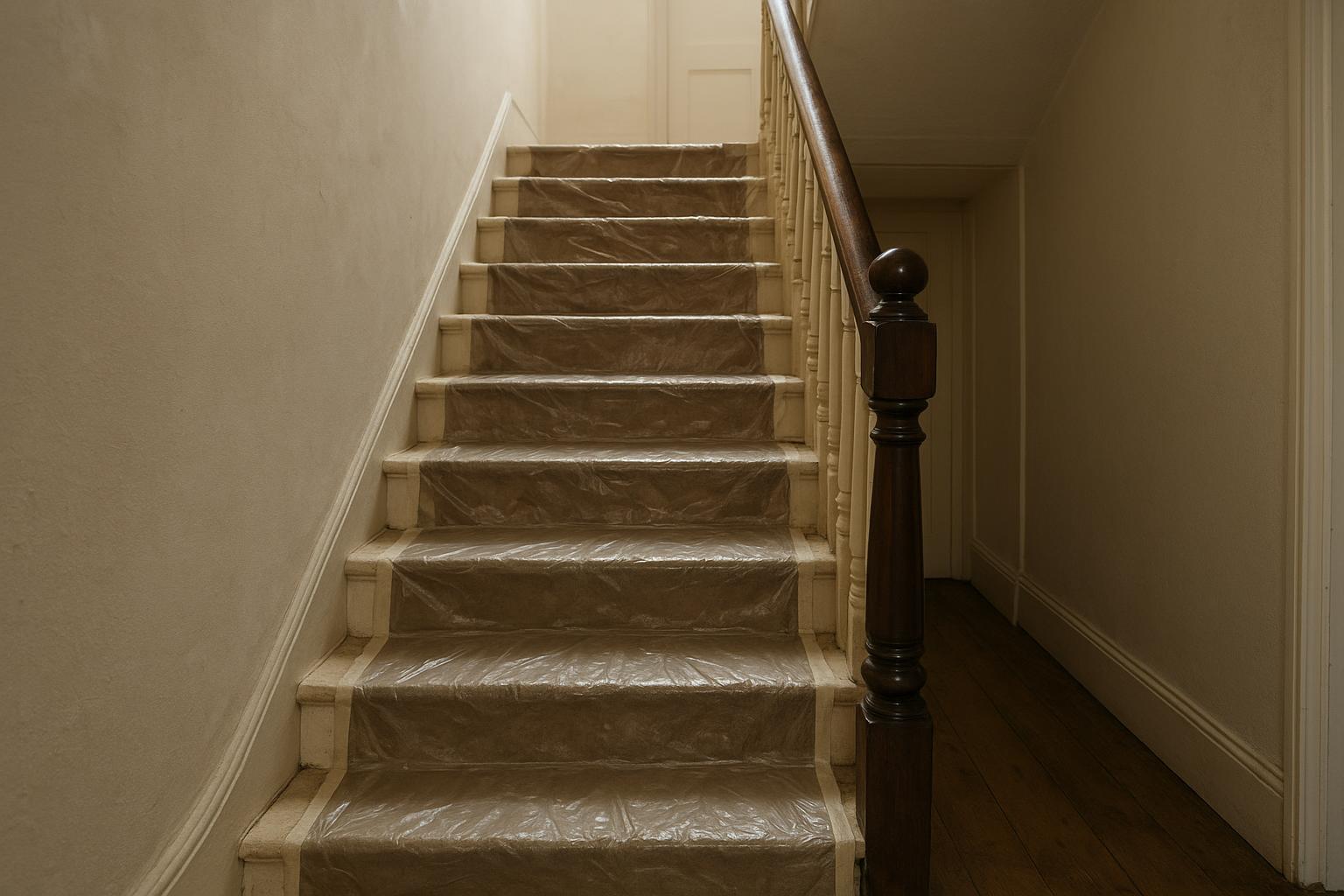
Ask whether the carrier uses floor protection, corner guards and blankets. If not, you can lay down cardboard or dust sheets on delicate floors and ask the crew to use them. Protect banisters and door frames at pinch points with padding.
Plan the route with the crew. Agreeing which way an item will go before it is lifted prevents most of the awkward turns and last-minute improvisation that cause damage.
If damage happens
Act quickly and keep records.
Tell the crew leader straight away, take clear photographs from several angles and note the time and place. Ask the crew to stop moving items through the damaged area if there is a risk of further harm. If there is a danger, such as a broken pipe or exposed wires, make the area safe and call a qualified tradesperson.
Ask the carrier how they want to deal with it and request their insurer's details in writing. Do not sign anything that says the damage is accepted or that you waive claims. Do not pay the final invoice in full without noting the damage in writing, though you should take advice on withholding payment.
Keep copies of quotes for repair. If the repair is urgent, such as a window, make it safe and keep receipts. Our guide to invoices and records explains what to keep.
Repairs and who arranges them
Keep control of the process.
Once the damage is reported, you may be asked to accept a repair by the carrier's own contractor, a cash settlement or a claim through the insurer. Decide which suits you. A cash offer can be quicker but check that it covers the real cost, and get independent quotes first.
If you arrange a repair yourself, keep invoices and photographs of the work and send them to the carrier or insurer. Agree the scope in advance if you can, so that the claim is not reduced later on the grounds that the repair was not necessary.
For structural problems, ask a qualified professional to assess the damage. Do not rely on a quick fix for something that could affect the safety of the building.
Making a claim or complaint
A sensible order of steps.
Start with the carrier. Describe the damage, attach photographs and quotes, and ask them to pass the claim to their insurer. Many problems are settled at this stage. Keep the tone factual and the timeline clear.
If the carrier refuses, delays or denies the problem, you can write a formal complaint, use any dispute process attached to the booking and consider your own insurer. For smaller sums, the small claims track of the county court is designed to be used without a solicitor, and GOV.UK explains how to start. Check the current process before you act.
If you paid by credit card for part of the cost, there may be extra protection under the Consumer Credit Act 1974 in some cases. Ask your card provider. Advice from Citizens Advice or a consumer service can help you to decide.
Time limits and records
Do not leave it too long.
There are legal time limits for bringing claims, and insurers have their own notification deadlines. Report damage promptly and do not wait weeks to start the process. Delay makes evidence harder to find and gives the other side a reason to question the claim.
Keep a simple log of dates, calls and messages, and save emails and photographs in one folder. If the matter goes to a complaint or small claim, a clear timeline helps.
If the amount is significant, take advice early. Legal expenses cover attached to a home insurance policy may pay for advice, so check your policy.
Common mistakes and a checklist
Avoid the usual gaps.
The usual problems are assuming that every carrier is insured, not asking for a certificate, not photographing the property beforehand, being absent on the day, signing a completion note without checking, and not telling the landlord. Each makes a claim harder.
A simple checklist helps.
- Ask for the public liability certificate and check the name, dates and limit.
- Confirm that the policy covers the work you are booking.
- Photograph the property and key routes before work starts.
- Agree protection for floors, stairs and doors.
- Report any damage immediately and take photographs.
- Keep the invoice, messages and quotes together.
- Check your own buildings or contents policy and your landlord's requirements.
What a good outcome looks like
Calm, documented, fair.
Most damage claims in clearance are small and are resolved quickly when both sides are reasonable. The carrier accepts responsibility, the repair is done and the matter is closed. This is more likely when you have asked about insurance beforehand and kept a record.
It is worth remembering that a clearance carrier also has an interest in a fair outcome. A good reputation and repeat business depend on dealing with problems properly.
Insurance is a safety net, not a substitute for a careful crew. Choose carriers who take care, prepare the property sensibly and keep records, and you are unlikely to need the policy at all.
Frequently asked questions
Common questions about insurance and damage in a clearance.
Who pays if a clearance crew damages my wall or floor?
Normally the carrier who did the work is responsible if the damage came from a lack of reasonable care, and they may pass the claim to their public liability insurer.
Is public liability insurance compulsory for clearance companies?
No, not in the way employers' liability is for most employers, so some carriers do not hold it. Ask to see the certificate before booking.
Does houseclearance.co insure the work?
houseclearance.co is a quote-matching marketplace of independent carriers. Each carrier is responsible for its own work and cover, so ask the carrier for details.
What does a public liability certificate show?
The business name, insurer, policy period, limit of cover and description of the business. Check that they match the carrier and the work.
Will my own home insurance cover the damage?
It may, depending on the policy. Buildings insurance can cover accidental damage to the structure. Check the wording and speak to your insurer before you claim.
What should I do if damage happens?
Tell the crew, take photographs, make the area safe, get the carrier's insurer details in writing and do not sign anything waiving your rights.
Can I refuse to pay after damage?
Do not withhold payment without advice. Note the damage in writing and ask the carrier how they will resolve it, and take advice from Citizens Advice or a solicitor.
What if the carrier has no insurance?
You can still pursue them for the damage, but recovery may be harder. For a larger loss, consider your own insurer and take legal advice.
