Direct answer
Hidden fees usually arise from vague quotes rather than secret charges. Before you accept, make sure the quote states what volume or items it covers, whether labour, loading, stairs, parking, disposal and any taxes are included, what the carrier will do if the load is larger than described and how and when you pay. Be wary of a price given with no questions asked, a refusal to put it in writing, a demand for cash only, and an unwillingness to show waste carrier details. Our guide to hidden fees in man and van quotes covers that service in detail. This one is about reading any waste collection or clearance quote, and what to ask before you say yes.
Contents
- Where hidden fees really come from
- A useful mindset for comparing quotes
- Reading the quote line by line
- An example of wording to look for
- Dates, windows and cancellation terms
- Pricing methods and what they hide
- Minimum charges and call-out fees
- Fixed price versus estimate
- Charges to ask about
- Disposal fees and special items
- Access charges that can appear later
- How photos and descriptions protect you
- Items people forget to mention
- Getting it in writing
- Quotes through a marketplace
- Red flags in a quote or conversation
- Scams and fly-tipping risks
- Pressure tactics
- Checking waste carrier details
- What to keep after the job
- What to do if the price changes on the day
- A short list of questions to ask before you book
- If you have already paid too much
- Frequently asked questions
Where hidden fees really come from
Usually ambiguity, not trickery.
Most disputes about waste collection charges do not come from a secret fee that was never mentioned. They come from a quote that was vague about what it covered. A phrase such as "from" a certain price, or "van load" without a size, leaves room for the final figure to differ from what you expected.
There are also genuine reasons a price can change. The load may be larger than described, access may be harder than the photos showed, or the carrier may find items that need special disposal. A fair carrier will explain these possibilities in advance, and a clear quote makes it easier to agree what happens if they arise.
The aim of this guide is not to make you suspicious of everyone. It is to help you read a quote so that you and the carrier have the same understanding before work starts. For the overview of what drives cost, see our guide to what affects house clearance cost.

A useful mindset for comparing quotes
Clarity first, price second.
A good way to think about quotes is to treat clarity as part of the price. A slightly higher quote that spells out everything may cost you less in the end than a lower one that leaves room for extras. When you compare, ask yourself which quote you could most easily check against the final bill.
Think about the questions you would ask if you were buying anything else of similar value. What am I getting? What is excluded? What happens if it is not as expected? Those same questions work for waste collection.
It also helps to remember that carriers are independent businesses with their own costs. A fair quote reflects them, and a good carrier will welcome informed questions.
Reading the quote line by line
What a clear quote looks like.
A clear quote states who is quoting, what is being collected, where from, when and what is included. It should say how the price was worked out, for example by volume, by the number of items or by time. It should state whether the figure is fixed or an estimate and what could change it.
Check that it names labour and loading, transport, disposal and any taxes. If the carrier is VAT-registered, the quote should say whether the price includes it. Look at whether stairs, long carries, parking and any charges for the area are covered.
If any of these are missing, ask. A reputable carrier will not mind adding clarity, and you will have the answers in writing.
An example of wording to look for
Illustrative, not a template.
A clear statement might say that the price covers two people, loading from the ground and first floor, transport and disposal at an authorised site for a stated volume, and that any additional volume or special items will be agreed before they are loaded. It might also say that the price assumes parking within a certain distance.
A vague statement might say only "full clearance, one price". That could be perfectly fair, but it does not tell you what the carrier assumed, and so it is harder to hold to.
You do not need legal language. Plain, specific wording is enough, as long as it is in writing.
Dates, windows and cancellation terms
The small print that costs money.
Check the date and the arrival window, and ask what happens if the crew is late or you need to reschedule. Some carriers charge a cancellation fee or a call-out fee if the job is cancelled at short notice, and some take a deposit.
If a deposit is required, ask whether it is refundable, under what conditions, and how it is taken. Keep the receipt.
Cancellation terms are not hidden fees in themselves, but they can feel like it if you did not know about them. Ask early.
Pricing methods and what they hide
Volume, item count and time.
Carriers price in different ways. Volume-based pricing estimates how much of a vehicle your waste will fill, and our guide to pricing by volume explains how that works. Item-based pricing gives a figure per item, which suits small jobs. Time-based pricing charges by the hour, which can be fair but needs a limit or estimate.
Each method has its blind spots. With volume pricing, the question is who decides the volume and what happens if it is more. With item pricing, the question is how small things and bags are counted. With hourly pricing, the question is the minimum charge, how travel is counted and whether there is a cap.
Ask which method the quote uses and what happens at the edges. That single question reveals a lot.
Minimum charges and call-out fees
Small jobs have floors.
Many carriers have a minimum charge, because a visit has fixed costs whatever the size of the job. For small collections, the minimum may be higher than a simple per-item calculation would suggest.
If you have only a few items, ask about the minimum. Our guide to bulky item removal costs explains how small jobs are typically priced.
Be aware too of any call-out fee if the carrier visits to give a quote. Some do it free, while others charge, and that should be clear before they come.
Fixed price versus estimate
Know which one you have.
A fixed price means that the carrier will charge that amount for the job as described. An estimate means the final figure may differ. Both are legitimate, but you should know which you have and what could change it.
If you want certainty, ask whether the carrier will fix the price after seeing photos or visiting. Some will, and may specify a volume or item list that the price covers.
If the quote is an estimate, ask how the final price will be calculated and whether you will be told before work starts if it will go over.
Charges to ask about
The usual suspects.
The extras that most often surprise customers are stairs or lack of a lift, long carries from door to vehicle, parking and loading costs, congestion or other charges, disposal fees for particular items, waiting time and extra stops. Our guide to man and van hidden fees covers these in a different context, and the same questions apply.
Special items are another source of extra cost. Fridges, freezers, mattresses, TVs, paint and chemicals often have separate disposal rules. A carrier may refuse them or charge extra, so mention them upfront.
Ask whether each of these is included, excluded or charged separately, and if separately, how much and under what conditions.
Disposal fees and special items
Not everything goes in the same load.
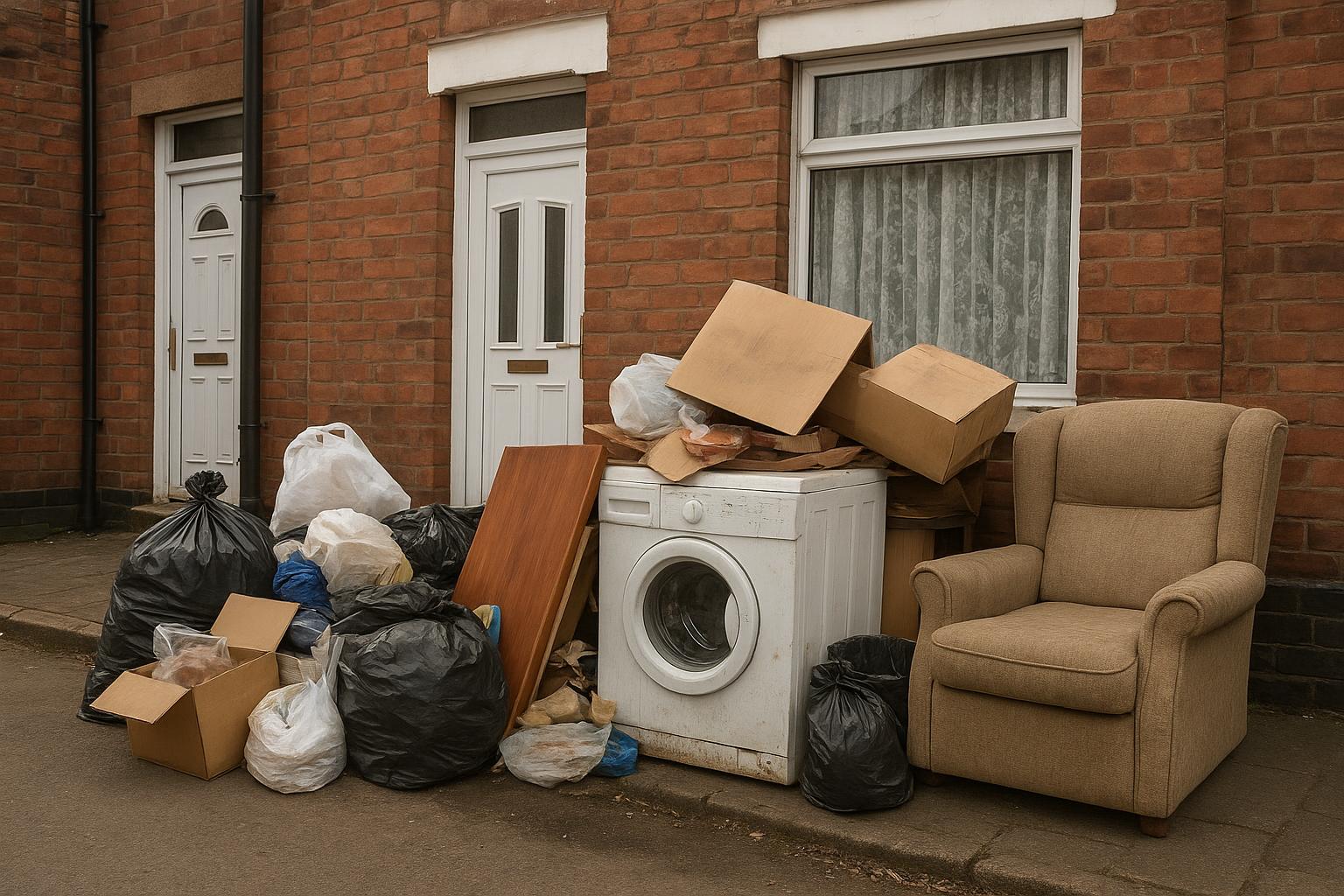
Some items need separate disposal and may cost more, including fridges, freezers, mattresses, televisions, tyres, paint and chemicals. Our guides on hazardous waste and on WEEE electronics recycling explain why.
A carrier may exclude some of these items or charge extra. Ask in advance, and tell them if you have any. Do not hide them in the load, because that can create problems for the carrier and for you.
If you are not sure whether an item is hazardous, take a photo of the label and ask.
Access charges that can appear later
Stairs, carries and parking.
If the quote assumed easy access and the crew finds a third-floor flat with no lift, the job may take longer. Whether a carrier charges for this depends on what was agreed. Tell them about stairs, narrow halls and distances up front.
Parking is another area. If the vehicle has to stand on a restricted road, there may be costs for a permit, or risk of a ticket. Ask who is responsible. Our guide to parking in controlled zones explains the options.
If you give accurate details, you reduce the chance of a change on the day.
How photos and descriptions protect you
Evidence works both ways.
If you send photos and a description for a quote, the carrier is entitled to rely on them. If you leave things out, the final price may reasonably change. Conversely, if the carrier prices from your photos and then charges more for items that were visible, you have a stronger case to dispute it.
Take clear photos of every room, the loft, garage and garden, the stairs and the parking. Mention anything unusual, such as heavy items or things you might forget are in the loft.
Keep copies of what you sent and the quote that came back. If there is a disagreement, those records are the best evidence you have.
Getting it in writing
A record is your best protection.
A verbal price is difficult to prove. Ask for the quote by email, text or in a booking system, and keep it. The message should say what is included, the price, the date and any conditions.
If the price was agreed after a visit, ask the carrier to confirm it in writing afterwards. If anything changes on the day, ask for the change in writing before work starts, or take a photo of the message.
Where the carrier is a marketplace listing, check how the platform records quotes and what it says about disputes.
Quotes through a marketplace
What to look for.
If you request quotes through a platform that connects you with independent carriers, check how the platform shows what each quote includes, how you communicate with the carrier and what the platform says about disputes. A platform that connects you with carriers is not itself doing the work, so the terms are between you and the carrier.
Keep messages within the platform where possible, because they can serve as a record. If the carrier proposes a different arrangement, such as paying outside the platform, think carefully about what protection that leaves you.
Whatever the route, the same advice applies: clear terms, written confirmation and records.
Red flags in a quote or conversation
Signs that the price may not hold.
Be cautious of a price given instantly without any questions about the job, a quote that is far lower than others with no explanation, a refusal to put anything in writing, and pressure to book at once. Be cautious too of a request for a cash payment only, or of a carrier who will not show waste carrier details.
- No questions about access, stairs or quantity
- A very low price with no breakdown
- No written quote or terms
- Cash-only payment and no receipt
- No waste carrier registration to show
- A price that changes once the crew arrives
One red flag does not prove anything on its own, but several together are a good reason to look elsewhere. Our guide to the risks of unlicensed operators explains the legal side.
Scams and fly-tipping risks
A cheap price can come back to you.
Some unregistered operators take payment and then dump the waste illegally. If it is traced to you, you may face enforcement action as the householder, because you have a duty of care. Our guide to fly-tipping penalties explains the exposure.
The risk is highest with unsolicited offers, such as a leaflet or a knock on the door, and with adverts that give no business name or address. A genuine carrier can give you details that you can check.
If in doubt, do not hand over waste until you have checked the registration and the identity of the person collecting it.
Pressure tactics
Take your time.
Phrases such as "the price is only valid today" or "I can do it now for cash" are designed to speed up a decision. Genuine carriers may have limited availability, but they will also give you time to check the details.
If you feel pushed, say you need to review the quote and will reply later. A reasonable carrier will accept that.
Walking away from a rushed deal costs little. Paying for a poor one can cost much more.
Checking waste carrier details
A duty that sits with you.
Anyone who transports waste as part of their business in England generally needs to be registered as a waste carrier, and householders have a duty of care to take reasonable steps to check that the person taking their waste is authorised. You can search the Environment Agency public register.
Ask for the registration number and the name it is registered under, and check that they match the business that gave the quote. Be careful of a number that does not match, or a business that cannot give you one.
Our guides to the householder duty of care and choosing a licensed clearance company explain the checks in more detail.
What to keep after the job
Your paper trail.
Keep the written quote, the invoice or receipt, any waste transfer note, and photos of the property before and after. Note the carrier's name, number and vehicle registration. Our guide to waste transfer notes explains what the note should contain.
These records protect you if waste is later found fly-tipped, and they help if you dispute a charge. A few minutes of organisation can avoid weeks of difficulty later.
Store them somewhere you can find them, such as an email folder, for at least a couple of years.
What to do if the price changes on the day
Stay calm and ask for specifics.
If the crew says the price has gone up when they arrive, ask them to explain exactly why, and compare it with your written quote. If the job is the same as described, the price should be the same. If something has changed, such as more items or harder access, ask what the revised price is and why.
You do not have to accept a new price on the spot. You can ask for it in writing, take photos, and decide whether to proceed. If you feel pressured, you can ask the crew to leave and seek another quote. Do not hand over cash for work not yet done under pressure.
If you have a dispute afterwards, keep your records and contact the platform, the carrier and, if needed, Citizens Advice or Trading Standards for guidance.
A short list of questions to ask before you book
Copy and paste these.
You can send these to any carrier before you accept a quote.
- Is this price fixed, and what could change it?
- What exactly is included: labour, stairs, parking, disposal and VAT if applicable?
- What happens if there is more than I described?
- Are there any items you will not take or charge extra for?
- What is your waste carrier registration number?
- How and when do I pay, and will I receive an invoice?
- What is your cancellation or rescheduling policy?
Their answers, and the speed and clarity with which they give them, will tell you a lot about how the job will go.
If you have already paid too much
Options after the event.
If you believe you were overcharged, start by contacting the carrier or the platform with your records and ask for an explanation. Keep the tone factual. Many problems are resolved at this stage.
If that does not work, you can ask Citizens Advice for guidance or contact Trading Standards through the usual consumer routes. If you paid by card, ask your card provider whether any protection applies, as the rules depend on the circumstances.
This is general information, not legal advice. For serious disputes, consider speaking to a solicitor or a consumer organisation.
Frequently asked questions
Common questions about reading a waste collection quote.
What does a good waste collection quote include?
Who is quoting, what is collected and from where, how the price was worked out, what is included, whether it is fixed or an estimate, and what could change it.
Is a "from" price reliable?
A "from" price is a starting point. Ask what the final price depends on and get a confirmed figure in writing once the job is described.
Should the quote include VAT?
If the carrier is VAT-registered, ask whether the price includes it. Not all carriers are registered, so ask rather than assume.
Can the carrier raise the price on the day?
Only for reasons that were explained or that genuinely changed, such as more items or harder access. Ask for the reason and the new price in writing before work starts.
Should I pay in cash?
Be cautious of cash-only terms with no receipt. Ask for a written quote and invoice, and see whether other payment methods are available.
How do I check a waste carrier?
Ask for their registration number and search the Environment Agency public register. Check that the name matches the business quoting.
Do I need to keep any paperwork?
Yes. Keep the quote, messages, invoice and any waste transfer note or receipt in case of a later dispute or a fly-tipping enquiry.
Where can I get help with a dispute?
Start with the carrier or platform, then consider Citizens Advice or Trading Standards for guidance on your rights.