Direct answer
A biohazard clearance is the removal and safe disposal of material that can carry infection or harm health, such as blood and other bodily fluids, sharps, human or animal waste, rotting food and heavily contaminated furnishings, usually from a property affected by extreme squalor, an unattended death or serious neglect. It is different from an ordinary house clearance because the people doing it need protective equipment and trained methods, and the waste often has to be handled as hazardous or clinical waste. Do not enter or move things yourself if you see sharps, bodily fluids or heavy infestation. In England, contact the police first if there has been an unexplained death, ask the local council's environmental health team for advice, and only then look for carriers able to do this work.
Contents
- What biohazard clearance actually means
- Extreme squalor, hoarding and self-neglect: how they differ
- The real health risks inside a contaminated property
- Why this is not a DIY job for family members
- What to do first: a sensible order of steps
- If the person is still living there
- How English law treats hazardous and clinical waste
- What the safety rules expect of a contractor
- What to ask a carrier or specialist before you agree
- What a professionally run job usually involves
- Unattended death, probate and deceased estates
- Landlords, tenants and abandoned or damaged properties
- Where houseclearance.co fits
- Frequently asked questions
What biohazard clearance actually means
The term is used loosely, so it helps to be precise.
"Biohazard" is a trade word rather than a legal category. In practice, a property needs biohazard-level attention when it contains material that could transmit infection or cause harm through contact, inhalation or injury. Typical examples are blood and other bodily fluids, used needles and other sharps, human and animal faeces and urine, vomit, rotting food, mould-covered or sewage-soaked materials, and the droppings and remains left by rodents, birds or insects.
Biohazard situations usually arise in one of a few ways: an unattended or traumatic death, a long period of self-neglect, severe hoarding where hygiene has collapsed, drug paraphernalia left in a rental, an animal-related accumulation, or flooding and sewage backflow. Each has different priorities. A death in a property involves the police and coroner before any cleaning. Self-neglect involves the person living there and often adult social care. A tenancy left in a state involves a landlord and possibly an insurer.
This guide is general information for families, executors, landlords and managing agents in England, not medical, legal or health and safety advice. Rules and guidance change, so check current wording on the linked official sites. It is also not a replacement for the specialist assessment a competent contractor should carry out on site.
If the cause is clutter rather than contamination, a different guide applies. Our step-by-step guide to a house clearance for someone with hoarding disorder covers the person-centred approach, and our guide on the legal and psychological line between collecting and hoarding explains how councils and clinicians think about it.
Extreme squalor, hoarding and self-neglect: how they differ
They overlap, but they are not the same problem.
Hoarding is about the accumulation of possessions and the difficulty of discarding them. Squalor is about the state of hygiene and sanitation in a home: dirt, decay, waste, vermin and the absence of working toilets, washing or cooking facilities. A home can be heavily cluttered but clean, and a home can be nearly empty but squalid. Many properties that need biohazard attention involve both, but families and professionals who treat them as one thing tend to misjudge what is needed.
Clinicians and social care professionals sometimes use the term self-neglect for a pattern in which a person lacks the ability or willingness to maintain their own hygiene, health or surroundings. You may also hear the informal label "Diogenes syndrome"; it is not a formal diagnosis in the DSM-5 or ICD-11, and it is better treated as a description of behaviour than as a medical explanation. Poor physical health, dementia, depression, psychosis, addiction, bereavement and isolation can all sit behind an unsafe home, and a person's own wishes still matter where they have the mental capacity to make decisions about their living conditions.
A squalid home is rarely just a waste problem. Someone usually needs help, and clearing everything quickly can destroy trust, remove documents and sentimental items, and leave the cause untouched.
The real health risks inside a contaminated property
Know what you are protecting yourself from before you open the door.
The risks are physical, biological and chemical, and several can be present together.
Bloodborne viruses. Needles and other sharps, and blood-contaminated items, can carry hepatitis B, hepatitis C and HIV. The main route in a clearance is a needlestick or cut, which is why sharps should never be picked up by hand, squeezed into a bag or put in an ordinary bin. The Health and Safety Executive (HSE) publishes guidance on bloodborne viruses and sharps injuries for workplaces.
Faecal and urinary contamination. Human and animal waste can carry bacteria and parasites that cause stomach illness. Leptospirosis (Weil's disease) is a bacterial infection associated with rat urine, so a rodent infestation is a health matter and not just a nuisance. The NHS describes it and the symptoms to watch for.
Airborne dust and mould. Disturbing dried droppings, old bedding, mould or long-settled dust can put fine particles into the air. People with asthma, lung conditions or weakened immunity are at greater risk, which is a good reason for them to stay out of the property during clearance.
Pests. Rats, mice, cockroaches, fleas, bed bugs and flies can be present in large numbers and can hide in furniture, stored paper and soft furnishings. A pest treatment is often needed before or alongside clearance so that insects do not spread to neighbouring homes.
Chemicals and mixed hazards. Old cleaning products, solvents, gas canisters, medicines and batteries can be present among the waste. Never combine cleaning chemicals; bleach mixed with ammonia-based products or with acids can release toxic gases.
Structural and fire risks. Rotted floors, collapsing stacks, faulty electrics, blocked exits and no working smoke alarm turn a dirty home into an unsafe one. If a gas or electrical fault is suspected, the supplier or a registered engineer should deal with it, not an amateur with a torch.
Asbestos. Many buildings put up or refurbished before 2000 contain asbestos-containing materials. They are generally harmless if undisturbed but can release fibres when damaged during strip-out. The HSE asbestos pages explain the Control of Asbestos Regulations 2012 and when a survey is appropriate before work that disturbs the fabric of a building.
Why this is not a DIY job for family members
Wanting to spare a relative the work is understandable. Here is why it is usually the wrong call.
Relatives often feel they should deal with a distressing property themselves. With genuine biohazards that instinct is risky: cuts, needlesticks and inhaled dust can cause harm that is not obvious at the time, and seeing a relative's living conditions, or the scene of a death, can be traumatic.
A sensible threshold is this. If you can see or smell any of the following, stop and get a professional assessment before moving anything: sharps or syringes, blood or bodily fluids on floors or soft furnishings, faeces or urine in bulk, visible infestation, standing sewage or black mould spreading over large areas, or a smell strong enough to make you feel unwell. You can wear a basic mask and gloves for a quick look, but do not start clearing. If you are in doubt about whether an area is safe, treat it as unsafe.
Children, pregnant women, people with weakened immune systems and anyone with breathing conditions should not take part.
What to do first: a sensible order of steps
The order matters more than speed.
- Stay safe and do not disturb anything yet. If you have already seen sharps or fluids, avoid touching them, keep other people out and wash any exposed skin thoroughly with soap and water.
- If there has been an unexplained death, call the police. Do not clean, tidy or remove anything until the police and, where relevant, the coroner's officers have finished. In England the police, coroner and registrar each have defined roles, and nothing should be cleared until you are told it is released.
- If the person is alive and may be at risk, act for the person first. An urgent medical concern means 999 or 111. If they may have care and support needs and are neglecting themselves, a safeguarding concern can be raised with the local authority's adult social care team.
- Contact the council's environmental health team. They can advise on pests, statutory nuisance and unsafe conditions, and they may already know about the property.
- Check who has legal authority. Is it the occupier's own home, a tenancy, or a deceased estate? That decides who can authorise access, spending and disposal. For estates, see our guide on executor legal responsibilities for property and chattels.
- Photograph the property from the doorway, and document conditions. This helps with insurance, landlord disputes and later decisions. Do not enter rooms to get better photos.
- Check insurance. Buildings and contents policies and landlord policies differ widely. Some may contribute to specialist cleaning after certain events, but do not assume cover; read the policy and ask the insurer before work starts.
- Get a site assessment from suitably equipped carriers or specialist cleaners. Ask for a written scope of what will be done and how waste will be handled.
If you are also dealing with a bereavement, our guide on organising a house clearance after bereavement may help you pace it.
If the person is still living there
A biohazard clearance done to someone, rather than with them, rarely works.
When someone is still living in a squalid home, the aim is usually to make it safe and keep them safe, not to wipe the slate clean. In England a person with mental capacity is entitled to make their own decisions, including decisions that others consider unwise. The Mental Capacity Act 2005 assumes capacity unless it is shown that a person lacks it for a particular decision, and that has to be assessed at the time, by the right people, for that decision.
The Care Act 2014 requires local authorities to make enquiries where an adult with care and support needs is experiencing or at risk of abuse or neglect, and the statutory guidance expressly includes self-neglect within that. That gives a route to a social worker, who can coordinate health, housing, fire safety and, where appropriate, practical cleaning support. Where there is also a clutter problem, Hoarding UK offers support for people affected by hoarding and for those around them.
A few principles help the work succeed:
- Agree what is happening before the day, including which rooms and which items come first.
- Let the person identify what matters most to them, for example photographs, documents, medication or a favourite chair, and handle those with care where it is safe to do so.
- Expect that contaminated soft items cannot be saved; be honest and kind about this in advance.
- Plan follow-up. A one-off deep clean without support often leads back to the same situation within months.
Our hoarding disorder step-by-step guide and our hoarding clearance guide for families expand on the conversation side of this, and our guide on coping with the emotional weight of clearing a parent's home is relevant where the person has died.
How English law treats hazardous and clinical waste
The rules depend on what the waste is and who produces it.
Two ideas sit behind most of the law in this area. The first is the waste duty of care in section 34 of the Environmental Protection Act 1990: anyone who produces, keeps, carries or disposes of waste must take reasonable steps to stop it escaping or being handled by someone not authorised to do so, and to pass it only to an authorised person. For a householder arranging a clearance, the most important practical step is to use a registered waste carrier. The GOV.UK waste carrier registration guidance explains who must register in England and how to check the register.
The second is that some waste is classed as hazardous. Under the Hazardous Waste (England and Wales) Regulations 2005, certain wastes are listed as hazardous because of their properties, and they have extra controls for storage, transport, record-keeping and disposal. Sharps contaminated with blood, clinical waste and some chemicals and asbestos-containing materials can fall into this category. The GOV.UK hazardous waste guidance explains how waste is classified. It is not a quick do-it-yourself test, and it is a reason to ask the carrier how they will classify and document what they remove.
There is a further practical point. Waste from a household is generally treated differently from waste produced by a business, and a contractor removing waste as part of a commercial cleaning job is generally handling it as business waste. This is one reason why a reputable provider will talk about waste transfer paperwork and registered disposal sites rather than a vague "we take it away". Different local authorities also have different arrangements for household sharps and clinical waste, so if you are only dealing with a few needles from a household, contact your council or pharmacy for the local route rather than putting them in a bin or at the tip.
Ordinary household recycling centres are not set up for clinical waste or contaminated bulky items. For the paperwork side, see our guide on waste transfer notes for house clearance, and for the legal exposure when waste goes missing, our blog article on waste carrier licensing and fly-tipping liability. Our fly-tipping and waste removal in London page covers the consequences of illegal dumping.
What the safety rules expect of a contractor
The people doing the work are working under health and safety law.
Anyone employing staff for this kind of work has duties under the Health and Safety at Work etc. Act 1974 and its regulations. For biological hazards, the key framework is the Control of Substances Hazardous to Health Regulations 2002 (COSHH), which covers hazardous substances including biological agents. In outline, an employer should assess the risk, put control measures in place, provide suitable personal protective equipment (PPE), train workers and review the job as conditions change. Employers with employees are also generally required to hold employers' liability insurance under the Employers' Liability (Compulsory Insurance) Act 1969; the HSE explains who needs it.
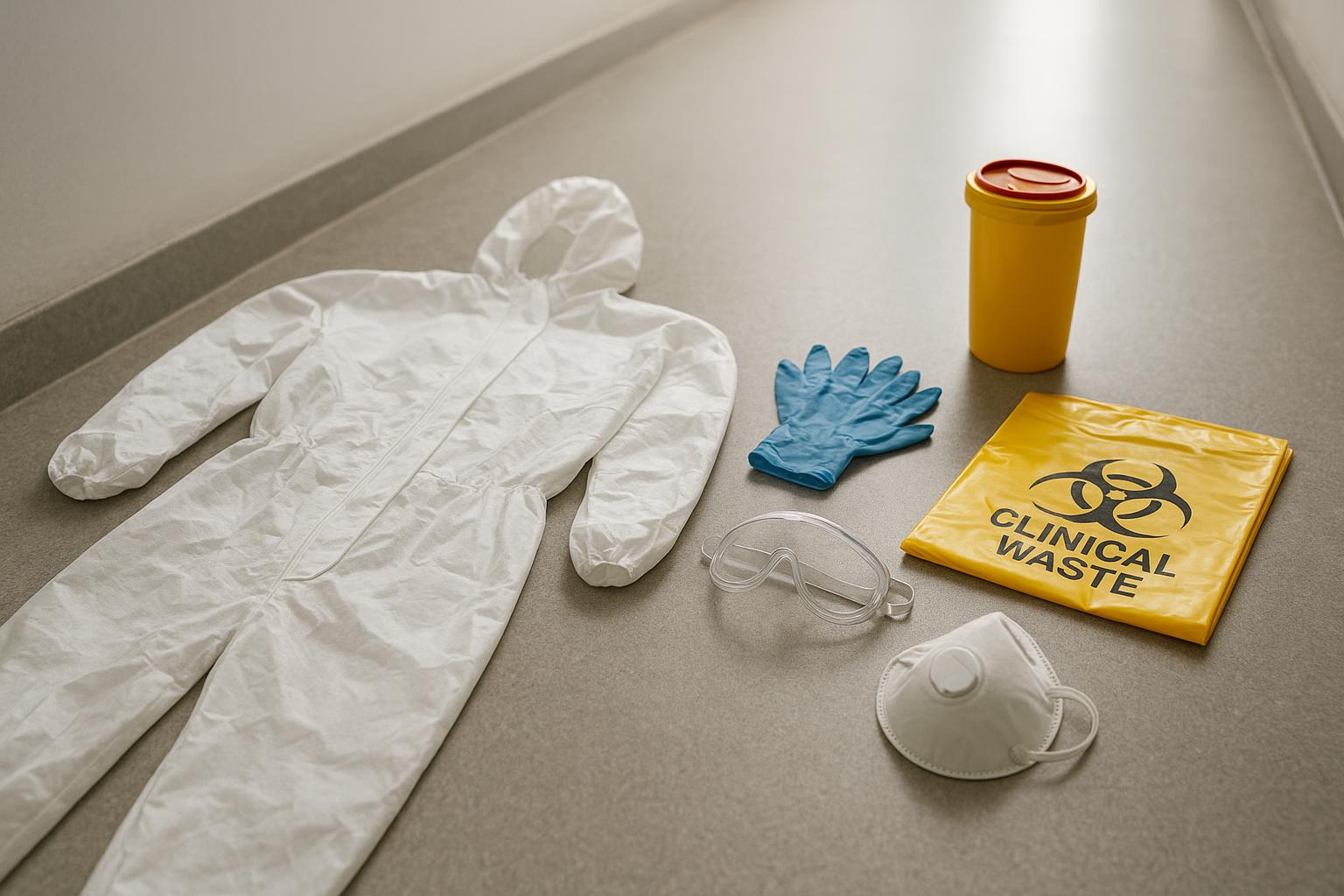
The HSE also explains that tight-fitting respirators such as FFP3 masks need to be face-fit tested for the person wearing them, so that the mask seals properly. A bearded or ill-fitting mask may not protect the wearer as intended. This is a good example of why PPE bought in a pack from a shop does not equal safe practice.
There is no single national licence for "biohazard cleaning" as a trade in England, and standards vary. That means you cannot rely on a job title or a website claim. Instead, ask for evidence of how the work will be done safely.
What to ask a carrier or specialist before you agree
Questions that separate prepared firms from opportunists.
On houseclearance.co you describe the job and independent, licensed local carriers may contact you with quotes. Because this work is specialised, many general clearance firms will decline it and refer you to a cleaning specialist. That is a good sign, not a bad one. If someone does offer to take it on, these questions help you judge whether they are prepared.
- Waste carrier registration. Ask for the registration number and check it on the Environment Agency register through GOV.UK. Our guide on how to choose a licensed house clearance company walks through this.
- A written risk assessment and method statement. A reasonable firm can summarise what hazards they expect, how they will control them and how waste will be segregated.
- Training and PPE. Ask what training the crew has for biological and sharps hazards, what PPE they use and whether respirators are fit-tested.
- Insurance. Ask for evidence of public liability insurance, and employers' liability where they employ staff.
- How hazardous or clinical waste is classified and where it goes. They should be able to say how it is separated, who carries it and which permitted facility receives it, and provide the paperwork afterwards.
- Pest control and decontamination. Does the scope include pest treatment, deep cleaning, odour treatment or is that separate?
- What happens to your belongings. Ask how items of possible value, documents and personal effects will be set aside, and how contaminated items will be photographed before disposal.
Beware of anyone who quotes a price over the phone without seeing the property, asks for cash only, cannot show a waste carrier number, or offers to "dump it quickly". Our guide on what drives hoarding clearance cost in London explains, without specific figures, why contamination, pests and specialist handling change how a job is scoped.
What a professionally run job usually involves
Methods differ, but the sequence tends to follow the same logic.
This is a general outline, not a specification of what any carrier will do.
- Site assessment. The firm inspects the property, notes hazards, access, utilities, ventilation and the volume of waste, and identifies items the client wants protected.
- Setting up. Work areas are defined, signage and barriers may be used, and PPE is put on before entering contaminated areas. Pest control may be arranged first.
- Removing sharps and obvious hazards first. Sharps go into approved sharps containers; they are not compressed or moved by hand.
- Segregating waste. Waste is sorted into streams, for example general waste, hazardous or clinical waste, recyclables and items to be kept or valued. Our guide to hidden family valuables and documents is a useful reminder that papers, cash and keepsakes can be buried in a contaminated room.
- Bulk removal. Contaminated furniture, bedding, carpets and soft furnishings that cannot be cleaned are removed.
- Cleaning and decontamination. Surfaces are cleaned and disinfected with appropriate products, with attention to contact time and ventilation. Odour often needs specific treatment.
- Checks and repairs. After cleaning, the property may need pest proofing, repairs, new flooring, redecoration or an electrical or gas check before it is occupied again.
- Paperwork. The client should receive waste transfer or consignment documentation as relevant to the waste types, and a clear record of what was done.
Unattended death, probate and deceased estates
A frequent reason families first meet this kind of work.
When someone is found dead at home after some time, the first priority is the legal process, not the clean-up. In England, deaths that are sudden, unexplained or otherwise of concern are reported to the coroner, and the police usually attend. Only once the property has been released should cleaning begin. Check with the police or coroner's officer if you are unsure whether you may enter.
For executors and next of kin, the remaining questions are practical and legal. Who has authority to instruct contractors before probate is granted? What happens if the property is rented, and what is the landlord's position? How are items of value found, kept and valued? Executors should read our guide to executor responsibilities for property and chattels and consider timing using our probate house clearance timing guide.
Contaminated items can be low-value or worthless once soiled, but it is worth checking before disposal for objects that could be cleaned, such as jewellery, ceramics and some metal items, and for paper records that matter to the estate. Take advice from the solicitor dealing with the estate before disposing of anything that could be relevant.
Landlords, tenants and abandoned or damaged properties
Squalor in a rented property raises separate questions about rights and liabilities.
Landlords sometimes find a property in extreme condition at the end of a tenancy or after a tenant has left. The legal position on what to do with left-behind goods and how to recover costs depends on the type of tenancy and what has happened to the tenant, and it is easy to get wrong. Take proper legal advice before disposing of anything a tenant might claim, and keep photographs and records. Our page on landlord abandoned property clearance in London sets out the practical side.
Conditions in rented homes also fall within the Housing Act 2004 and its Housing Health and Safety Rating System (HHSRS), under which councils assess hazards such as damp and mould, pests, domestic hygiene and fire. If you are a tenant living in a property that has become unsafe, the council's environmental health or housing team is the appropriate contact. Where a tenant is vulnerable, tell the landlord and the council early rather than waiting for a crisis.
Where houseclearance.co fits
A quote-matching marketplace, not a clearance company.
houseclearance.co is a marketplace. You describe the job, and independent, licensed local waste carriers may contact you with quotes. We do not carry out clearances ourselves, we do not quote prices on this page and we cannot promise that any carrier will take a biohazard job. For most contaminated properties, the best route is a specialist assessment first. A general carrier may then handle the removal of ordinary waste once the hazardous material has been dealt with.
When you post a job, be honest about what you know. Mention any sharps, bodily fluids, infestations, the presence of a hoarding situation, access difficulties, the floor level and whether anyone is living there. This helps carriers decide whether they are suitable and prevents wasted visits. Our house clearance checklist shows what to have ready, and our hoarding clearance London service page covers sensitive property situations where clutter is the main problem. For a broader view of costs, see our hoarding clearance cost guide.
Ready to see your price?
When you are ready to move forward, describe the job and we will pass it to vetted, licensed local carriers, who may contact you with quotes.
Frequently asked questions
The questions that come up most often about biohazard and extreme squalor clearances.
What is biohazard clearance?
It is the safe removal and disposal of material that can carry infection or harm health, such as blood and other bodily fluids, sharps, human or animal waste, rotting food and heavily contaminated furnishings. It usually involves protective equipment, trained methods and, for some waste, hazardous or clinical waste handling.
Can I clear a contaminated property myself?
It is not recommended where there are sharps, bodily fluids, heavy infestation, sewage or strong smells. Needlesticks, cuts and inhaled dust can cause harm that is not obvious at the time. Stop, keep other people out and get a professional assessment before moving anything.
What should I do if someone has died in the property?
Call the police if the death is unexplained or has not been reported. Do not clean, tidy or remove anything until the police and, where relevant, the coroner's officers say the property is released. Cleaning and clearance can be arranged afterwards.
Is there a licence for biohazard cleaning in England?
There is no single national licence for biohazard cleaning as a trade. Carriers removing waste must be registered as waste carriers, and employers must meet health and safety duties such as COSHH. Ask for a registration number, a written risk assessment and evidence of insurance.
Who deals with extreme squalor in a private home?
It depends on the situation. The council's environmental health team can advise on pests, statutory nuisance and hazards. If the occupier may have care and support needs and is neglecting themselves, a safeguarding concern can be raised with adult social care. The person's GP and the fire service may also help.
Is hazardous or clinical waste treated differently from normal rubbish?
Yes. Some waste, such as contaminated sharps, clinical waste and some chemicals, is classed as hazardous under the Hazardous Waste (England and Wales) Regulations 2005 and has extra controls for storage, carriage and disposal. Ask the carrier how they classify the waste and what paperwork you will receive.
Will my insurance pay for specialist cleaning?
Possibly, but it depends on the policy and the cause. Some buildings, contents or landlord policies may contribute to cleaning after certain events, while others exclude neglect or gradual deterioration. Read your policy and speak to the insurer before arranging work, and keep photographs and receipts.
Can items be saved from a contaminated property?
Some hard, non-porous items can often be cleaned, while soft furnishings, mattresses and carpets are usually not salvageable. Documents, jewellery and keepsakes may be set aside for assessment. Ask the carrier in advance how personal items and papers will be handled, and tell them what matters most.
Does a biohazard clearance also deal with pests?
Not necessarily. Pest treatment is often a separate service that may be needed before or alongside clearance, and cleaning is another stage. Ask each provider exactly what is in scope. Councils may also advise on pests in their area.
How does houseclearance.co fit into this?
houseclearance.co is a marketplace, not a clearance company. You describe the job and independent, licensed local carriers may contact you with quotes. For a contaminated property, say so clearly when you post the job. We do not quote prices on this page or promise that a carrier will accept the work.