Direct answer
To get rid of an old washing machine in London, first disconnect it from the water supply and drain hose (and ideally the power), then choose one of three routes: take it yourself to a borough recycling centre for free as a resident, book a paid council bulky waste collection, or arrange a paid removal through a carrier via a service like houseclearance.co, which tends to be the fastest option if you can't transport it yourself. A washing machine is classed as WEEE (electrical waste), so it legally can't go in or alongside your ordinary black-bin rubbish - it has to go through one of these dedicated routes instead. Costs vary by carrier and by whether it's a single item or part of a wider clearance; see the costs section below for the real indicative ranges.
Why you can't just put it out with the rubbish
Electrical appliances have their own waste stream, separate from household bin collections.
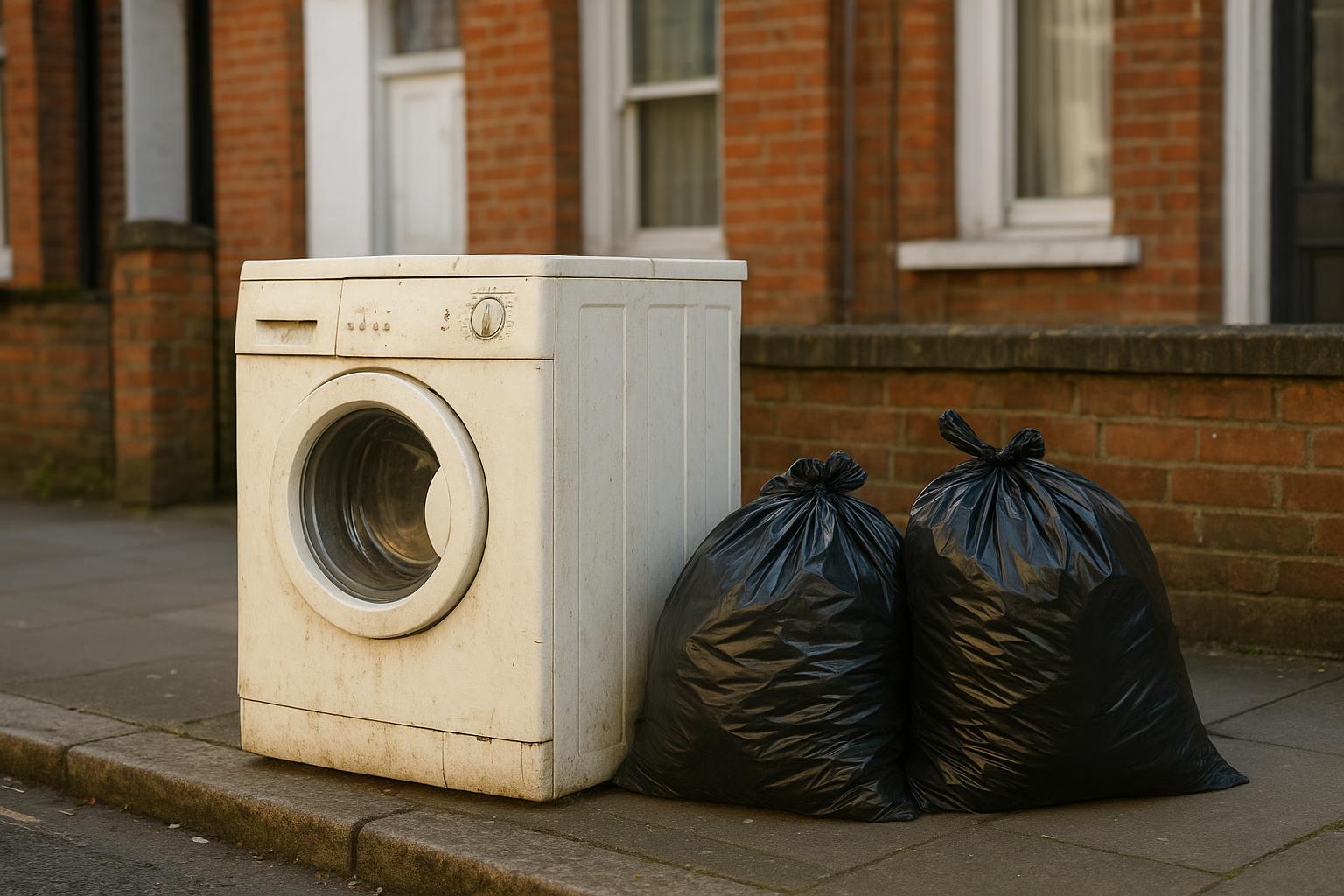
A washing machine is an electrical appliance, which means it falls under the UK's WEEE (Waste Electrical and Electronic Equipment) regulations rather than being treated as ordinary household rubbish. WEEE items contain components - motors, wiring, circuit boards, and in some appliances small amounts of other regulated materials - that need to be processed through routes designed to recover and handle those materials properly, rather than being crushed and landfilled alongside general waste.
Because of this, almost every London council explicitly excludes large electrical items from standard black-bin or general waste collections. If you put a washing machine out with the regular rubbish, most boroughs simply won't collect it, and in some cases leaving it on the street without an arranged collection can be treated as fly-tipping, which carries its own enforcement risk for the household or landlord responsible.
There's also a legal dimension that's easy to overlook: under the UK's waste duty of care, anyone who produces or holds waste - including a household getting rid of an appliance - has a responsibility to make sure it's passed only to someone authorised to take it, such as a council collection service, a licensed recycling centre, or a properly licensed waste carrier. Handing a washing machine to an unlicensed "man with a van" for cash, with no paperwork and no idea where it ends up, can leave the householder exposed if it's later found dumped illegally. Booking through a route that uses licensed carriers avoids that risk entirely.
It's also worth knowing that washing machines aren't the only large appliance covered by these rules - the same WEEE classification applies to tumble dryers, dishwashers, fridge-freezers and most other mains-powered white goods. If you're clearing a kitchen or utility room with more than one appliance going at once, it's often more efficient to arrange them as a single removal rather than booking separate trips for each item, since a carrier can usually combine several WEEE items into one visit.
Disconnecting it safely before collection
A removal carrier moves the appliance - it doesn't usually do the plumbing.
Before a washing machine can be safely carried out of a property, three things typically need to be dealt with: the cold water supply valve needs turning off and the fill hose disconnected, the waste/drain hose needs detaching from the standpipe or under-sink connection, and ideally the appliance should be unplugged and the power isolated at the socket. Skipping this and simply trying to drag the machine away from the wall risks a flooded kitchen or utility room, a split hose, or water damage to flooring.
It's worth being clear about where the responsibility sits here. A general house clearance or appliance removal carrier is in the business of moving items out of a property, not plumbing. In practice that means the disconnection - turning off the isolation valve, loosening the hose fittings, dealing with any hard-plumbed-in connection - is typically something the customer needs to handle themselves, or arrange a plumber for, before the carrier arrives. Some carriers may be willing to do basic disconnection as an informal add-on if it's simple (a standard valve and hose with easy access), but this isn't something you should assume is included. Always ask the carrier directly, when you request a quote, whether disconnection is something they'll do or whether it's on you to sort out beforehand.
If the machine is integrated or built under a worktop, there's often an additional step before the plumbing disconnection even becomes accessible - see the access section below for what that typically involves.
What it typically costs to have removed
Indicative ranges from the carrier marketplace, not a fixed company-wide fee.
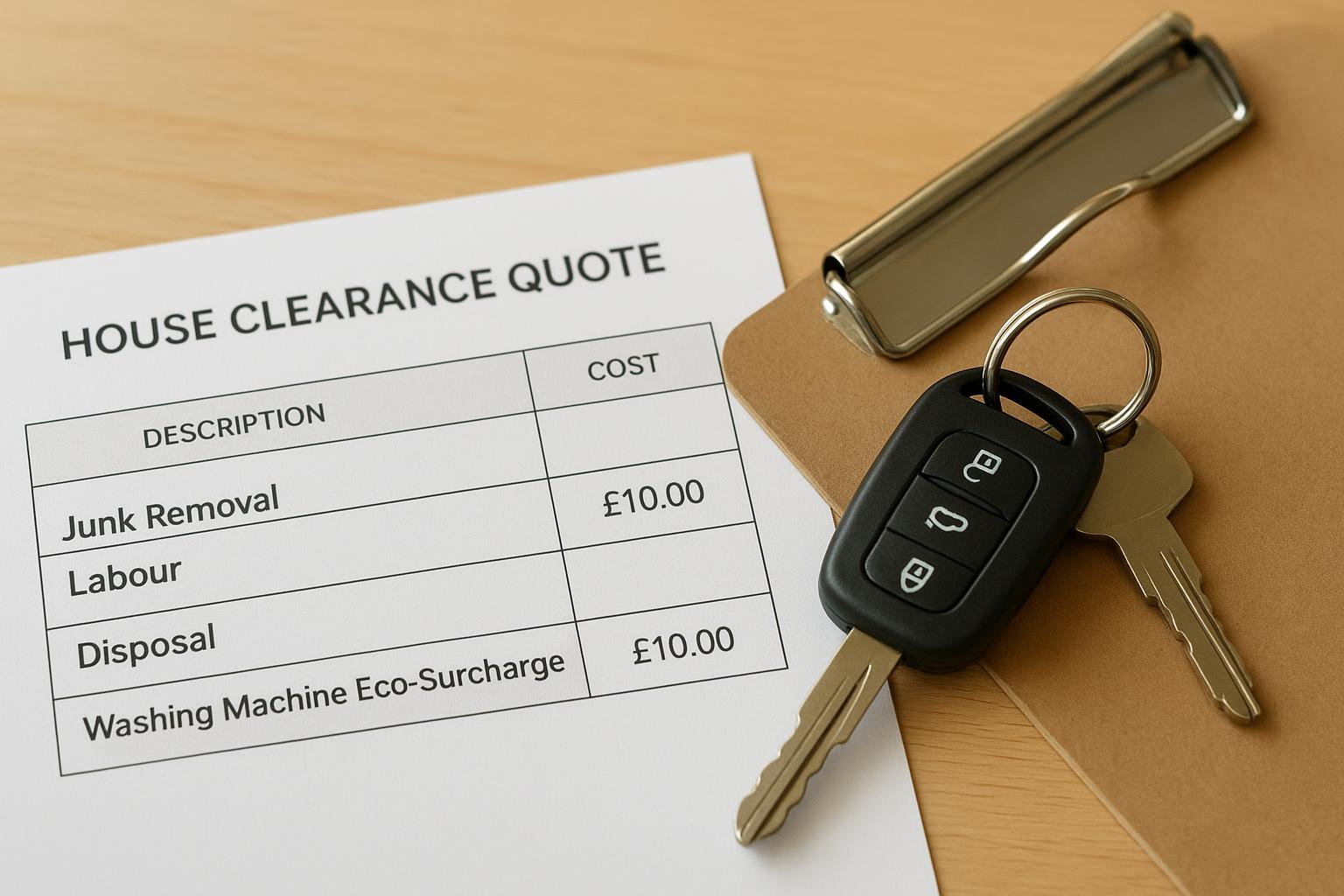
houseclearance.co doesn't charge one fixed nationwide price for washing machine removal - independent carriers set their own quotes, and the amount depends on whether the machine is the only thing being collected or part of a larger clearance. The published pricing guide gives two relevant indicative ranges that carriers on the network typically work within:
| Scenario | Typical indicative range | Notes |
|---|---|---|
| Eco-surcharge, added to a wider clearance job | £30 – £50 | Applies when a washing machine, tumble dryer or dishwasher is one item among several being cleared |
| Single item removal (washing machine only) | £65 – £95 | Falls under the site's single item minimum charge band, since a dedicated collection still needs a van and crew time |
If the washing machine is being removed alongside other items - say, during a kitchen refit or a wider house clearance - it's generally charged as an eco-surcharge on top of the main job rather than as a separate call-out, since WEEE items carry their own disposal cost regardless of how they're collected. If it's the only item being removed, it's treated as a standalone single-item job, which has its own minimum charge to cover the cost of sending a vehicle and crew for one appliance. These are indicative ranges drawn from carrier pricing on the network, not official RRP figures or a guaranteed quote - the exact price depends on your postcode, access, and the individual carrier you're matched with.
A few things tend to push a quote toward the higher end of either range: difficult access such as an upper-floor flat without a lift, an integrated machine that needs a cabinet door or worktop fixing removed first, a machine that hasn't been drained and still holds standing water, or a booking needed at short notice. A free-standing machine on the ground floor, already disconnected and drained, with flexible timing, tends to sit toward the lower end instead. None of these are fixed fees - they're simply the kind of detail worth mentioning upfront so the quote reflects the actual job rather than needing to be revised once a carrier arrives. See the full prices page for the complete breakdown of how quotes are built.
Recycling centre vs collection vs retailer take-back
Four genuinely different routes, each with its own trade-off between cost, speed and effort.
| Option | Cost | Speed | What's involved |
|---|---|---|---|
| London council recycling centre | Free for residents (WEEE items) | Same day, whenever the site is open | You disconnect and load it yourself, then drive it to the site; needs a vehicle big enough and, in some boroughs, a booked slot or van permit |
| Council bulky waste collection | Usually a fee per item or per collection, set by the borough | Booked in advance, often with a multi-day or multi-week lead time | You disconnect it and leave it accessible (e.g. kerbside or communal bin area) on the scheduled day; borough staff collect it |
| Retailer take-back | Often free when delivering a like-for-like replacement | Tied to the delivery date of the new machine | Under UK WEEE retailer regulations, many retailers selling a new washing machine must offer free collection of the old one on a like-for-like basis when they deliver; you still need to disconnect it beforehand |
| Private carrier / marketplace booking | Paid - see indicative ranges above | Fastest; can often be arranged within a few days | No need to transport it yourself; a carrier collects from the property, though you still handle disconnection beforehand |
Which option makes sense depends mostly on whether you have a vehicle, how much time you have, and whether you're replacing the machine with a new one anyway. If you're buying a replacement, it's always worth asking the retailer about take-back before arranging anything separately. If you're not replacing it, or you need it gone faster than a council slot allows, a private carrier booking is usually the most straightforward route. The same comparison applies to other large appliances - see our guide on how to dispose of a fridge freezer for a similar breakdown on refrigeration units, which have additional refrigerant-handling rules on top of standard WEEE processing.
Borough recycling centres vary in how they handle large electricals on arrival - some have a dedicated WEEE skip or cage near the entrance, others direct you to a specific bay after checking in at a booth. It's worth checking your local centre's current rules before travelling, since several London boroughs require proof of address or a van permit for non-car vehicles, and some restrict the number of visits residents can make in a given period. None of this applies to a council bulky collection or a private carrier booking, since in both cases someone else loads the vehicle.
Access and practical considerations
Washing machines are heavier and more awkward than most people expect.
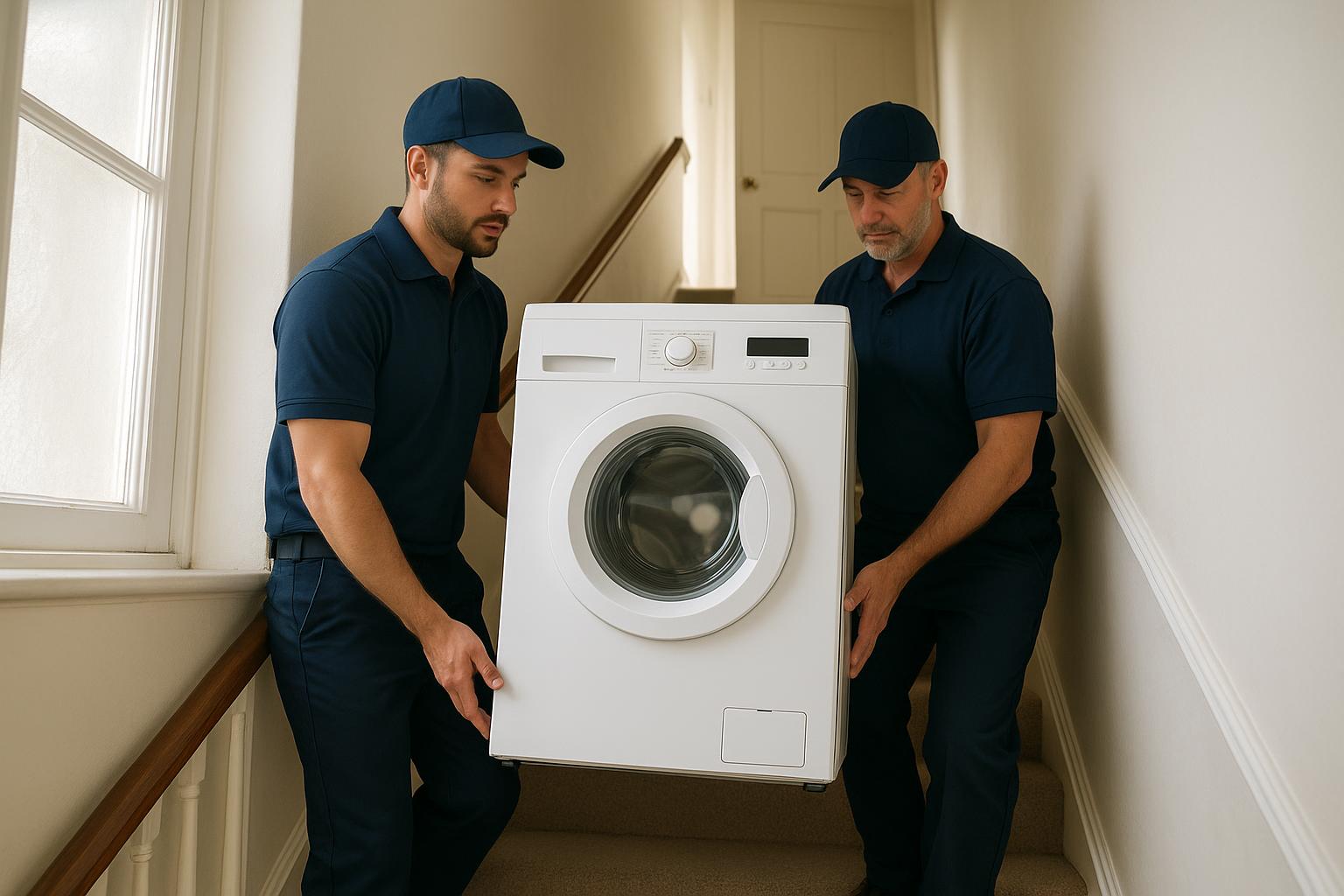
A typical domestic washing machine weighs roughly 65-90kg depending on the model, with larger-capacity and integrated/built-under machines often at the heavier end of that range. That weight, combined with an awkward shape and no easy handholds, makes it a two-person job in most cases rather than something one person can safely carry alone, especially on stairs or through narrow doorways and hallways typical of many London flats and terraced houses.
If the machine is integrated - built behind a matching cabinet door as part of a fitted kitchen - or built-under a continuous worktop, it usually can't just be pulled straight out. The cabinet door or fixing brackets typically need removing first, and in some kitchens the worktop itself needs to be lifted slightly or a neighbouring unit loosened to create clearance. This is extra work beyond a straightforward free-standing machine and is worth mentioning specifically when you request a quote, since it affects both time and price.
Residual water left in the drum, the door seal, or the pump filter area adds further weight and risk of leaking during the move if the machine hasn't been properly drained beforehand - see the disconnecting section above. Combined with narrow access routes, this is the main reason washing machine removal can take longer than its size alone suggests.
Stairs and turns in the staircase matter more than straight-line distance. A washing machine's depth (often 55-65cm) and square shape mean it doesn't pivot through a tight stairwell turn the way a narrower item like a chair or a box might, so a property with a half-landing or a 90-degree turn partway up can take noticeably longer to clear than a straight run of stairs of the same total length. If there's a lift, it's worth confirming its internal dimensions as well as the door width, since some older London blocks have lifts that are tall enough but too narrow for a machine to sit flat inside.
What to confirm before booking
A short checklist that avoids delays or surprises on collection day.
- Has the water supply valve been turned off and the fill hose disconnected?
- Has the waste/drain hose been detached from the standpipe or under-sink connection?
- Has the power been isolated, and has the drum been fully emptied of water and any leftover contents?
- Is the machine free-standing, integrated behind a cabinet door, or built under a fixed worktop?
- If integrated or built-under, has the cabinet door or worktop fixing been identified as something that needs removing first?
- What's the access route out of the property - how many stairs, how narrow the doorways, and is there a lift?
- Is disconnection something you're handling yourself, or has the carrier confirmed (not assumed) that they'll help with it?
A couple of photos of the machine in place - including the connections at the back and the route it needs to travel out of the property - usually helps a carrier quote accurately and arrive with the right crew size and equipment on the day.
Frequently asked questions
The questions that come up most often before arranging washing machine removal.
Is a washing machine classed as WEEE?
Yes. A washing machine is electrical waste, so it falls under the UK's WEEE (Waste Electrical and Electronic Equipment) regulations. That means it has to be collected, treated and recycled through routes set up specifically for electrical items, rather than being thrown away with ordinary household rubbish.
Can I put a washing machine out with the general rubbish?
No, in almost every London borough a washing machine can't go in or next to a general black-bin collection. Councils exclude large electrical items from standard rubbish rounds, so you need to book a bulky waste collection, take it to a recycling centre yourself, or arrange a private removal instead.
Does a washing machine need disconnecting before it's collected?
Yes - the water supply valve, the waste/drain hose and ideally the power should be isolated before anyone tries to move it safely. A general clearance or removal carrier handles getting the appliance out of the property, not plumbing work, so disconnection is typically something you or a plumber need to sort out first unless a carrier has explicitly agreed to help with it.
Is there a cost to recycle a washing machine?
Taking a washing machine to a London recycling centre yourself is free for residents in most boroughs, since WEEE items are accepted at no charge. What isn't free is having someone come and take it away for you - a van collection or removal service is a paid job, whether that's a council bulky waste booking or a private carrier.
Does the washing machine need to be emptied before collection?
Yes. Any leftover water sitting in the drum or pipework should be drained out, and anything left in the detergent drawer, drum, or pockets of an integrated unit should be cleared. A machine that's still full of water is considerably heavier and messier to move, and residual water can leak during transport.
What actually happens to a washing machine once it's collected?
It goes through WEEE processing, where it's broken down so the useful materials can be recovered. The outer casing, drum and frame are typically stripped for metal, motors and electrical components are separated out, and any residual water or oil left in the unit is drained and handled safely rather than left to leak during dismantling.
Need your old washing machine gone?
Post the details - disconnected or not, integrated or free-standing - and compare quotes from licensed carriers.