Direct answer
You have three realistic routes for getting rid of an old TV in London: take it to a council recycling centre yourself (usually free for residents, but you handle the transport), hand it back to a retailer when they deliver a replacement (often free for a like-for-like swap), or book a collection through a private carrier or a marketplace such as houseclearance.co, where someone comes to you and removes it directly. Whichever route you choose, a television cannot legally go in your general black-bin rubbish in most London boroughs, because it's classed as WEEE (Waste Electrical and Electronic Equipment). Older CRT box televisions need more careful handling again, since the tube itself contains leaded glass. If you book a collection, the cost is set by the carrier taking the job, not a fixed company-wide fee - screen size and whether it's a CRT or flat-screen both affect what's typically charged.
Why TVs can't go in general rubbish
A television is classed as electrical waste, not ordinary household rubbish.
Every television sold in the UK falls under the WEEE Directive - the regulatory framework that governs how waste electrical and electronic equipment has to be collected, treated and recycled, rather than sent to landfill with general rubbish. Because of this, most London boroughs specifically exclude TVs from standard black-bin or general waste collections, and putting one out with your ordinary rubbish risks it simply being left uncollected, or in some cases can be treated as a waste duty-of-care or fly-tipping issue if it's dumped rather than disposed of through a proper route.
The reason TVs are singled out comes down to what's actually inside them. Screens and the circuit boards behind them contain a mix of materials that need to be separated out carefully during recycling - plastics, metals, and in older sets, hazardous substances that shouldn't enter the general waste stream. Older CRT (cathode ray tube) televisions are the most significant case: the tube itself is made from leaded glass, and the inside of the screen is coated with phosphor compounds, both of which are treated as hazardous waste once the set is discarded. Modern flat-screen TVs don't contain the same leaded glass, but they still count as WEEE and still need to go through proper electronic waste processing rather than general rubbish.
In practice, this means every disposal route for a TV - council recycling centre, retailer take-back, or a paid collection service - exists specifically because general waste collection isn't an option. If you're clearing a wider property and want to understand how electronic items fit into a bigger job, see houseclearance.co's electronic waste & WEEE clearance service page.
London boroughs enforce this exclusion in slightly different ways - some will simply leave a TV on the kerbside if it's spotted in or next to a general waste bag, while others treat it as a reportable fly-tipping or illegal dumping incident if it's left out in a way that suggests it was meant to be collected as ordinary rubbish. Either outcome means the item usually has to be dealt with a second time, which is slower and more hassle than using one of the proper WEEE routes from the start. It's also worth knowing that this exclusion isn't unique to London or even the UK - the WEEE Directive originates from EU environmental law that the UK retained after leaving the EU, and similar separate-collection rules for electronics exist across most of Western Europe for the same underlying reason: electronic items are too resource-intensive, and in some cases too hazardous, to bury in landfill alongside food waste and general packaging.
None of this means disposing of a TV responsibly has to be difficult. The separate collection requirement exists precisely because there are established, mostly low-cost routes already built for this exact item - the next sections cover how those routes differ in practice, and when each one makes sense.
Flat-screen vs CRT: what's different
Not all televisions are equal when it comes to weight, bulk and how strictly they're regulated.
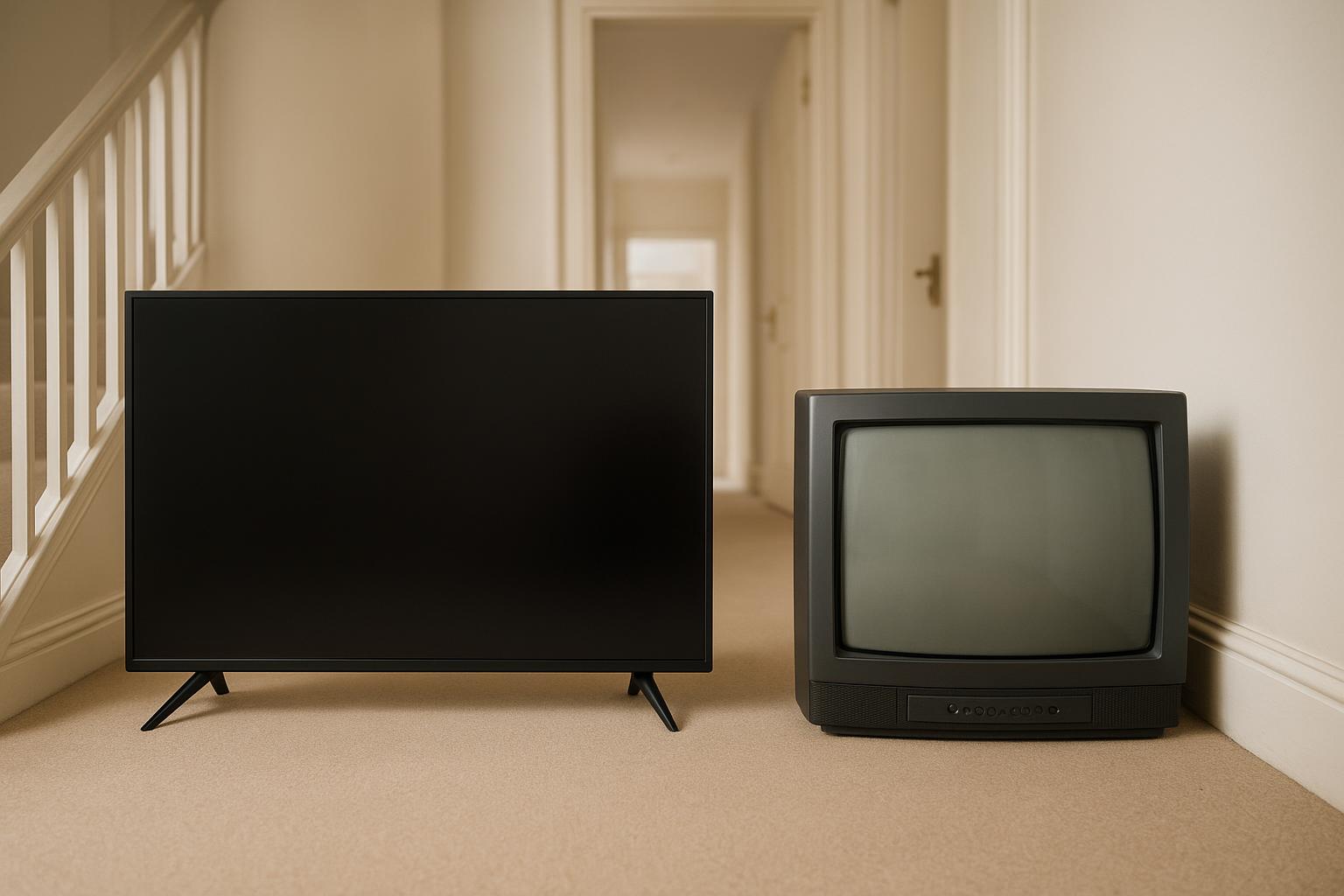
A modern flat-screen TV - LED, LCD or OLED - is relatively light for its size, generally manageable for one or two people to carry, and doesn't contain the leaded glass found in older sets. It's still classed as WEEE and still needs to go through proper recycling, but the handling itself is straightforward: disconnect it, take it down if it's wall-mounted, and it's ready to move.
An older CRT box television is a different proposition entirely. The cathode ray tube that produces the picture is built from thick leaded glass and is physically heavy - a CRT set can weigh two or three times as much as a flat-screen with a similar diagonal measurement, and the weight is concentrated at the back of a deep, bulky cabinet that's awkward to grip and carry, particularly down stairs or through tight doorways. Because of the leaded glass and phosphor coating inside the tube, CRT sets are treated as hazardous WEEE and processed through dedicated facilities that can safely separate and handle the glass, rather than standard electronics recycling. This combination - genuinely heavier, bulkier, and requiring more careful processing - is why CRT disposal is consistently treated more strictly, and usually costs more, than disposing of a flat-screen.
What it typically costs to have collected
Indicative surcharge ranges from houseclearance.co's published pricing data - not a fixed company-wide fee.
If you book a television collection - either as a standalone single-item pickup or as one item within a wider house clearance - TVs are priced as an itemised eco-surcharge rather than a flat charge, because of the WEEE handling involved. The ranges below are published as indicative figures on houseclearance.co's prices page, and reflect what carriers on the platform have typically quoted; they are not a guaranteed price, since the carrier who takes your actual job sets the final figure based on the specific item, access and your postcode.
| Item | Indicative London price range | Why |
|---|---|---|
| Flat screen TV / monitor (under 40in) | £15 – £25 | Standard WEEE processing, lighter and easier to handle |
| Large TV / commercial screen (over 40in) | £30 – £50 | Greater size and weight, more handling effort |
| Older CRT box televisions | £35 – £60 | Higher due to lead and mercury content in the glass, plus extra weight |
These figures are the same surcharge amounts used elsewhere on houseclearance.co for TVs and monitors, whether the television is one item within a larger clearance job or the only thing you're having collected. Flag the screen size and whether it's a CRT or flat-screen when you post your job, so a carrier can quote accurately rather than adjusting the price once they see it.

Recycling centre vs retailer take-back vs collection service
Three realistic routes, with different trade-offs between cost, speed and effort.
| Option | Cost | Speed | What's involved |
|---|---|---|---|
| Council recycling centre | Free for residents in most London boroughs | As soon as you can get there | You transport the TV yourself, which can be awkward for a large or heavy set without a car |
| Retailer take-back on new TV delivery | Often free | Tied to your new TV's delivery date | Generally only covers a like-for-like swap - check the retailer's own terms before assuming it applies |
| Private carrier / marketplace collection | Paid - see indicative ranges above | Usually the fastest, bookable to suit you | No self-transport needed; carrier collects from your property, including upstairs or wall-mounted sets |
A council recycling centre is the cheapest option if you're able to transport the television yourself, but a heavy CRT set or a large flat-screen can be genuinely difficult to move alone, especially without a car. Retailer take-back is worth asking about whenever you're buying a replacement TV, since it's frequently free, though it's typically limited to swapping an old set for a new one of the same type. A paid collection through a carrier or a marketplace like houseclearance.co removes the transport problem entirely - someone comes to the property, which matters most if the television is large, wall-mounted, upstairs, or you simply don't have a way to move it yourself.
Which route suits you best usually comes down to how much your own time and effort are worth against the cost saved. If you already drive, have a free weekend, and the television is small enough to lift into a car boot unaided, a trip to the recycling centre can genuinely cost nothing beyond fuel and the drive there. If you're buying a new television of a similar type and size, it's always worth asking the retailer directly whether take-back is included - it isn't guaranteed and policies vary between retailers, so confirm it rather than assuming. Where the TV is large, old, awkward to reach, or simply one part of a bigger clearance that already needs a carrier, paying for a collection tends to work out as the more practical option even though it isn't free, because it avoids the physical handling and transport risk entirely.
Handling and access considerations
What actually affects how straightforward a TV collection is on the day.
A large or wall-mounted television usually needs to be taken down from its bracket before it can be collected. Some carriers will do this as part of the job if you've flagged it in advance, but others may expect the TV to already be disconnected and off the wall when they arrive - it's worth checking rather than assuming either way, since bracket removal and cabling can take genuine extra time, particularly with in-wall cable routing or a soundbar and other equipment attached to the same mount.
Screens are also fragile, especially modern flat-screens, which can crack or be damaged by pressure on the panel even when the rest of the unit looks undamaged. Handling that's fine for most furniture - leaning an item against a wall, stacking something on top - can damage a screen, so TVs generally need to be carried flat or upright and kept separate from other bulky items during loading.
In a wider house clearance context, it's common for a property to have more than one television - a set in the living room, a smaller one in a bedroom, possibly an older CRT set that's been left in a loft or garage for years. Flagging the number, size and type of each TV when you post the job, rather than just mentioning "a television," helps a carrier price and plan for the job accurately the first time.
Access to the property matters more for televisions than it might seem. A large flat-screen or a heavy CRT set that needs to come down several flights of stairs without a lift, or be carried through a narrow hallway or around a tight stair turn, can add real time to a collection - particularly with an older set where the bulk of the weight is concentrated low and to the back of the cabinet, making it awkward to keep balanced on stairs. If the property has restricted parking, a controlled parking zone, or the only loading space is some distance from the front door, it's worth mentioning this too, since it affects how long the collection takes and, in some cases, what a carrier can quote.
It's also worth checking whether any accessories need to go with the television - a wall bracket left fixed to the wall once the screen is removed, a separate set-top box, or cabling that's been run through conduit. These items aren't always included automatically in a TV collection, so it's worth asking directly whether a carrier will also remove a now-redundant bracket or associated cabling, or whether that's treated as a separate task.

What to confirm before booking
A short checklist that makes a real difference to how accurate your quote is.
- Screen size, and roughly how old the TV is (helps identify flat-screen vs CRT)
- Whether it's a flat-screen or an older CRT box television
- Whether it's wall-mounted or free-standing, and whether the bracket needs removing
- How many TVs or screens need collecting, if more than one
- Access details: which floor it's on, stairs, lift availability, and distance to where a vehicle can load
None of this needs to be exact - a rough description and a photo, if you can manage one, is usually enough for a carrier to quote accurately on houseclearance.co's job request form, without the price needing to change once they arrive.
Frequently asked questions
The questions that come up most often before getting rid of an old TV.
Can I put an old TV in my normal rubbish bin?
No. A television is classed as WEEE (Waste Electrical and Electronic Equipment) and is banned from general black-bin collection in most London boroughs. TVs contain materials - including leaded glass in older sets, circuit boards and plastics - that aren't allowed to go to landfill as ordinary household waste, so they have to be taken to a recycling point, handed back to a retailer, or collected separately.
Is an old CRT TV harder to dispose of than a flat-screen?
Yes. Older CRT (cathode ray tube) televisions contain leaded glass in the tube itself and are treated as hazardous WEEE, which means they need more careful handling and processing than a modern flat-screen. They're also significantly heavier and bulkier for their screen size, which adds to the physical effort and cost of moving one.
Do retailers take old TVs back for free?
Many do. Under UK WEEE retailer regulations, shops selling electrical items above a certain size are generally required to offer free like-for-like take-back of your old television when they deliver a new one of the same type. It's worth asking at the point of purchase, since the exact arrangement can vary by retailer.
Is there a charge to recycle a TV at a council recycling centre?
Dropping off a TV at a council-run recycling centre is free for residents in most London boroughs, since WEEE items are accepted as part of standard household recycling. The cost that isn't covered is getting the television there yourself - transport, and manual handling if it's large or on an upper floor.
Does screen size affect how much it costs to have a TV removed?
Yes, generally. Larger and heavier screens take more effort and van space to collect than a small monitor, and that's typically reflected in a higher collection cost. Older CRT sets tend to cost more again, partly because of their weight and partly because of how the leaded glass has to be processed.
What actually happens to a TV after it's collected?
Collected televisions go through WEEE processing, where the casing, circuit boards, plastics, metals and screen glass are separated out and recycled or treated as appropriate. Lead-containing CRT glass is handled under specific controls because of its hazardous content, while flat-screen components go through a different separation process.
Need an old TV or screen collected?
Tell carriers the screen size and type when you post, and compare quotes from licensed providers who handle WEEE items.